Lesson 12 — Cards That Pass in the Night and Cards Up the Sleeve
LESSON 12
This is a very important lesson for in it I give you three of the greatest card classics known to Magic.
Be sure to review Lesson 9 before beginning the study of this lesson. In that lesson I set forth for you some marvellous principles on which Card Magic is based. I hope that you mastered these principles as you will need a thorough knowledge of them to perform these effects.
In addition, I give you the following new card principles:
1 — The Card Transfer
2 — The False Count
3 — Misdirection Palming
4 — Pocket Concealment
5 — Self-Contained Card Vanish
6 — Back to Front Hand Card Vanish
7 — Pivot Card Vanish
The mechanical arrangements are:
1 — The Sleeve Pocket
2 — Shoulder Concealment
CARDS THAT PASS IN THE NIGHT
This is my version of the famous "Thirty Card Trick" or "The Cards from Pocket to Pocket," which has been so popular with conjurers. Every magician of note has his own angles of working this effect and various sleights which he uses in accomplishing it. I have used many ways in presenting this experiment, but the one that I am going to teach you is my favorite method.
This effect is one of those magical experiments which seem to be performed supernaturally. It permits of fine Showmanship and enables you to impress upon your audience the fact that you are doing Master Magic.
EFFECT:
Twelve cards are counted into the performer's left hand by a spectator and twelve cards are counted into his right hand also. Spectator then wraps the right-hand packet of cards in a handkerchief and holds it during performance of effect. The left-hand packet is given to another spectator to hold. Someone in audience is requested to call a number between one and five. Let us assume that number three is called. Performer now says he will cause three cards to pass from the spectator holding the twelve cards to the spectator holding the packet wrapped in the handkerchief. One card passes. Another card passes. Performer counts packet of cards and finds there are only ten. Magician now pretends to take a third card from packet and to hold its "spirit" in his hand. Spectator then counts the cards and finds there are only nine. Magician now pretends to put the "spirit" card back and then the packet is found to contain ten cards again. The invisible card is removed again and the packet contains nine cards. Performer tosses invisible card to packet in handkerchief. Three cards have now passed. Spectator takes packet from handkerchief and counts cards. He finds that he now holds fifteen cards instead of twelve.
PARAPHERNALIA:
1–A deck of cards.
2–A borrowed handkerchief.
SECRET AND PATTER: To Perform:
Take deck of cards from pocket or borrow a deck and remove cards from case.
Have two gentlemen come up from audience. You stand between the two men. Turn to the one on the left and say,
"Will you, sir, kindly help me with this experiment? I want you to shuffle this deck thoroughly and count twelve cards into my left hand."
NOTE:
As a rule, performers count fifteen cards into each hand or onto the table. The two pockets contain thirty cards. This is where the trick gets the name "Thirty Card Trick." However, I prefer to use twelve cards in each packet for several reasons. You will understand this when you master the effect.
Give cards to spectator to shuffle.
"Count TWELVE cards into my left hand one at a time and count them loud enough so that all may hear you."
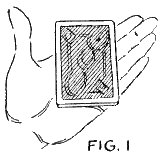
Performer holds out left hand, palm upward, and spectator counts twelve cards out one at a time into his palm. Fig. 1. The cards should be counted backs up. If spectator does not count loud enough, you count with him. You must impress upon your audience the fact that twelve cards are in your hand.
"TWELVE cards."
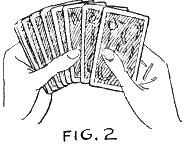
Hold up packet of twelve cards and fan it out slightly. Fig. 2.
"You are correct, sir — a very good mathematician."
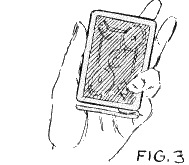
Square up cards again. As you do so, insert first joint of little finger of left hand under top three cards in packet. Your left hand and little finger are in the same position as they were in doing the simplified pass explained in Lesson 9. Fig. 3.
Drop left hand with packet at your side. Hold cards so that audience is not aware of position of little finger, separating top three cards.
To the audience it appears that all you have done is to fan open cards to be sure that spectator was right in his count.
"Now, count TWELVE cards onto the palm of my right hand. Count them one at a time aloud so that there will be no mistake in the number."
Spectator counts twelve cards out onto performer's right hand as he did onto the left hand.
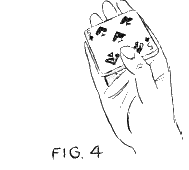
Now square up cards and reverse them so that they face upwards. Hold them between tips of fingers and thumb. Fig. 4.
Hold hands far apart — packet in right hand with faces of cards up; packet in left hand with little finger separating top three cards. Fig. 5.
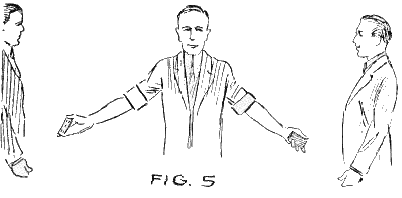
"Twelve cards in my right hand also. Thank you."
Turn slightly to left toward spectator there. As you do so, take position shown in Figure 6.
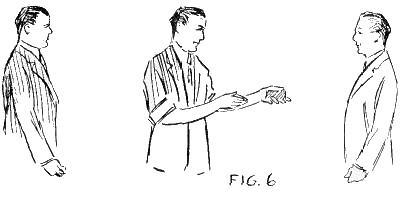
Turn your right hand back to audience and bring packet of cards in each hand on a horizontal line with each other.
Say to gentleman on left:
"Have you a handkerchief which we can use?"
THE CARD TRANSFER:
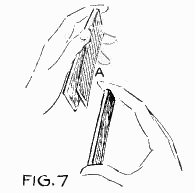
The following move teaches you the principle of transferring cards from one packet to another. Study it carefully and practice it until you can perform it perfectly.
Your hands are in this position. Fig. 7. A designates the top three cards on the left hand packet.
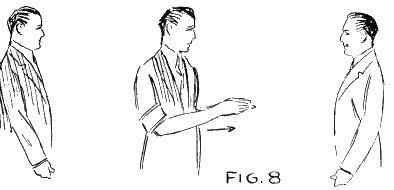
As you ask for handkerchief, quickly pass packet in right hand over packet in left hand. Fig. 8.
Place your right thumb against the A section (top three cards) of packet in left hand. Your little finger separates these three cards from rest of packet so that it will not be difficult to grasp them with thumb of right hand. The first joints of second and third fingers of right hand bear down on the front end of the three cards. Fig. 9.
Carry these three cards away at bottom of packet in right hand. Bring them up against the rest of packet. Fig. 10.
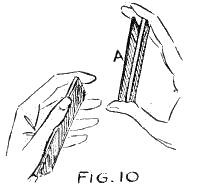
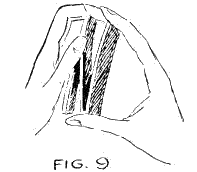
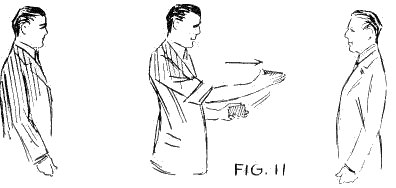
This whole move is done very quickly. It must appear that you merely passed the right hand past the left as a gesture in asking for the handkerchief. You must not hesitate an instant in bringing away the three cards from left packet. Finish leaves right hand up in front of spectator for a moment. Fig. 11, next page.
You now have NINE CARDS in LEFT PACKET and FIFTEEN CARDS in RIGHT PACKET.
"Thank you, that one will do nicely. I will have you wrap the TWELVE cards I hold here in the handkerchief. Wrap them securely so that no cards can get in or out without your knowing it."
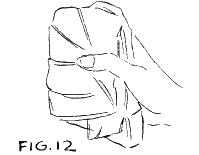
Spectator wraps packet of fifteen cards in handkerchief. Fig. 12.
Of course, audience and spectator think that packet contains twelve cards.
"Hold them in your right hand, up about shoulder height, so that the audience can see them. Now, to make sure that the gentleman placed TWELVE cards in my left hand, I will count them again."
Your next move is to prove that the NINE cards which you hold are TWELVE.
THE FALSE COUNT:
Hold the nine cards faces toward you in your left hand, thumb on top of cards. Fig. 13.
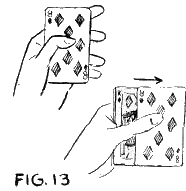
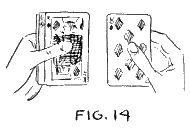
Push first card over to right with thumb, grasp it with right hand and remove from packet. As you do this, count aloud. Fig. 14.
"One."
Now push second card over to right a little with thumb. Bring card in right hand up behind packet in left hand and place right thumb on top of second card. Fig. 15.
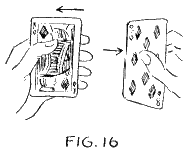
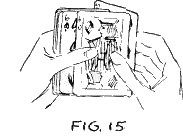
You apparently take this card, but in reality you perform the FALSE COUNT. Move your right thumb toward right to make the sound of drawing the card from the pack. The second card extends over the edge of the pack for about an inch. By bending card at the edge with right thumb and then releasing it you get the snapping sound of removing a card from the pack. As your right thumb snaps the card, your left thumb draws the second card back onto the pack. Your right hand moves to the right several inches with the one card in it just as it would if you had really taken off another card from pack. Fig. 16.
"Two."
The audience has heard the drawing of the card and the snap, and naturally they think that you have pulled TWO cards from the packet and now have them in your right hand. You count -"two"- to help the illusion.
Stand in front of your mirror and practice this method of False Counting. The best thing to do is to actually count the cards and pass them from left hand to right. Then imitate the natural moves and hold back a card now and then.
False Counting is a very important principle in Magic. It sometimes proves to be a regular life-saver in an emergency.
You must be able to perform the move so well that the keenest eye cannot tell whether you did a straight or a false count.
Count the third card actually into right hand on top of the one card there, making the snapping sound as you bring the card away from the packet.
"Three."
False count the next card, making the snapping sound.
"Four."
Count next card fairly, bringing it away from packet on top of two others in right hand.
"Five."
False count next card.
"Six."
You have in reality now three cards in right hand and six in left packet. Audience, however, believes that you have counted six cards into your right hand and have six left in packet.
The six cards left may now be counted fairly.
"Seven – eight – nine – ten – eleven – twelve."
TIME and RHYTHM are the important elements in False Counting. Count the cards fairly fast. Be sure to keep the time and rhythm in straight counting and false counting the same.
If you have difficulty in pulling card back onto left packet with left thumb, do not worry about it. The time and rhythm of your count is more important than this. The ability to do this will come to you with practice.
Practice the False Count until you have it down fairly well and then try it out on someone without letting him know what you are trying to do.
To gentleman on right, say,
"And I shall ask you to hold these cards. Take them with your right hand and hold them up on your right lapel."
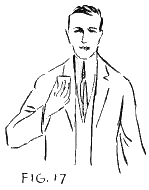
Give packet to spectator and then place his right hand with the cards on his right lapel at the button-hole. Fig. 17.
The reason for doing this is to place the cards out of the line of vision of the spectator. This keeps him from counting the cards too. Occasionally you find an assistant who works against you and is contrary. Placing the cards in this position will forestall any such difficulty.
"I was going to tell you to place them against your heart, but it is over on the left and I want to do the trick RIGHT."
Pick out some intelligent looking person in the audience and ask him to call out any number between one and five.
"Will you please give me any number between one and five?"
IN THE MAJORITY OF CASES THE PERSON WILL SAY THREE. It is a psychological fact that this number will be called in most cases when you ask for a number between one and five.
We will carry on the experiment now just as if the spectator had called Three. Later on I will tell you the method of procedure if the numbers one – two – four – or five are called instead of three.
"The lady (or gentleman) says 'THREE.' That was your own free choice, was it not? You could have selected one, two, four. or five. But she says 'Three.' Then three it shall be. Now, note how matters stand, for I am going to show you an __ experiment in miracle magic that you will remember as long as you live. The gentleman here counted twelve cards into my left hand and twelve cards into my right hand. They were recounted to prove the number to be correct. At no time have my hands been together while they held the cards. The gentleman took the twelve cards himself from my right hand and wrapped them securely in his handkerchief. The remaining twelve cards were recounted and placed on this other gentleman's lapel. I called for a number — any number — and the lady said, 'Three.' What I intend to do now is to cause THREE cards — the number selected — to pass from the packet on the gentleman's lapel to the packet in the handkerchief which this gentleman on the left is holding. Not One, Two, Four, or Five cards — but Three. I shall pass the cards invisibly. Night-time when all is dark is the best time to have the cards go invisibly. When the CARDS PASS IN THE NIGHT, then you cannot see them. As we are in the light, however, we will have to pretend we are in the dark, and if your imagination is good you can imagine inky blackness between the two gentlemen. Just right for the spirits to work in. Now, I shall take a card from the gentleman here."
Pretend to take a card from gentleman at right. Hold up right hand as though you had a card in it.
"I have a card here in my hand, but as we are in the dark you cannot see it. I shall toss it to my friend here."
Make tossing motion to gentleman on left.
"You could not see it, but did you feel it?"
Gentleman usually laughs and says, "No."
"Perhaps you are not feeling so well."
If he says, "Yes," say, "Ah, the gentleman is feeling pretty good this evening."
Pretend to take another card from packet at right. Hold up right hand as though you held card.
"Now I have another card, but the darkness, of course, again prevents you from seeing it. Again I toss it to the gentleman."
Make tossing motion to gentleman at left.
"Of course, you felt that one."
Perhaps gentleman nods a little this time.
"See — he is feeling better already. Suppose we actually see whether the cards are passing over to the gentleman. I'll blow away the darkness."
Blow into the air as if you were blowing out a candle.
"Well — well — it's light again."
To gentleman at right.
"Will you please give me the cards?"
Take the cards and hold them in left hand.
"I will show you that I have really taken two cards from this packet. Two from twelve is ten, is it not?"
FALSE COUNT the nine cards in the packet. Do your false count on the second card to make the nine cards count ten.
Count each card loud and distinctly to convince audience that you hold ten cards in your hands.
"The two have gone. But you said you wanted three to go. Well, all I have to do is to make it dark again. There you are. A total eclipse. I will now take another card from the pack."
Pretend to take another card with right hand and hold up hand as though you held card in it.
To gentleman at right.
"Will you please count the cards yourself to see whether I am holding a card or not?"
Give the gentleman the nine cards.
"Count them into my left hand one at a time."
Spectator counts cards.
"One, two, three, four, five, six, seven, eight, nine. So you see I am really holding the tenth card. Now I place it back in the pack and I'll count the cards again."
FALSE COUNT the cards as ten.
"One and nine makes ten. Now take the card out again."
Pretend to take card out again and hold it in right hand.
"Count the cards again and we have nine."
Cards are counted again.
This repetition cannot help but convince the audience that there are ten cards (though you really have only nine) and that in some mysterious manner you get a card out and into the packet.
This point of repeating and emphasizing a certain fact or supposed fact is a great thing in Magic.
"So all I have to do is merely to toss the card through the darkness into the handkerchief. If the gentleman will count the cards himself he will find that instead of holding twelve cards he now holds fifteen. The extra three cards are those which passed over from this other packet. Now blow away the darkness."
Blow again.
"And it is light again. Count the cards slowly into my left hand."
Hold the packet of nine cards in right hand.
Spectator counts the fifteen cards into your left hand and you count with him, especially accenting THIRTEEN, FOURTEEN, FIFTEEN.
Bring the packet of nine cards from right hand over on top of those in left hand but keep them separated by little finger of left hand.
Thank the gentlemen for helping you. Just as the one on left starts to turn and go, PLACE RIGHT HAND OVER CARDS AND PALM THE NINE CARDS. Then grasp his right lapel with your left hand and open his coat.
"Pardon me, sir, before you go –"
Reach up under his coat to a point under and a little behind his right shoulder. Fan cards out from right palm and bring them out so that audience can see them.
"Before you go I'll take those few cards of mine which you have up under your coat."
This last move is a good COMEDY touch. This you will find it to be a good finish after you are able to palm the cards successfully.
Back of right hand is toward audience and they do not suspect that you have cards in hand. You put your hand under the spectator's coat quickly and when you suddenly fan the cards and produce them, it causes a stir of surprise and amusement to run through your audience.
WHAT TO DO IF THE NUMBERS ONE, TWO, FOUR, OR FIVE ARE SELECTED INSTEAD OF THREE
The test of a real magician is his ability to meet emergencies — the ability to carry on his effect even when unexpected things arise during his performance.
According to a law of psychology when a person is asked to call a number between one and five, he will call three in most cases. In performing this effect you transfer three cards from one packet to the other, thus making fifteen cards in one packet and nine in the other. You are counting on the working of this psychological law to make the spectator call the number three.
You must, however, be prepared for emergencies — for the times when spectators will call numbers other than three.
If the spectator calls number one, you say,
"I want any number between one and five."
If number five is chosen, the above also applies.
The spectator then thinks that you want number two, three, or four and will choose another number.
If number two is called, you must change your patter to suit this number instead of three. You played up and emphasized the fact when number three was chosen, but with number two do not do this.
Do not for a moment let your audience know that number two is not the number you wanted. They must think that any number chosen is all right.
Perform your experiment to the point where two cards have passed. Prove this by FALSE COUNTING the nine cards to be ten. Then continue in this way:
"I have caused the two cards which were chosen to pass. Now would you like to have me explain to you how the cards pass over? All right, this is the way it is done."
From this point you may complete your experiment with the third card, supposedly explaining the effect by passing a third card. Use the patter about causing the card to pass in the darkness. Pretend to take the card from the pack, replace it, and take it out again just as you do when number three is selected by spectator.
If number four is chosen, start your experiment this way:
"How would you like to see the cards pass–VISIBLY or invisibly?"
Most people would like to see them go visibly. They want to see how it's done and perhaps expect the cards to fly through the air.
"VISIBLY? Then visibly you shall see them go. (To gentleman on right) Will you please give me one card?"
Gentleman gives you one card.
"You are certain that there is just one card? Fine. Now I will carry it VISIBLY over to the gentleman at my left and have him place it with the other cards in the handkerchief. Take the card, sir?"
Gentleman places it in handkerchief with other cards.
"One card has passed. How many did you say you wanted to pass, sir? Four? All right, we will pass another one VISIBLY."
At this point a snicker runs through the audience for they think you are just being funny.
"What's that? It is no trick to do it visibly? Well, maybe it isn't, but you said you wanted the cards to go visibly, so visibly they are going. You can all see them, can you not? What's that? You would rather see them travel INVISIBLY? Then we'll have them go invisibly."
One card has been passed to the packet in the handkerchief so that you now have eight in the packet held by spectator at right. You may now complete the experiment, pretending to pass three more cards. You must change your patter, of course, to conform to the needs of this occasion.
NOTE:
Another version of this experiment which I use is this: Instead of the darkness idea I use the spirit card idea. I say that I am causing the spirit of the card to travel from one pack to the other. I tell the audience that I do this by dematerializing the card and then materializing it again.
When I hold the invisible card up I use this patter:
"Perhaps some of you cannot see the card. The reason for this is that I am holding the spirit of the card which I have dematerialized. The card in its spirit form vibrates at the rate of four million times a second so that you cannot see it."
You see what opportunity you have for using your imagination in Magic. Give it full play and you will be delighted at the results you get in patter and in putting effects across.
THE CARDS UP THE SLEEVE
This is another old card classic. There are many methods and routines used in performing this effect. Each performer uses a variation of the experiment which best suits his individuality. After you have mastered the trick as I teach it to you, you may start blending in other principles or varying parts of the effect to develop a routine which you like best.
In this effect STUDY YOUR MISDIRECTION CAREFULLY and MASTER YOUR PALMING.
This effect is a good one to use after CARDS THAT PASS IN THE NIGHT. It is impromptu and can be performed on any occasion.
EFFECT:
Performer counts twelve cards from the deck, holding them toward the audience so that they can be seen. Cards are held in left hand. Magician pulls out right trousers' pocket to show that it is empty. Performer says that cards will pass invisibly up his sleeve into his empty pocket. He clicks the packet in his left hand and then removes a card from his right pocket. This is repeated until the twelve cards have passed one by one, apparently through the performer's sleeve, into his pocket.
PARAPHERNALIA:
1–A deck of playing cards.
SECRET AND PATTER: To Perform:
If you use this effect after THE CARDS THAT PASS IN THE NIGHT, you may start with this patter:
"Perhaps you would like to know just how I cause the cards to travel in the darkness. I will explain it to you in the light. First, you must have twelve cards."
Count off twelve cards from deck, calling the number of each one distinctly so that audience will be sure that twelve have been counted. Hold faces of cards to audience so that spectators see them and can perhaps remember a few.
Place rest of deck on table. Transfer the twelve cards from right to left hand.
"We have twelve cards."
Fan the cards with faces toward audience, using both hands in doing it. Close fan and insert little finger of left hand to separate top three cards. See Figures 2 and 3 of this lesson for method of doing this:
Stand with right side turned a little toward audience. Extend left hand out, holding backs of cards toward audience.
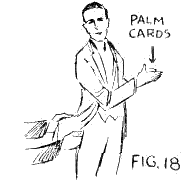
If you are performing on a stage you may call up a spectator to assist you. If you are performing in a parlor you may have a spectator remain seated while reaching into your pocket.
"Will you, sir, please reach into my right trousers' pocket to see that my pocket is empty and that all is fair?"
Spectator reaches into pocket and convinces himself and the audience that pocket is empty.
While spectator is reaching into pocket, turn your right side toward audience. Figure 18.
MISDIRECTION PALMING:
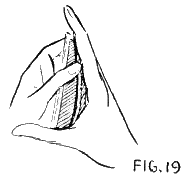
Place right hand over cards. With aid of little finger of left hand, palm the top three cards of the packet in right palm. Figure 19.
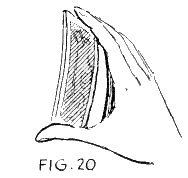
Hold the other nine cards in right hand also to make it appear that you merely transferred packet from left to right hand. Figure 20.
"You are convinced, are you not, that there is nothing in my pocket?"
Figure 21 shows position of cards in hand. Three cards are palmed in right hand and remaining nine cards of the packet are held by thumb and forefinger.
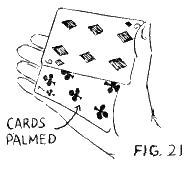
The audience sees only the back of your hand.
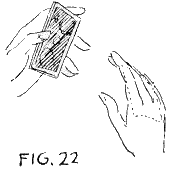
Place the packet of nine cards into left hand again and draw right hand with palmed cards away toward trousers' pocket. Figure 22.
POCKET CONCEALMENT:
Put right hand into right trousers' pocket and push the three cards into the upper corner. Hold them there a moment with thumb. Figure 23.
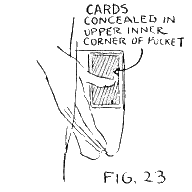
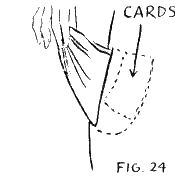
With tips of fingers bring out the pocket. You will find that pocket can be drawn out and shown empty even when there is something in it. Figure 24. Replace pocket.
NOTE THE USE HERE OF EMPHASIS. You requested spectator to reach into pocket. He found that it was empty. Now you pull out pocket and show it to be empty. The audience is in this way convinced that you have nothing in your pocket.
"I will now recount the cards to make assurance doubly sure."
FALSE COUNT the nine cards as twelve. Refer back to the first effect in this lesson for explanation of false counting.
Count the cards one at a time aloud. ALWAYS HAVE BACKS OF CARDS TO AUDIENCE in this form of false counting. There is danger of detection if the audience can see the faces of the cards for they are likely to notice when the same kind of card remains in sight for two counts.
"Twelve cards."
Hold the packet in left hand, backs of cards to audience.
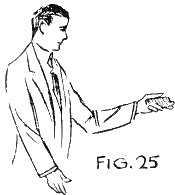
Your left hand is extended and your right side is turned toward audience. Figure 25.
"What I propose to do is to cause the cards to pass one at a time UP my sleeve and down into my right trousers' pocket."
With right hand draw an invisible line from left hand along sleeve and down to right pocket — merely touching outside of pocket.
"All I have to do is to click the cards and they will pass up my sleeve. This is quite similar to the way I vanish an elephant or a big bowl of goldfish and water up my sleeve. Sleeves are quite handy. If I want to produce a lady I merely shake my sleeve and a lady assistant appears. If I wish to vanish her, I say 'Hocus Pocus' and she vanishes up my sleeve again. Now, watch closely and perhaps you can see the cards go. ONE –"
Click cards with left thumb. Show right hand empty, fingers wide apart and palm of hand to audience. Reach into pocket with right hand and take out one of the cards. Throw it on nearby table or chair. Figure 26.
"Did you see it go? (Click cards.) There goes another. TWO –"
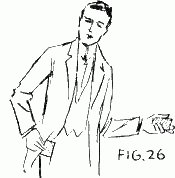
Reach into pocket after showing right hand empty. Throw second card on table.
A few spectators may have heard of palming and may think that you palm the cards in some way so whenever you can do so, show right hand empty before reaching into pocket.
"I hear someone saying to himself, 'I wonder whether those cards really do go up his sleeve and into his pocket.' Let us see."
FALSE COUNT the nine cards as ten.
"Two from twelve leaves ten. You see two cards have passed. Now again. (Click cards.) THREE –"
Count cards out slowly so that all will be thoroughly convinced that you have nine cards.
Fan cards again as you did in the beginning of the effect. Close fan and insert little finger of left hand to separate six cards from remaining three.
"I will ask the gentleman here to reach into my pocket himself to see whether the third card is there."
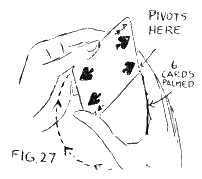
Turn your right side to audience. As spectator reaches into pocket, place right hand over cards again, PALM THE SIX TOP CARDS in right palm. With tips of fingers of left hand turn up the three cards with faces toward audience, using thumb and first finger of right hand as pivot. Figure 27.
The effect is that you have transferred packet of cards to right hand and turned it over so that audience could see face of bottom card. Audience is absorbed in watching spectator who is reaching into your pocket and may not even see this move at all.
When spectator removes third card from your pocket, take three cards in left hand again and reach into pocket with six cards palmed in right hand.
Repeat move of pushing cards into upper corner of pocket, holding them with thumb, and pulling out pocket to show that it is empty.
"You are sure, sir, that there was nothing else in my pocket?"
Gentleman responds, and you push pocket back again.
"Now watch again. (Click cards with left thumb.) Up the sleeve goes the fourth card and here it is in my pocket."
Remove a card from pocket and place on table.
"Next."
Click cards. Then reach into pocket and PALM one card.
"I thought it went into my pocket but I guess it didn't."
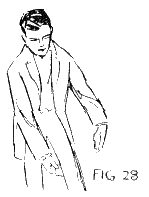
Bring right hand out of pocket with palmed card and place hand behind left knee. Be careful always to have back of hand to audience when you are palming cards.
"It seems to have traveled down behind my left knee."
Turn hand over and bring card out, holding it by thumb and tips of fingers of right hand. Figure 28.
This effect of apparently reaching up with tips of fingers and thumb bringing out a card is an important one. Practice palming a card, moving it about to various places, and then suddenly getting it to the tips of the fingers and thumb and suddenly producing it. By pressing card against some surface, in this case, the knee, you will have no difficulty in getting it from your palm to the tips of your fingers.
"They wander around sometimes."
Click cards. Reach into pocket and take out another card. Place it on table or chair.
"That one went all right."
Click cards. Take another card from pocket and place with the rest on table or chair.
"Up the sleeve and into my pocket."
Click cards. Reach into pocket, palm card, and bring hand out.
"That's funny. Oh, I see it got stuck at my elbow."
As you say this, reach up behind left elbow and bring out palmed card with finger tips and thumb of right hand. Place card on table.
"They get stuck in the joints occasionally. How many have we left?"
FALSE COUNT the three remaining cards as four.
"One – two – three – four. Four cards remain."
Click cards and then count the three cards slowly as three.
"Please reach into my pocket and remove the card."
Assistant reaches in and takes out the remaining card in pocket.
"We now have three cards left."
SELF-CONTAINED CARD VANISH:
Show cards separately and then square them up and hold them in left hand with faces toward audience.
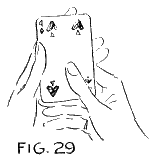
Hold them as shown in Figure 29. Click cards again.
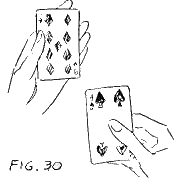
With right thumb slip the first card down away from the other two. Hold the remaining two cards in left hand tightly as one. Figure 30, next page.
"One card."
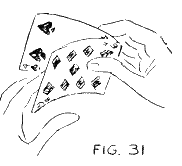
Place the two cards held as one on top of the first card. Hold tight with right thumb. Snap cards with fingers of left hand as you put them down. This makes it appear that you have only two cards. Fig. 31, next page.
"Two cards."
You have apparently vanished a card.
Square up cards perfectly so that the three will look like one card and hold them in left hand.
Snap face of card with right second finger.
"Pass."
Turn cards over as one card and snap them on the back with finger.
"One card left."
The snapping back and front emphasizes the effect of holding only one card.
In my work I actually throw three cards from right to left hand and they do not come apart. You will find many uses to which you can put this principle of showing three cards as one. As you study, new ideas may present themselves to you for using this principle.
"Now the last card."
BACK TO FRONT HAND CARD VANISH:
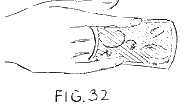
Place the three cards as one with backs to audience on the back of right hand. Grasp edges under first and last fingers at about the second joints. Fig. 32.
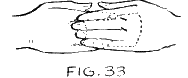
Pass left hand over cards on back of right hand. Fig. 33.
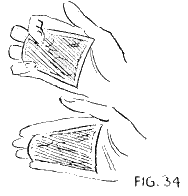
As you do this, turn fingers and cards down into palm of right hand. Bring out second and third fingers, then straighten all the fingers. Fig. 34.
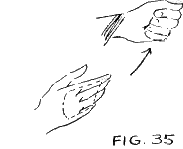
As left hand leaves right hand, it should be kept closed as if it had taken card from the right hand and closed around it. Cards are now concealed in palm of right hand. Fig. 35, next page.
Bring left hand about eighteen inches away from right and open it slowly to show that card has disappeared.
Place right hand in right trousers' pocket and bring out the cards one at a time.
"One – two – three."
Note — Learn to do this effect also without having gentleman reach into pocket. In stage work a spectator may not be near enough — or it may not be advisable to use a committee.
VARIATIONS:
The preceding effect may be presented in a little different way.
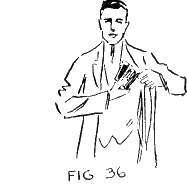
Before you begin the experiment place two cards in your upper left vest pocket, faces toward your body. Then while you are performing and have passed about six cards to pocket, click a card and pretend that it did not go into pocket. Start looking for it and reach up under coat with right hand. Take the cards from vest pocket quickly and carry them up under shoulder. Grasp left side of coat with left hand and open coat. Bring out the two cards fanned out, backs to audience. Fig. 36.
"That time two went up together and, as a result, got stuck at my shoulder. Let them now continue on their way."
Let go of coat with left hand. Reach up under left side of coat with right hand and quickly put cards back into upper vest pocket. Then move hand up to shoulder so that audience can see coat lifted, giving the impression that you placed the cards there.
"One – two — there they go. And here they are."
Reach into trousers' pocket and take two cards out. Then continue effect as described above.
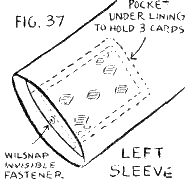
Another variation of the effect involves some preliminary work. Have the lining on your left coat sleeve opened and pocket sewed in large enough to hold several cards. On the edge have a snap fastener sewed on. Fig. 37.
Before appearing for your performance place two cards in pocket of sleeve. After having passed several cards, pretend that cards got stuck in sleeve. Reach up sleeve with right hand, open snap, and take cards from pocket. Fan the two cards, backs to audience. Then say that they will continue on their way. Reach into sleeve again, replace cards in pocket of sleeve, close snap. You can now show empty sleeve to prove that cards have vanished.
Then produce the two cards from trousers' pocket.
Little stunts like these add Showmanship to a trick and make it more interesting.
EMERGENCY METHOD:
If you should happen to be before a group, some of whom have seen you perform this experiment before and think you use palming, it is best to vary the effect in the way I shall describe here. These spectators are watching you closely and you must leave them completely mystified at the end of the experiment.
Slip three cards into your right trousers' pocket beforehand. Then instead of counting off twelve from the deck, FALSE COUNT nine cards off as twelve.
Show pocket empty by method I described above. Start clicking cards. The sharpest eye cannot see the cards go into the pocket now, for they are already there.
Another ruse is actually to count twelve cards from the deck or to have someone else count them, then to palm off six and replace them on top of pack in squaring up the pack and placing it on table. Have six cards in pocket before you start.
CARDS UP THE SLEEVE
(The Shoulder Method)
This is a pleasing variation of the CARDS UP THE SLEEVE effect. Instead of producing the cards from the trousers' pocket they are produced from under the left side of coat at the shoulder.
EFFECT: Twelve cards are counted from the pack and placed in the left hand. Performer causes the cards to pass one at a time up his left sleeve and takes them out from under the left shoulder of his coat. PARAPHERNALIA:
1–Deck of Cards.
SECRET AND PATTER: To Perform:
Have twelve cards counted from deck and hold them in left hand, separating top three cards ready for palming in right hand.
PALM OFF the three cards in right hand and drop hand a little at side.
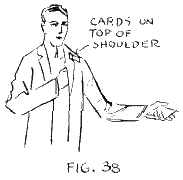
"Before beginning this odd experiment I want to tell you about a magician's sleeves. This one has two ends, one at the bottom (point with right hand to bottom of sleeve) and an end at the top."
Grasp left edge of coat with left hand and make a gesture with right hand to show upper end of sleeve, placing hand on left shoulder. Drop left side of coat. This screens right hand and the palmed cards. Leave cards on upper part of left shoulder. The weight of the coat will hold them securely in place. Audience is not aware of your real move. It appears that you were merely explaining the sleeve. Fig. 38.
"There have been many stories told about magician's sleeves and how things go up and down them. Of course, a sleeve is the only place where a magician could conceal anything, especially a couple of lions, a tiger, a dozen rabbits, a billy goat, a couple of girls, and a barrel of pickled herring. The real problem, however, is 'Just how does the magician cause the various objects to pass up and down a sleeve?' I will explain by causing these cards to walk up my sleeve one at a time. First, we have twelve cards."
FALSE COUNT the nine cards as twelve.
"I will place them in my left hand and when I click them, up will walk a card into my sleeve and travel upwards."
Click cards in left hand.
"Did you see that one go? A little too fast, was it? Well, here it is."
Show right hand empty, fingers wide apart. You must convince audience that you have nothing in your right hand. Reach up under left side of coat and take ONE card from shoulder. Show it plainly. Place card on table.
"One card. Up one end and out the other. Again!"
Click cards with left thumb.
"Up goes the second card."
Show right hand empty again and then take another card from shoulder.
"You see it is a sort of clickety click arrangement. Do they really pass up the sleeve? We shall see."
FALSE COUNT the nine cards as ten.
"Ten cards left. The two have gone. Now watch the cards just as closely as you can so that you will see one jump from the packet in my hand out and into my sleeve."
Click card.
"See that one jump? Here it is."
Take third card from shoulder.
Count nine cards as nine.
Fan cards a bit, then square them up and get little finger under top six cards. Palm the six cards in right hand, then place the three remaining cards in right hand. Refer to Figures 19 and 20.
Audience believes these three cards to be nine. They do not suspect that you have cards palmed.
Place the three cards in left hand again, click them, and reach right hand up under coat to left shoulder. Place the six cards on shoulder. Take one card out with a quick and snappy movement.
"That's a speedy fellow."
Now produce the next five cards one at a time, varying the manner of producing perhaps two of them.
Reach up under shoulder and pretend that you failed to locate the card. In reality, palm one of the cards in your right hand. With left hand lift left edge of vest, reach up under it with right hand, and bring out card by thumb and finger tips, as you did in the production at the knee.
"That one went so hard it lit down under my vest."
Another time, palm card from shoulder and produce it from right coat pocket or from bottom of left trousers' leg.
"These are getting to be regular sky-rockets."
Produce cards until only one is left at shoulder and you have three in left hand.
Count the three as four, then click cards and take another card from shoulder. Now count the three cards slowly
as three.
TO VANISH THE LAST THREE CARDS:
This is a most important move and one which can be used in many effects to vanish a number of cards. With practice you will perfect this move and become skilled in its use.
The effect is that you just push the cards into left hand which closes on them. Then you open left hand — and the cards have vanished.
PIVOT CARD VANISH:
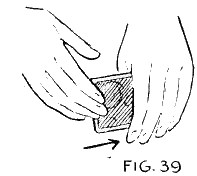
Place the three cards in left hand as shown in Figure 39. This is the way it looks to the audience.
Push cards into left hand with right fingers, edges of cards just at second joint of right fingers. Figure 40.
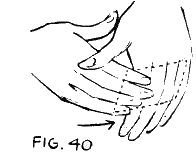
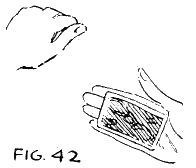
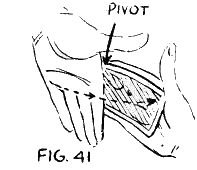
When cards are almost all in left hand push tips of right fingers forward. This causes card to pivot on first finger of left hand and to revolve automatically into the right palm. Bend right hand slightly and palm the cards. Fig. 41.
At the moment when cards are propelled into right hand, close left hand as though cards are in it. Lift left hand up, constantly looking at it. Remember your MISDIRECTION here — not to look at right hand at any time when you have cards palmed in it. Figure 42.
Open hand slowly and show that cards have vanished.
Now place right hand suddenly into right trousers' pocket, push palmed cards into upper corner of pocket, and bring pocket out empty. Then pull left pocket out empty. Look perplexed as though you do not know where the cards are. Push the pocket back in again. Reach up under coat to left shoulder, then feel around vest for them. Give your vest a shake as though you are shaking something down. Then suddenly reach into right trousers' pocket again and remove the three cards.
Or right hand can be pushed under left side of coat and cards produced from shoulder.
Lesson 13
In the next lesson we continue to study card effects — this time some very interesting card stabs. With the effects, of course, you learn some more essential principles of Card Magic.
1 — A deck of cards is divided into two parts. A card is selected from each half by a spectator, remembered, replaced, and shuffled into its respective half deck. The two packets are put together to form whole deck again. The deck is placed behind a piece of newspaper. A spectator stabs through the paper into the deck of cards with a knife. Paper is removed. Deck is opened at place where knife pierced it and it is found that the selected cards are there, one on each side of the knife.
2 — Spectator selects a card from deck. This card is shuffled back into the deck. The cards are wrapped securely in a piece of paper. Spectator is then given a knife, which he stabs through the paper into the cards. Performer removes the paper and it is found that the knife has located the selected card.
3 — A card is selected, then thoroughly shuffled into the deck. Spectator runs knife into deck anywhere he chooses. Cards are separated and it is found that the selected card is at place where knife was inserted.

TARBELL SYSTEM, INCORPORATED, Chicago.
Book contents
Introduction
Core card lessons
- Lesson 9 — The Principles of Card Effects
- Lesson 12 — Cards That Pass in the Night and Cards Up the Sleeve
- Lesson 13 — Review, the Regular Pass and Card Stabs
- Lesson 14 — The Force, Card and Orange, and Banana Effects
- Lesson 15 — Card Positions, Palms, Shifts and Discoveries
- Lesson 16 — Card Penetrations Through Boards and Handkerchiefs
- Lesson 17 — Snap It, Flash Production and the Glass House
- Lesson 18 — Rising Cards
- Lesson 19 — More Rising Card Effects
- Lesson 34 — Twelve Impromptu Effects with Cards
- Lesson 35 — Sleight of Hand with Cards
- Lesson 36 — More Card Magic
Additional card effects
- Lesson 26 — A Card and Ribbon Mystery
- Lesson 29 — The X-Ray Cards
- Lesson 31 — Blindfold Card Reading and A Mystic Discovery
- Lesson 45 — Spirit Photography
- Lesson 54 — The Card Slot