Lesson 36 — More Card Magic
LESSON 36
MORE CARD MAGIC
When you have mastered this lesson, you will be able to handle a deck of cards in true professional style. You will have a foundation of principles to use as a basis for many effects and many combinations. You will be prepared with methods of handling cards to carry you through almost any emergency.
I teach you Card Magic with a regular deck of cards, purposely avoiding effects which require specially printed cards. I want you to know how to perform with an ordinary deck so that you are ready for impromptu work, for emergency work. You can add fake cards to your work later on, if you desire to. They are not difficult to obtain. But right now, I want to feel that you are learning real Sleight of Hand with Cards and have the ability to take your place in the field of Card Magic as a real Sleight of Hand performer.
This lesson is very interesting.
You learn–
COMEDY FLOURISHES EASY METHODS OF FORCING A CARD METHODS FOR FALSE COUNTING FOUR ACE EFFECTS RISING CARDS THROUGH THE AIR CARD FOUNTAINS
PRODUCTION OF CARDS FROM THE MOUTH
EFFECT:
This is a comedy flourish. Magician reaches up with his hand and apparently takes many cards from his mouth, or from a boy's mouth.
TO PERFORM:
Palm off from the deck a dozen cards, or as many as you can conveniently palm, in your right hand. It is preferable to palm them with faces of cards against hand. To do this, hold deck in left hand right in front of you with faces of cards toward you and backs toward audience. Place right hand over deck. Turn toward the left, and as you do so, get left little finger under a dozen or so cards. With aid of little finger, palm the cards in right hand.
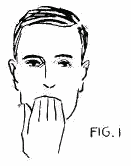
Place cards up against mouth with back of hand to audience, being careful to conceal cards. Push top of cards up into mouth about an inch, Figure 1.
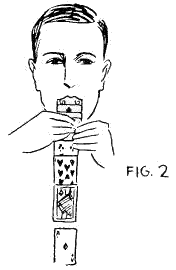
Draw right hand aside and place left hand on cards also. Immediately start pulling cards down in ribbon fashion, allowing them to fall one by one to the floor. As you pull cards down with fingers of both hands, you create the illusion of actually pulling the cards out of your mouth, Figure 2.
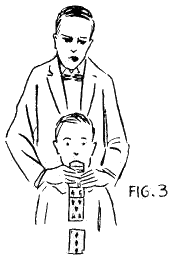
If you do this with a boy, have him face audience. Stand behind him, and under cover of his body, palm your cards. Reach your arms around his neck, place cards up into his mouth a little way, and immediately start pulling cards down, Figure 3.
CASCADE PRODUCTION FROM BOY'S NOSE
EFFECT:
Another comedy flourish in which performer places his hand on boy's nose and a stream of cards cascades down.
TO PERFORM:
Stand behind boy and palm off half the deck in right hand. Hold cards as you were taught to do for the CASCADE DROP in Lesson 35.
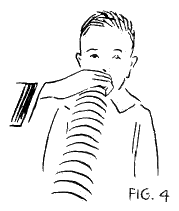
Step around to right of boy, place your right hand up to his nose, and cascade the cards downward, allowing them to fall to the floor. Tilt your hand a little to get proper angle for a good waterfall or cascade of the cards. This stream of cards, apparently coming from the boy's nose, always gets a laugh, Figure 4.
EASY METHODS FOR FORCING CARDS
I have already shown you how to force a card on a spectator in a previous lesson. There are other methods which you should know. These which I give you here are easy and give you a good variety. You will find them most useful.
The Mathematical Force —
EFFECT:
Performer makes a selected card appear at any number from the top of the deck which spectator chooses. To save time, spectator is asked to choose number between one and twenty.
TO PERFORM:
Have card freely selected and then returned to middle of deck. Allow TWO cards from upper packet to fall on selected card. Place left little finger on top of these two cards, do the Simplified Pass to get them and the selected card to top of deck. Selected card is now third down from top.
Ask spectator to select a number under twenty. Suppose TEN is the selected number.
Hold cards with backs up in left hand. Count down 12 cards quickly, one on top of the other, placing them on table. Count each card aloud as you deal it. Then say,
"Pardon me, what number did you say?"
Spectator says he chose number 10. Quickly replace the 12 cards on the deck.
"My mistake. Ten cards, you say."
By counting the cards down on the table, you have reversed the order of them. Originally you had two indifferent cards on top of the deck and the selected card third from the top. Now, by counting two more cards than the selected number, you bring the selected card just at the selected number down from the top. Spectators do not realize that you have reversed order of cards and stacked them so as to bring selected card into position.
Regardless of what number is chosen, count down TWO more in the first counting. Then replace all the cards on the deck.
Now you can proceed to count down to the tenth card. After you have counted nine, have spectator take tenth card — and this proves to be the selected one.
NOTE:
If number 1 is chosen, fan cards enough to get left little finger under top three cards. Lift the three cards as ONE with right hand and show face card as selected card.
If number 2 is called, deal off the first card on the table. Then for second card, deal SECONDS as you were taught in Lesson 35. This will bring out the selected card as the second card.
If number 3 is called, merely count down the two indifferent cards and show the third as selected one.
If number 4 is called, you may proceed in the regular way or else FALSE COUNT three cards as four and show selected card.
If you want to use this method for forcing a card, select the card you want forced and place it third from top of deck before beginning experiment. Then have spectator select number and proceed as above to get the forced card. Spectator believes he has had free choice, but you have brought out the card you want used. Then you can proceed with the experiment you want to perform with forced card.
Forcing Bottom Card —
EFFECT: Cards are fanned and spectator is asked to select one by touching it. Magician separates pack at that point and shows card which had been touched. This is in reality the card magician wanted selected. TO PERFORM:
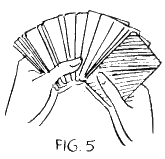
Place card to be forced, say the Ace of Diamonds, on "Bottom" of deck. Fan cards, backs up, Figure 5.
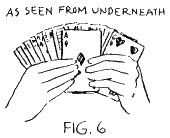
With right finger-tips move bottom card over to center of fan under other cards. Movement and shifted card are concealed by fan of cards, Figure 6.
Have spectator touch any card in fan. He will usually touch one in the middle somewhere, but wherever
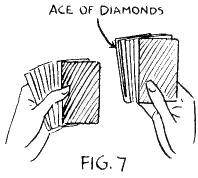
he touches, separate the pack at that point. Be sure to get the card he touched in the right-hand pack. Bring the bottom card quickly up even with bottom card of right packet (spectator's touched card) and pull two hands apart. The Ace of Diamonds becomes bottom card of right packet.
It is apparently the card spectator touched, but in reality is a forced card. Hold right packet facing audience to show selected card, Figure 7.
You may now proceed with the experiment which you desire to perform with the forced card.
If you want to force three or four cards, place them on bottom of deck and force each by the same method as above. Be careful not to expose bottom of left packet.
This force is always sure. It is easy to do and cannot be discovered by audience if you do it right. This is also a good method for locating one or more selected cards.
Force Behind Performer's Back —
EFFECT:
Performer places deck behind his back, and spectator selects a card. This card is forced.
TO PERFORM:
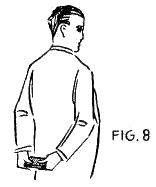
Place card to be forced on bottom of deck. Be careful not to expose it. Place pack behind your back, holding cards in both hands lightly. Backs of cards are up, Figure 8.
Ask spectator to lift off a few cards. When he has done so, turn to the left to face him for an instant. Cards are kept in same position behind your back and are now out of sight of audience.
"Did you take off a few?"
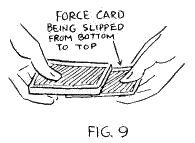
The moment cards are hidden, slip the bottom card to the top. Do this quickly with right hand, Figure 9.
Turn your back to spectator again with cards behind you as before. This turning and adjusting of cards is done so quickly that audience does not suspect anything. It seems natural for you to turn to spectator as you ask him whether he took a few cards.
"Now that you have lifted off a few cards from the deck — I do not know how many — just lift up the next card and look at it. Remember it."
And so you have forced your card.
THE CIRCUS TRICK
This is a good effect which you may perform after you have forced a card by above method.
TO PERFORM:
After spectator has looked at Forced Card, tell him to place it with other cards in his hand and shuffle it in well. Then give him rest of deck, telling him to place all the cards together and shuffle them. Then take deck.
"This is a circus trick, in days gone by performed by the fakers who used to follow the circus. This was one of the old standbys like Three Card Monte and the old Shell Game. The object is to find your card by a mental process. Now, I shall deal the cards, face up and one at a time, on the table. As your card is turned up, I want you to say, 'Stop!' mentally. The moment you think — Stop — I shall tell you your card. Sometimes it is difficult to tell the card on first impression. If I fail, say nothing. Do not help me. Make no noise or motion besides a mental Stop."
Hold deck in left hand, backs of cards up. Turn over top card and place it on table, face up. Continue to do this, placing one card on top of the other, until you come to selected card. Do not stop here but continue to deal off three or four more cards on table, allowing part of selected card to show from under others.
Take hold of top card on deck and remove it half way but do not expose face. Then say to spectator:
"Would you be willing to wager that the NEXT card I turn over will NOT be your card? Personally, I have a hunch it is. I might say at this stage that there are no two cards in the deck alike."
Draw attention to the card half way off the deck. Spectator thinks you are referring to that card. He knows that selected card is on the table, so he probably says that the next card you turn over will not be his card.
"This is a circus trick, and I would not wager with you because you would be sure to lose. When a person bets that the next card turned over will not be his card, performer reaches down and turns over the selected card which is already on the table."
As you say this, reach down and turn over the selected card on the table.
"Was that your card? That's a warning to you to be careful how you bet."
The Riffle Force —
EFFECT:
Spectator is asked to think of any card in the deck as cards are riffled. Spectator is forced to think of certain card.
TO PERFORM:
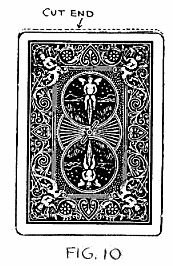
This force requires what is known in Magic as a SHORT CARD. You prepare it this way: Trim off with a pair of sharp scissors a small edge from one end of a card from 1/32 to 1/16 of an inch. Trim the corners down, rounding them to look like those of ordinary card, Figure 10.
This Short Card looks like any other card. The difference is so slight that even keen eyes would not notice it. When this is mixed into the deck, it can readily be located by riffling top of cards with the thumb. The moment this short card slips by thumb, there is a snap and a little hesitation in the riffling.
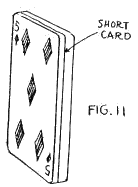
Suppose you want to force the Ace of Hearts. Place the Short Card in front of the Ace and place both cards about 1/3 to 1/2 of the way back from front of deck, Figure 11, next page.
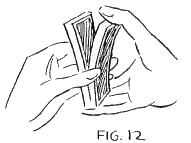
Hold deck in left hand and riffle top edge with right thumb. Do this fast so that eyes of spectator will not have a chance to concentrate on any one card. When your thumb reaches short card, this card snaps forward and exposes the Ace of Hearts a little longer than any of the other cards. Spectator concentrates on this card and selects it. Rest of cards are riffled through rapidly, Figure 12.
Spectator thinks he has freely selected the card, but he really had no chance to see any card long enough to remember but the forced card. Experience will teach you just how fast to riffle the cards and how long to hesitate on the forced one. This hesitation must not be noticeable but just long enough to get the result.
Say to spectator:
"I am going to riffle the cards, and as I do so, I want you to THINK of any one of the cards as they pass by. I want you to make a deep mental impression of one card and remember, it. Choose any card except the bottom one. Do not select one in advance, but select ONE of the cards as they riffle by."
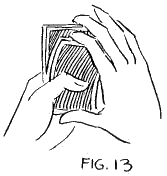
Riffle the cards and force the desired one. You may then proceed with experiment for which you forced the card.
You keep backs of cards toward yourself. You need not see faces of cards. If you find it easier, you may riffle with first finger, Figure 13.
Riffle Force with Unprepared Cards —
TO PERFORM:
This riffle force is done with unprepared cards and no Short Card. In this case, keep faces of cards turned so that you can see them. Tell spectator to remember a card as you riffle. Start riffling cards rapidly, then about one-third way back in the deck, hesitate a moment and allow a card at this point to be shown longer. Then continue riffling fast. Remember card at which you hesitated.
Now look through cards and get selected card to top of deck. Lift the two top cards as ONE and show face of second.
"This, I believe, is the card you thought of. No?"
Replace the two cards on deck. Then remove top card, back up.
"What was your card?"
Spectator names card. Turn top card over and show it.
"That's what I thought!"
NOTE:
If you fail to locate card the first time, show spectator card in your hand and say:
"Did you notice something peculiar? Is this the card I first showed you? No. It has changed. Look at it closely."
Give him the first card you selected. Hurriedly look through the deck for the second selected card and get this to top of deck.
"Strange, it isn't even in the deck."
Take card back from spectator.
"Are you sure you thought of the Seven of Diamonds?" — (or whatever selected card happens to be.)
As you say this, do the card change, placing this card on bottom of deck, and take top card which is selected card.
"I do not understand it."
Then turn card over and show it to be selected one.
"Well, it happened to be your card, after all."
Forcing One of Four Cards on Table —
EFFECT:
Four cards are laid down on table in a row. Through various methods, Magician can force any one of the cards.
TO PERFORM:
Place four cards down in this manner, backs up, Figure 14.
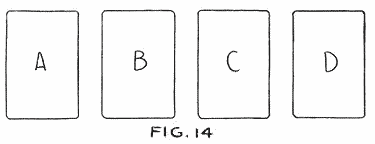
1- Free Choice Force —
If you place card which you want forced in position C and have it a little nearer spectator than other cards, it is a psychological fact that he will select C in most cases.
If this force fails, you can easily remedy the situation. If spectator touches D, say, "I should have told you to select any two of the cards."
If he touches C this time, keep C and D and say you will discard the other two.
If he touches either of the other two cards, keep that one with C and discard the other two.
Now with two cards left, ask spectator to select either one. If he chooses C, discard the other one. If he chooses the other card, merely discard it with the others and retain C.
No matter what spectator chooses, he really has no choice in the matter. You use whichever card you want anyway.
2 – Force by Naming Number —
A convenient force for row of four cards. Suppose you want to force C. Ask spectator to name number BETWEEN one and four. This limits the choice to two or three. Audience rarely notices how limited the choice is, however.
If spectator chooses two, start counting at right end of cards toward left. Take C as the second card. If he says three, count from left end of cards, which makes C the third card.
3 – Force with Die —
A die has six sides, numbered with one to six dots, Figure 15.
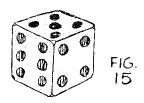
You desire to force B or C; let us say, C. Have spectator throw die on table to select number for card. If it lights with one or four up, ask him to throw it again to prove that it is not loaded. You want two, three, five, or six to come up.
If two ones or two fours come up in succession, spectator is more than willing to throw die again to see whether it is loaded or not. If four is thrown first and then a one, or vice versa, you say four and one are five and you will take the card at number five.
This is the way you select the card:
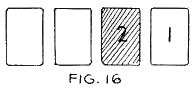
If two is thrown, count from right side, Figure 16.
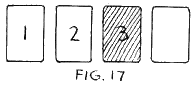
If three is thrown, count from left side, Figure 17.
If one or four are thrown, you ask for another throw.
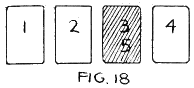
If five (or four and then one) is thrown, you count from the left and back one to the right, Figure 18.
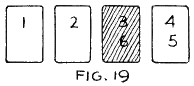
If six is thrown, begin counting at left end, double count last card and then count back one to left, Figure 19.
Forcing One of Four Cards by Using Deck —
EFFECT:
With four cards on table, performer takes rest of pack and mysteriously produces from it an ace, two, three, or four-spot to coincide with number of card to be selected from table. This is a double force in which you force a card from the deck according to the card which you want forced from the table.
TO PERFORM:
Use any method for forcing these cards which you prefer from among those taught you in this lesson.
Slip of Paper Force —
TO PERFORM:
Take four small slips of paper. Tell audience you will write number 1, 2, 3, and 4 on each respectively. In reality, you write same number on each slip — the number of card you want forced. If you want fourth card forced, write number 4 on each slip, etc.
Do not let anyone see what you have written. Fold each slip immediately after numbering it and throw on table. Have a slip selected by spectator and called out. Immediately crush the other slips and place them in your pocket.
If you wish to use right or left counting, you may write number 1 on two slips and number 4 on two and count according to number chosen. The same applies if you desire two or three chosen. Always pocket the three remaining slips.
FALSE COUNTING
In the effect, CARDS THAT PASS IN THE NIGHT, in a previous lesson, I taught you a method of False Counting. Here I give you other methods that will add to your fund of Magical knowledge. The effect, as you remember, is apparently to count a certain number of cards, but in reality to count fewer.
The Slip Over False Count —
TO PERFORM:
Assume that you want apparently to count TWELVE cards and really to count only NINE.
Hold deck in left hand, backs of cards to audience and faces toward yourself. Take first card with right hand and bring it upward a little and about six inches to right of deck, Figure 20.
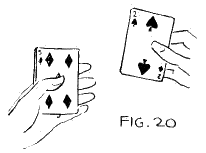
Count cards aloud, saying, "One."
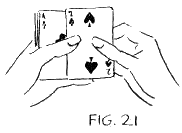
Slide next card to right with left thumb. Place card in right hand on top of it and bring the two away together as you did the first, Figure 21.
Count, "Two."
Do the same with the third card, counting, "Three."
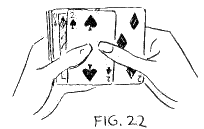
As you come down with right hand to pick up fourth card, slide the first card from right hand over to the left. With right and left thumbs get it back on to the deck. Remove the fourth card with the second and third, Figure 22.
You have only three cards in right hand but say, "Four."
Count the fifth card legitimately.
As you go along, slide two more cards back on to the deck at intervals and count the rest legitimately. Your count is then TWELVE, but you really have only NINE.
The Put Back False Count —
Suppose that you want apparently to count TWELVE cards off the deck but really to remove only FIVE.
Hold deck in left hand, backs up, in horizontal position. Or cards may be held with face of each showing as it is counted.
With left thumb slide top card half way off deck to right and take it with right hand. Count aloud — "ONE, Figure 23.
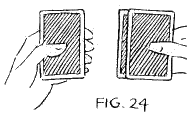
Push next card over to right. Place first card on top of it and remove the two with right hand. Count — "TWO."
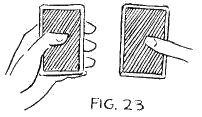
Continue this until you have removed FIVE cards. Now take the sixth card, but keep it jogged to the left about half inch, Figure 24.
Continue counting eleven cards, but keep all after the fifth jogged — even with the sixth card.
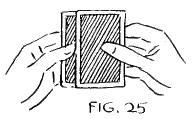
When you come to the twelfth card, do not push it over with left thumb. Bring right hand with cards over to top of deck and leave the six cards, separated from first five by jog, on deck. Thus instead of removing twelfth card, you put back all except five. Bring right hand quickly away from deck as if removing another card and count — "TWELVE, Figure 25.
Keep a uniform motion with each count. As you make the last move, keep cards turned downward a little.
The Pick Up False Count —
This is a method for actually counting MORE cards than you apparently do. Thus if you want to count TWELVE cards apparently but in reality count FIFTEEN, you may use this method.
TO PERFORM:
Hold deck in left hand, backs of cards up. Fan cards to right and get your left little finger under eight cards. Square up the deck. Now with right hand pick up the top card with fingers at outer end and thumb at edge nearest you. This view is from above, Figure 26.
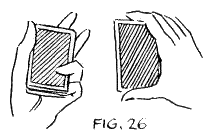
Lay this card down on spectator's outstretched hand and count — "ONE."
Pick up second card and lay it even with first on spectator's hand. Count — "TWO." Do the same with the third and fourth, counting — "THREE," "FOUR."
For the fifth, lift the next four cards — those separated from deck with left little finger. Place them down on spectator's hand as one and count — "FIVE." This gives you the three extra cards.
Continue counting until you have said "TWELVE." Spectator really holds fifteen cards in his hand.
The Palm False Count —
This is another method of counting less cards than you appear to. Assume that you count twelve cards apparently into spectator's hand, but in reality count nine.
TO PERFORM:
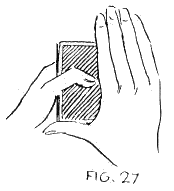
Hold nine cards squared up, backs of cards up, in left hand. Push off top card about half way to right. Place right hand over it and palm it, Figure 27.
This is not an invisible palming. You do not try to conceal card in this case. Place card on a spectator's outstretched hand and count "ONE." Continue this with THREE cards.
As you pretend to remove fourth card, pull it back on to the deck with left thumb. Continue motion of hand to spectator's, pretending to place a fourth card on top of the three already there. Spectator will not be aware that you do not actually place a fourth card in his hand.
Place the fifth card down legitimately.
False count the sixth.
Place the seventh down legitimately.
False count the eighth.
Place the next four down legitimately. Count—"TWELVE."
NOTE:
After first two cards are laid down on spectator's hand, palm is not exposed to audience. They take it for granted that you have a card each time, but they cannot see it.
The "Pick Up" and "Palm" False Counts may be combined and used to begin the experiment "Cards That Pass in the Night"— or other experiments. Have spectator count 24 cards into your hand, then you False Count FIFTEEN as TWELVE into one spectator's hand and NINE as TWELVE into another spectator's hand. Thus you can cause three cards apparently to pass from one spectator to the other.
FOUR ACE EFFECTS
Effects with Four Aces have won a popular place in Magic and have become more or less of a standard classic. There are many ways of performing these effects. I shall teach you here some of the best with unprepared cards.
The Wandering Aces
EFFECT:
Four aces are laid down in a row on the table, backs up. Three indifferent cards are placed on each ace. One of the four heaps is chosen, and when turned over, is found to contain all four aces. The other three heaps are shown to contain all indifferent cards.
TO PERFORM:
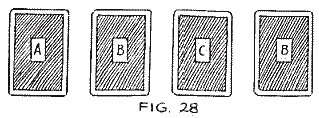
Run through the deck to pick out the four aces. As you find them, place them on the table in a row, backs up, Figure 28.
"I have placed the four aces in a row on the table. But I hear some odd suspicious murmurs that the cards may not be four aces. Pick them up, sir,
and make sure that all four aces are there."
As spectator looks at cards, fan deck without looking at it and get left little finger under top three cards. Square up deck.
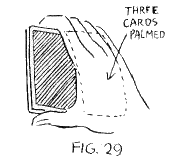
Palm off top three cards in right hand and immediately place rest of deck in right hand, Figure 29.
"If I didn't have four aces, I really couldn't work this experiment. Now, I shall ask you to place the aces on top of the pack again."
Take deck in left hand and hold it out so that aces can be placed on top of it. Place right hand up in front of right hip, back to audience.
When aces are on top of deck, bring right hand up and place the three palmed cards on top of aces, at the same time taking rest of deck in right hand again. With left hand, point to table.
"I placed four aces on the table. The aces have been examined. I will just replace them in a row on the table again."
Lay down the top three cards in a row, backs up, about two or three inches apart. As you lay down fourth card, turn it up casually and show it to be an ace, say the Ace of Diamonds.
"The Ace of Diamonds can be on the end."
Place Ace on table to finish row.
"Now, on each ace, I shall place three indifferent cards."
Place the top three cards from deck on the end card, the Ace of Diamonds. This brings all four aces together. Do not expose cards.
"Three cards here."
Place three more cards on next card to left and expose cards a little as you place them down to show that they are indifferent cards.
"Or you can deal indifferent cards from the bottom."
Turn cards over and place three cards on each of the two remaining cards, which are presumed by the audience to be aces. Place deck aside.
"We have an ace and three indifferent cards in each one of these heaps. I shall move the heaps around a bit."
Move heaps around so that the heap of four aces comes in third position from the left and second from the right.
FORCE THE ACE HEAP by one of the methods taught you in this lesson. Place chosen heap forward a little.
Turn over heap at left end and spread.
"No aces."
Turn over heaps two and four and with each say,
"No aces."
Now turn over the selected heap and spread out.
"The heap you selected — all aces!"
Slippery Aces
This is one of Stanley Collins' fine effects with four aces. Mr. Collins is a well known English magician.
EFFECT:
Four aces are laid on the table in a row, faces up. Three indifferent cards are placed on each ace, faces up also. The indifferent cards are then placed in one pile and the aces in another, backs up. Performer replaces indifferent cards on deck. Cards are now dealt from the deck into four heaps of four cards each. One of the heaps is selected. The other heaps are turned over and shown to be indifferent cards. The heap of aces is turned over and that, too, contains indifferent cards. Finally the selected heap is turned over and is shown to have changed to the four aces.
TO PERFORM:
Place the aces in a row on the table, faces up, Figure 30.
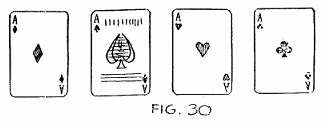
"I place four aces on the table. Now I shall deal three indifferent cards down on each ace."
Now you pretend to deal three cards down on each ace, but in reality you deal FOUR cards down on each. You perform it in this manner:
Hold cards in left hand with fingers on outer edge and thumb on inner edge. Cards face right. Bring right
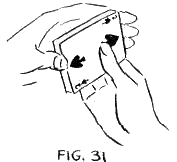
hand up to deck and place fingers behind it and thumb in front, Figure 31.
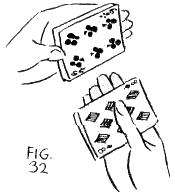
Pull down the face card in right hand, then the next card, Figure 32.
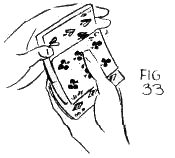
Reach up with right hand to get third card and as you pull it down, also pull down the rear card. Place these two cards quickly on top of other two in right hand, Figure 33.
The effect is that you have merely counted off three cards. Finger-tips should be moist enough to pull down rear card easily. Count cards aloud — "ONE." "TWO," "THREE."
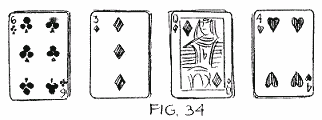
Place the FOUR cards (presumably three) on the first Ace at the left. Continue to count off apparently three cards, but really FOUR, and place them on each of the four aces, Figure 34.
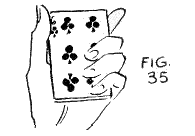
Pick up left-end heap and hold in left hand, showing the face card, Figure 35.
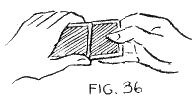
Turn cards with backs up and remove bottom card with right hand. Place it on table, face up, Figure 36.
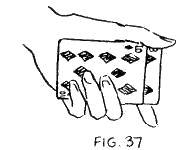
The bottom card now is the extra rear card which you counted off earlier in the experiment. With second and third fingers of left hand, push it back about a half inch underneath the packet.
Figure 37 is a view from below.
Now you can easily pull out second card from bottom with right hand. Place this face up on top of first card on table. Name the card.
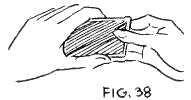
Reach over to left hand and take the two top cards as one. Place these down as the third card on top of other two on table. Square them up, Figure 38.
The Ace is the second card of the two which you show as one. You name the first card which conceals the Ace. Thus you get the Ace down on the table without being detected.
You have one card left in hand, which is supposed to be the Ace.
"I shall lay the Ace over here."
Place the remaining card aside, FACE DOWN. Keep it in full view of audience all the time.
Go through same routine with heaps B, C, D. Put all of the supposedly indifferent cards in one heap. Put the four cards supposed to be Aces in another heap.
Pick up the larger heap, turn cards with backs up, and place them on top of rest of deck. The four supposed Aces remain on table.
Deal down top cards of deck, one at a time, into four heaps, backs of cards up. First lay down your row of four, then place a card on each until you have the heaps of four.
This brings all four Aces in heap C. Move heaps around and push C forward a little. Ask spectator to select a heap and FORCE HEAP C.
Turn over the other three heaps, spreading the cards to show that they are indifferent.
"Now over here at the left, we have a pile of the four Aces. At the right we have the heap which you selected. Watch! The Aces disappear from here. . ."
Turn over heap of supposed Aces and show to be indifferent cards. Do this with left hand.
"And they appear here!"
Turn over selected heap with right hand, spread cards and show them to be the Aces.
Mystic Aces
EFFECT:
Similar to preceding effect, but done by a different method. Four Aces are placed on the table, face up. On each Ace are placed three indifferent cards, also faces up. Then each heap is picked up. The indifferent cards are placed in one heap and the four Aces in another. Magician then deals the indifferent cards into three heaps. One heap is selected. The other two are turned over and shown to contain indifferent cards. Heap of Aces is turned over and shown to contain indifferent cards also. The selected heap is then turned over and shown to contain all four Aces.
TO PERFORM:
In this effect, only sixteen cards are used, and only THREE cards are actually placed on each Ace.
Place the four Aces in a row on the table, faces up.
"I place the four Aces in a row on the table. Now on each I shall place three indifferent cards on each ace.
From bottom of deck count off one at a time, FACES UP, three cards. Place them on each Ace. Place deck aside.
Take Aces from bottom of each heap and place them on top.
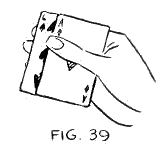
Now pick up heap A and hold in right hand. Push top card out a little with fingers, Figure 39.
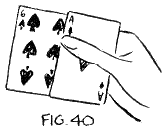
Push top card completely off heap in readiness for putting it down on table, Figure 40.
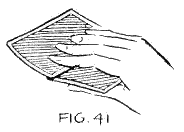
Turn right hand over and lay top card down on table, back of card up, Figure 41.
Show next top card in same manner. Name it as you push it off heap and place it on table, on top of first card.
Push off next top card just enough to show index. Name it.
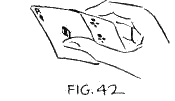
THIS TIME WHEN HAND IS TURNED OVER AND CARD IS LAID DOWN ON TABLE, THE TOP CARD IS HELD BACK BY FINGERS AND THE ACE IS PUSHED FORWARD WITH THUMB AND PLACED ON TABLE, Figure 42.
When this move is done quickly, it is not noticeable. Audience believes that you have three indifferent cards in a heap and an Ace left in your hand.
"I will place the Ace of Diamonds over here."
Place the supposed Ace at the left.
Follow the same routine with the three other heaps, placing the supposedly indifferent cards in one heap and the supposed Aces in another.
Pick up the larger heap and deal the cards into three piles — A, B, C. This brings the Aces all into heap A. Transfer heap C over to the left so that Aces are in center heap.
FORCE THE CENTER HEAP BY FREE CHOICE METHOD. Spectator will usually select center heap. If not, use the discarding system of getting heap C as selected heap.
Turn over the remaining two heaps and show the cards to be indifferent. Turn over pile of supposed Aces and show it to contain indifferent cards. Turn over selected pile and show the four Aces in it.
Note — If you perform the three Ace experiments one after the other, change position of Ace heaps. Start say with heap at Number Two from left. Then Number Three, etc.
RISING CARDS THROUGH THE AIR
We have discussed Rising Cards in earlier lessons, but these effects which you learn here are even more amazing than those I taught you before. Here you learn how to make cards rise up and soar into the air up into your hand. Howard Thurston made a hit in London years ago with this style of rising card effect and he still uses it in his evening performances. I give you three methods which are practical and easy to perform with or without an assistant. The effects are adapted to stage work and other work where a black thread is invisible.
Method 1
EFFECT:
Performer asks members in the audience to call out names of four cards. The deck is shuffled and placed in a glass tumbler on the table. Magician places his right hand high above the glass and causes one of the selected cards to rise out of the deck and soar up into the air to his finger-tips. Each of the four selected cards is made to rise in similar manner. At the end of the experiment, selected cards are thrown out to audience.
PARAPHERNALIA:
1 — Two decks of cards. 2 — A tray. 3 — A glass tumbler with base, large enough to hold deck of cards easily. 4 — A Wrist Reel. We supply you with a Reel for a reasonable price. SECRET AND PATTER TO PREPARE:
One deck of cards is placed, face up, on table offstage so that audience is not aware of it. Deal the cards into four or more rows so that any card can be picked up instantly.
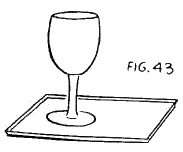
Nearby have the glass tumbler on the tray. An assistant offstage has charge of this, Figure 43.
The Wrist Reel is a special piece of magical apparatus. It consists of a small round box, 1 3/8 in. in diameter and 3/8 in. thick. At one side is a flesh-colored ring attached to a button, about 3/8 in. in diameter. A piece of elastic with snaps on the ends is attached to the reel. This is to go around performer's forearm, Figure 44.
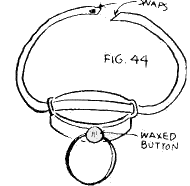
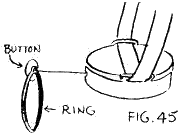
Inside of the box is a wheel in which a spring is coiled and attached to a pivot. Around the wheel is wound about 30 inches of fine black silk thread. One end is attached to the wheel inside, and the other free end comes through a small hole in the side of the box. This end of thread goes through eyelet of a small flesh-colored ring and is finally tied to a small flat button. When reel is not in use, the force of the spring keeps ring and button up against the box. A piece of conjurer's wax is placed on button, Figure 45.
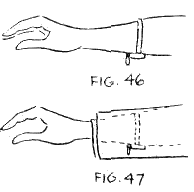
Fasten the Reel around your right forearm by snapping the elastic tape into place. Reel should be placed up high enough on forearm so that Ring and Box do not show. Coat sleeve is, of course, pulled down to cover Reel. It is important to be able to reach up with left hand and take hold of ring easily. You will have to experiment in adjusting apparatus, Figures 46 and 47.
As the silk thread will wear out, you must watch it closely. TEST APPARATUS BEFORE EVERY PERFORMANCE. It is easy to change thread. To do so, lift off top of box, loosen the spring at center pivot, take out wheel, and put new thread on. Then replace wheel in box, tighten spring, and replace top of box.
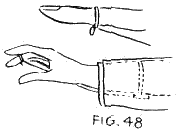
Just before starting your experiment, secretly get the ring on second joint of second finger of right hand. Help adjust it with left hand. Have button toward inside of hand. If ring is too large or too small, have a jeweler adjust it, Figure 48.
TO PERFORM:
Have assistant offstage at the table with cards.
Come forward with second deck of cards. The Reel is adjusted to your forearm with ring on second finger.
Ask members of audience to call out four cards.
As cards are called, assistant picks up each card called for from first deck on table offstage. He places these four cards together faces up, on tray with glass tumbler. First card called goes on bottom, then second, third and fourth.
Assistant comes on to stage with tray, holding it tilted back so that audience cannot see the cards on it.
As spectators have called cards, you have named each selected card after them. Now give deck a good shuffle to give assistant time to get out on stage with tray.
Place shuffled deck, cards facing up, on top of the four cards already on tray. Pick up the glass. Assistant places tray with cards on a table on stage and exits.
Tap glass.
"This glass was once the property of an old East Indian conjurer. It is clear and has a good ring. He used to tell his audience that he used a glass tumbler in his trick so that his spectators could see through it — that is, the tumbler, not the trick."
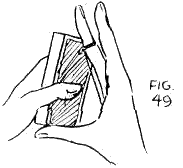
Replace tumbler on tray and pick up deck of cards. The four selected cards are on "Top" of the deck and ready for use. Hold deck in right hand with fingers above and thumb at bottom edge. Cards face audience. Bring left hand up to deck, Figure 49.
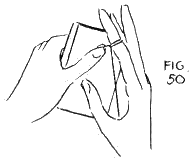
Grasp deck in left hand with fingers in front and thumb behind. Straighten second finger of right hand so that waxed button comes near cards. With tip of left thumb push button against top card about half an inch from top edge and midway between sides, Figure 50.
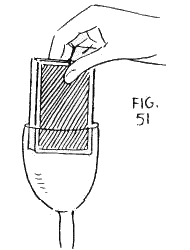
Hold button secure against card with left thumb. Then put right thumb against button and hold deck in right hand over the top edge of cards. Release left hand. Place deck in glass — cards face audience, Figure 51.
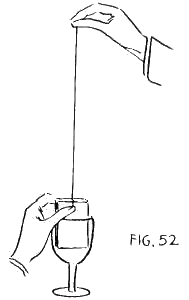
Place left thumb on button again and release right hand, raising it about 18 inches above the deck. Left thumb holds button on card securely to prevent card from rising prematurely. As right hand is raised, thread is pulled out of Reel. When right hand is in position, hold thread between thumb and forefinger to prevent its winding back into Reel until you are ready, Figure 52.
Release hold on button with left thumb and bring left hand away from cards. Say to person calling out first card:
"Pardon me, what was your card, sir? The Four of Diamonds. Four of Diamonds, rise!"
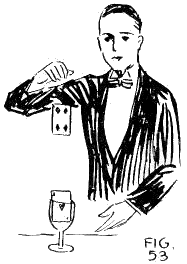
Release hold on thread with right thumb and forefinger and allow card to rise up into hand. The thread winds back on to wheel in Reel and causes the card to come up to right hand. The speed with which card is to rise must be experimented with. It must be neither too slow nor too fast. Card should come up gracefully and speedily enough to keep it from turning around, Figure 53.
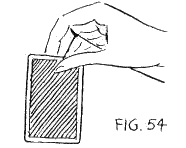
When card reaches hand, grip it at upper edge — Figure 54 shows view away from audience.
With right thumb loosen button from card and allow it to fly back against ring on second finger.
Remove deck from glass with left hand, using some suitable "Patter." Place selected card which has risen in front of deck and attach waxed button to rear card again.
Replace deck in glass, following same routine until all four selected cards have been caused to rise.
NOTE:
If desired, this experiment may be performed without an assistant. Have four spectators select cards from the deck and return them to middle of deck. Get selected cards to "Top" of deck. As you go back to stage, you can get ring from under right coat sleeve and place it on second finger. Then proceed as above.
BE CAREFUL THAT THREAD IS NOT HELD IN FRONT OF WHITE SHIRT OR SOME LIGHT- COLORED OBJECT. It is best to have glass at the right so that your right hand is extended to the right and the thread is invisible against the background of the stage.
Method 2
This is the Rising Card Method which Paul Fuchs and I use. We call it our Emergency Method. It has many possibilities and does not require mechanical apparatus.
Even though we may be doing the Rising Cards with a Reel or some other method, we have a glass tumbler prepared for this Emergency Method so that it can be used if necessary. It is a good idea to be ready this way in stage work, though it is not absolutely necessary. If your thread breaks or the trick fails for some reason, you may produce the selected cards in some other way.
However, here is the Emergency Method:
EFFECT:
Four cards are freely selected from pack, remembered, and returned to deck, which is then shuffled. Deck is placed in glass tumbler. Magician holds his hand high above the glass and the selected cards rise, one by one, up to his hand.
PARAPHERNALIA:
1 — A deck of cards. 2 — A glass tumbler with stem, large enough to hold deck of cards. 3 — A yard of fine black silk thread. 4 — A small button. 5 — Conjurer's wax. SECRET: TO PREPARE:
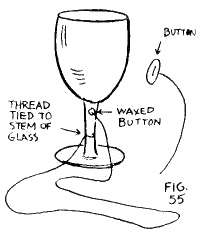
Tie one end of thread to stem of glass and the other end to a small flat button. Place a small piece of wax on button and stick button on stem of glass. Place glass thus prepared on table and you are ready to work. Turn side of glass with button away from audience. Thread is invisible, Figure 55.
TO PERFORM:
Have four cards freely selected, remembered, and replaced one by one in middle of deck. Do the Simplified Pass and get cards to top of deck. Shuffle cards without disturbing four selected cards on top.
Return to stage. Pick up glass and show. Place cards inside of glass with faces toward audience.
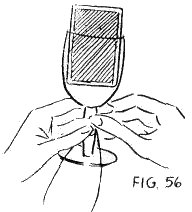
Hold glass by stem in left hand. With right hand remove button from stem, Figure 56.
Attach button to rear card of deck as you did in preceding experiment. Get right forefinger under thread and raise right hand above glass about 18 inches.
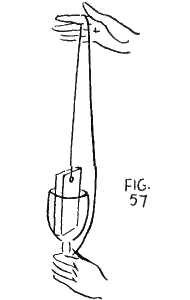
Figure 57 shows view from the side to give you diagram of arrangement of hands and thread.
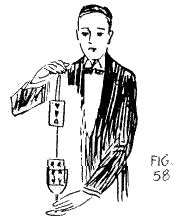
Ask last spectator what card he selected. Then cause the rear card (his card) to rise out of the glass by raising your right hand and lowering your left. Card comes right up to hand.
Figure 58 shows view from audience, except that thread is invisible.
Be careful to have right hand a little to the right so that thread is not in front of white shirt.
Place card in front of deck. As you do so, remove button and hold it concealed between right thumb and finger-tips. Attach button to rear card again and place deck in tumbler. Ask third spectator who selected card to name it, then cause this card to rise. Continue in this routine for all four cards.
The lowering of glass and raising of right hand slightly causes cards to rise without any apparent movement of hands.
Levitation of a Card
A splendid climax for the Rising Cards Through the Air if you are performing on a stage and have two assistants.
EFFECT:
Same as for Rising Cards Through the Air. Then as last selected card rises from deck and remains suspended in air, performer passes his hands around card to show no connection. At command, card rises and drops and finally drops almost to the floor. Then it comes up again to performer's hand.
SECRET: TO PREPARE:
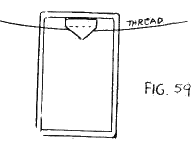
This effect requires a prepared card. Cut a piece from a card, straight at one edge and triangular at the other. Crease triangular end a little and paste straight edge down on back of another card at top. This makes a lip under which thread can be stretched, Figure 59.
Place this prepared card in a pocket which you can reach easily.
Stretch a fine black silk thread across the stage. Have each end held by an assistant in opposite wings offstage. Before performing effect, put thread out of the way by tying it in SLIP KNOT fashion over a nail high up on each side of stage.
TO PERFORM:
In having cards selected FORCE A DUPLICATE OF THIS PREPARED CARD AS THE FIRST SELECTED CARD. After you have had four selected cards returned to deck and have performed the Simplified Pass, this duplicate card is fourth from top of deck and is out of the way. As you go back to stage, get the prepared card and place it on top of deck. Or have assistant place prepared card on tray and you place rest of deck on it as taught to you in a preceding experiment.
In this case, place button on NEXT to top card to cause three selected cards to rise. After three cards have risen, the prepared card is next. This is on top of the deck.
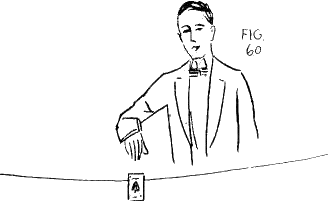
Take cards out of the glass and hold in left hand, cards facing audience. Fingers are in front and thumb behind cards. Hold deck about a foot in front of you.
At this point, have assistants pull on thread enough to slip knots from nails and bring it down in front of you and back of deck so that you can easily hook prepared card on it. Raise right hand a little, apparently causing card to rise as assistants raise thread. Drop left hand with cards to your side, Figure 60.
At command, card is caused to rise and drop at different rates of speed. At intervals you can pass hands above, below and around card to show no connections. When you pass hands over sides of cards, do it behind thread. It looks as though you pass hands directly beside edges of cards.
Finally have card drop down almost to floor, and then quickly rise up to hand, Figure 61.
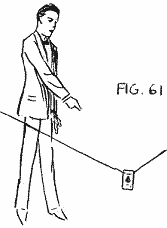
Catch card in right hand and hold as one assistant drops thread and other assistant pulls it clear of card and offstage.
With good SHOWMANSHIP, you can get a wonderful effect with this.
CARD FOUNTAINS
This makes a beautiful effect with cards and adds display to your program with little effort.
EFFECT:
Three cards are selected and shuffled back into deck. Deck is placed in a glass tumbler, which is placed on the seat of a chair. At command, the cards start flying out of the glass, way up into the air. They continue to fly out until only the selected cards remain in the glass. These are then removed from tumbler and shown.
Method 1
This Method is the one used by DeKolta, one of the finest magicians of days gone by.
TO PREPARE:
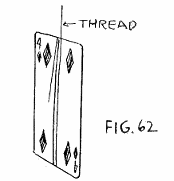
Take a spool of fine black silk thread and start unwinding it. Wrap the end of the thread twice around a card, Figure 62.
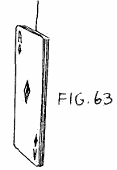
In front of this wrapped card, place three cards. When you perform the experiment you FORCE duplicates of these three cards as selected cards. Remember these three cards for forcing later, Figure 63.
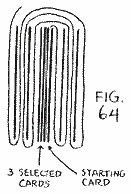
Now you proceed to thread rest of deck. Thread is wrapped around starting card. Now bring it back of card and down. Place another card BACK of starting card and bring thread up around this card, across top edges of the other cards you have placed together, and then down in front of selected cards. Place a card in front of selected cards and bring thread up around this card. Now carry thread over tops of cards again and down in back. Place card behind rest of cards again and bring thread up around it, over tops of cards and down in front of bunch of cards again. Place another card in front and bring thread up around it again. Proceed in this manner to thread the whole deck, Figure 64.
When deck is completely threaded, bring thread down around whole deck and up in back.
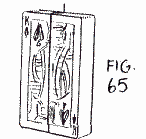
Figure 65 shows the threaded deck as it looks when finished.
Place threaded deck on seat of a chair and run thread up over back of chair and out backstage, where it is secured on a nail in the wall. Assistant can thus get end of thread when time comes for him to pull on it.
Place a silk or pocket handkerchief in front of deck on chair to conceal it.
Have a glass tumbler on chair also.
TO PERFORM:
Pick up another deck, unprepared. Come down to audience and FORCE duplicates of the three cards already placed in center of prepared deck, unthreaded. Have these selected cards well shuffled into deck.
Come back to stage and place this deck next to threaded one behind handkerchief. Pick up glass tumbler
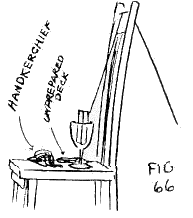
and show it, then replace on seat of chair again. Pick up threaded deck as if it were an ordinary one and place it in glass, Figure 66.
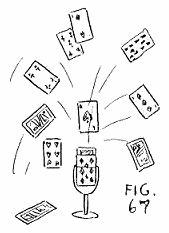
At command, assistant pulls thread fast. All the cards fly out of the glass high into the air, except the three unthreaded ones, Figure 67.
The three selected cards are picked up and shown separately. Call out the name of each.
A little practice will be necessary to get the hang of throwing cards high into the air, but when you have it mastered, you will be well repaid in having a beautiful effect.
NOTE:
In this method it is necessary for the thread to be pulled vertically. That is the reason the thread is run over the top of the chair.
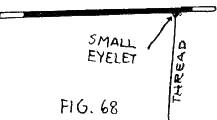
Another ruse which may be used in this one: Screw a small eyelet near end of your wand. Run end of thread from deck of cards through eyelet and out backstage to assistant, Figure 68.
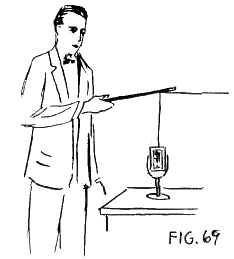
Glass, deck, and wand may be resting on a table with handkerchief screening threaded deck as before. When threaded deck is placed in glass, you have but to raise your wand above deck. Assistant pulls thread and cards fly out. Your wand keeps thread vertical above deck, Figure 69.
Method 2
This method is popular. It requires no vertical pull. A strong pull is required, however, and for that reason it is necessary to clamp glass down on table and table must be heavy enough not to tip easily.
TO PREPARE:
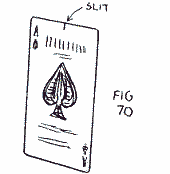
Take each card of deck and cut a quarter of an inch slit in middle of top edge, Figure 70.
Make knot in end of black silk thread and run thread through slit from front to back of first card.
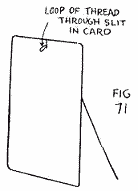
Turn card upside down and back of it place another card with slit end up. Bring thread up behind card. Push it through slit and back again, leaving a half-inch loop on front of card, Figure 71.
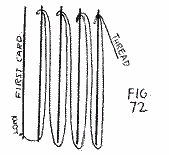
Now bring thread down again. Place another card back of it and bring thread up around it and loop through top slit as before. Continue this until you have the whole deck threaded except for 3 cards. The first card is the only one with the slit end down. The rest are all up with the thread looped through, Figure 72.
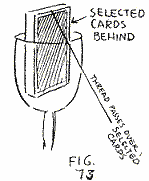
Place three selected cards, duplicates of which you are going to force, on back of deck. Place deck on table with handkerchief screening it. Run thread back over table, through a screw eye at the edge, and out to assistant backstage, Figure 73.
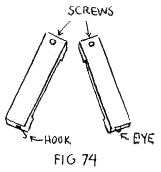
To secure glass to table, use a clamp of wood or metal. The clamp is of two sections. Have them screwed to table the width of the glass stem apart. Have screws at front end and arranged so that the two sections can be swung out. At the back end have a strong hook and eye arrangement for securing two sections of the clamp, Figure 74.
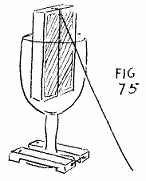
Figure 75 shows glass held in clamp on table. Glass is put between sections and clamp is fastened together.
TO PERFORM:
Take regular deck and force three cards, duplicates of three unthreaded cards in prepared deck. Have cards returned and shuffled into deck. Place it on table behind handkerchief. Show glass and clamp it to table. Pick up threaded deck and place in glass. Upon command cards fly from glass, leaving the three selected ones.
This Card Fountain makes a fine finish to a card act.

TARBELL SYSTEM, INCORPORATED, Chicago.
LESSON 37
A very novel lesson, teaching you most interesting effects in Oriental Magic. Something new and different for you.
Book contents
Introduction
Core card lessons
- Lesson 9 — The Principles of Card Effects
- Lesson 12 — Cards That Pass in the Night and Cards Up the Sleeve
- Lesson 13 — Review, the Regular Pass and Card Stabs
- Lesson 14 — The Force, Card and Orange, and Banana Effects
- Lesson 15 — Card Positions, Palms, Shifts and Discoveries
- Lesson 16 — Card Penetrations Through Boards and Handkerchiefs
- Lesson 17 — Snap It, Flash Production and the Glass House
- Lesson 18 — Rising Cards
- Lesson 19 — More Rising Card Effects
- Lesson 34 — Twelve Impromptu Effects with Cards
- Lesson 35 — Sleight of Hand with Cards
- Lesson 36 — More Card Magic
Additional card effects
- Lesson 26 — A Card and Ribbon Mystery
- Lesson 29 — The X-Ray Cards
- Lesson 31 — Blindfold Card Reading and A Mystic Discovery
- Lesson 45 — Spirit Photography
- Lesson 54 — The Card Slot