Lesson 34 — Twelve Impromptu Effects with Cards
LESSON 34
TWELVE IMPROMPTU EFFECTS WITH CARDS
This series of impromptu card effects will be a very valuable addition to your Magic repertoire. The experiments are all easy to perform but they are most mystifying and make the performer appear to have great magical powers. Every one of them can be done with a borrowed deck, and thus can be used for emergency work. These effects provide excellent entertainment.
1 – A BAFFLING DISCOVERY
EFFECT:
Performer places five cards in a row on the table, turns his back and asks a spectator to look at one of the cards, remember it, and replace it in its original position. Magician then gathers up the five cards, and showing his trousers' pocket to be empty, places the cards in it. He states that he will remove all the cards but the selected one from his pocket. He does so, and finally removes the fifth card and shows it to be the selected one.
SECRET AND PATTER:
Take deck of cards and hold it with backs of cards up. Secretly palm off four cards with right hand and place them in right trousers' pocket, backs outward, as you reach in for a handkerchief.
Have spectator shuffle deck thoroughly.
Count off FIVE cards, one at a time, and place them in a row on table, Figure 1.
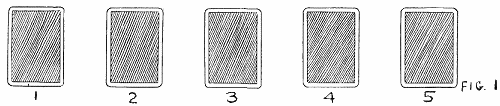
Place rest of deck aside.
"This is really an experiment in psychology to determine certain mental reactions and harmony of thought. I have placed five cards in a row on the table. Beginning with the left, we will number them one – two – three – four – five."
Point to cards as you call them out. Then say to spectator:
"When I turn my back to you, sir, will you please look at one of the cards and remember it. Replace it in its original position so that I cannot tell which one you selected. If you care to, move the other cards a little also. Remember your card and its number in the row."
Permit spectator to select card and replace it.
"Are you ready? All right."
Turn and face audience again. Pick up the cards, starting with number 1. Place it on top of number 2, then both cards on number 3, and so on.
Place cards in left hand, and with right hand show right trousers' pocket empty. This is easily done by pushing the four concealed cards into upper corner, as you have been taught to do. Replace pocket. Take cards from left hand and place them in right trousers' pocket also, BEHIND the four concealed cards. Backs of all cards must be outward.
To spectator who selected card:
"Will you please think of your card for a moment. That's enough. I believe I have the right impression."
Reach into right trousers' pocket with right hand.
"I shall separate the card you selected from the others and remove the four cards which you did not select. The selected card will remain in my pocket."
Remove the four concealed cards (the outermost cards) – one at a time – and place them in left hand with backs to audience. These are the four cards that have been in your pocket from the very first.
"You did not select any one of these so I shall replace them on the table. First, however, what was the number of the card you selected? The second card, you say."
Place the cards in a row again on the table, starting with number 1 and leaving a space for number 2 (or whatever number the selected card happens to be, Figure 2.
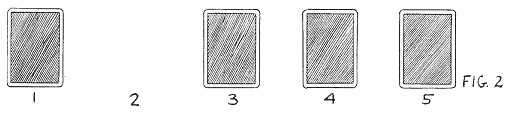
Reach into pocket with right hand. Quickly push out of the way the outer card, which was the first card in the row you placed on the table at the beginning. (If some other card was selected, push forward the proper number of cards to enable you to get at the selected card.)
Lift out the second or selected card and remove it from pocket, back toward audience.
"I reserved a space on the table for the card which I left in my pocket. I believe this is your card."
Turn face of card toward audience and then place it in second position on table.
"The Seven of Clubs (or whatever it may be) is the card you selected."
NOTE:
Regardless of which number spectator selects from the five cards, you will have no difficulty in producing the selected card. When spectator calls number of card, merely push forward the cards not wanted and bring out the selected card. ALL of the original five cards from the table are in your pocket, though spectators think you removed four of them when you brought out the four concealed cards.
Learn to remove any one of the five cards in your pocket without fumbling. You must do it as though there were really only one card in your pocket. The best way to pick out the selected card is to push the top of each card forward with your thumb and hold it between your first and second fingers until you reach the selected card. The first and fifth cards are easy to remove. If number four is called, you can reach it quickly by starting from the rear.
When you finish the experiment, four cards remain in your pocket so that you may repeat the effect once or twice more. Do not be in a hurry to get these four cards out of your pocket when you are through. When you are ready to remove them, place the whole pack in your pocket and then remove it with the four cards. Or, you may perform the Cards Up The Sleeve. As you already have four cards in your pocket, begin by False Counting 8 cards as 12, and then proceed.
2 – ROYAL CARD DISCOVERY
EFFECT:
A deck of cards is shuffled. Performer turns up the top card and shows it (suppose it is a three spot). He places it on the table, back up, and counts other cards on top of it, starting from three — thus: three-four-five- six-seven-eight-nine-ten. He stops at ten and then turns over the next card. Say it is a five spot. He places this down and starts another pile of cards, counting from five to ten. Then he turns over the next card and starts counting another pile from whatever number that card happens to be. Court cards count for ten. If a court card or ten spot are turned up, they are placed by themselves as they already count ten. When the whole deck has been laid out in piles in this manner, performer takes all piles of less than four cards and places them together. Turning his back to the audience, he asks a spectator to select three of the remaining piles and push them aside a little. The rest of the piles are to be placed together and thoroughly shuffled. Magician turns to audience again and asks that one of the three selected piles be chosen. The other two packets are turned over. Magician then names the bottom card of the selected packet, and turns packet over to show that he named card correctly.
SECRET AND PATTER:
Take a full deck of 52 cards, remove the joker, and have the cards well shuffled by a spectator. Lift up the “top” card and show it. Suppose it is a three spot. Place it on table, back up. Begin to count from the number of the card—in this case, three. Place a card from the deck on first card and say, four Continue this until you have counted to ten. This makes a pile of eight cards.
Now turn up the next card and start counting from whatever number the turned up card is until you have no more cards or not enough to make a ten pile.
Repeat this routine of counting to ten from whatever number the turned up card is until you have no more cards or not enough to make a ten pile.
Court cards count for ten. If a court card or a ten spot are turned up, place it by itself for it already makes a ten pile.
When piles are completed, remove all containing less than four cards and place them together, away from the other cards.
“The cards have been thoroughly shuffled and I have divided them into various packets on the table, starting with whatever card was turned up and counting to ten for each packet. In this way, we got a variety of packets. Now, I shall turn my back. Will you, Sir, please select three of the packets and place them aside? Keep the three packets separate and do not expose the faces of the cards. Now gather up the rest of the packets and place them together in one pile.”
Turn to spectator and take this last pile from him, placing it with the first pile you set aside on the table when you gathered up the packets of less than four cards. The three selected piles are now the only ones remaining on the table. Thoroughly shuffle the big pile of cards, which is the whole deck except for the three selected packets.
Fan cards from left to right, faces up, secretly counting off nineteen cards. Separate these with your left little finger, make a jog, or place these 19 cards aside on the table.
“I trust the pack was complete at the start. You have selected three piles of cards while my back was turned. Choose one of these piles and push it aside a little. Now turn over the remaining two packets.”
When two of the three packets are turned over, notice the cards that were on the bottom of each. Assume that one is a four spot and the other a two spot, Figure 3.
If you have removed 19 cards from packet in left hand, fan the remaining cards to the right. If you have merely separated these 19 cards, fan only those cards under your little finger, disregarding the 19 cards. Add the numbers on the two exposed cards of the selected packets — in this case, four plus two, making six. Count off six cards mentally from those fanned in your left hand.
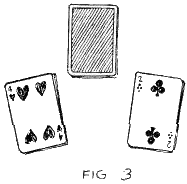
The number of remaining cards will tell you the number of the bottom card of the selected packet. If five cards remain, then that concealed card is a five spot, and so on.
"We have one pile left. None of us know what the bottom card is on that packet. That is where Magic comes to the rescue. A little spirit of Magic jumps on my shoulder and whispers in my left ear that the bottom card on the selected pile is A FIVE SPOT!"
Turn over the selected packet and show the card to be a five spot.
NOTE:
This effect works on a mathematical principle and will never fail you if you do each move properly.
3 – BIRDS OF A FEATHER
EFFECT:
A deck of cards is thoroughly shuffled. Spectator then cuts deck into two portions, gives one to the performer and retains one himself. Spectator is then asked to remove a card from those he holds and place it on the table. Performer also removes a card from his packet, shows it, and places it on the table. Assume that it is the Ten of Diamonds. Magician then places spectator's packet on top of his and shuffles them together. Spectator then cuts deck in half again and places his selected card – say, the Jack of Spades – on one half of the deck. About half of the remaining packet of cards is placed on top of his card and then performer places his selected card on top of that. The rest of the deck is placed on his card. Though the two cards are widely separated in the deck, the Magician causes them to come together and in a moment shows them to be side by side.
SECRET AND PATTER:
Have deck shuffled by spectator, then say to him: "Cut the deck, please, and keep the packet that you lift up."
You pick up the remaining packet and place it in your left hand, backs of cards up. Fan cards a little to the right and place little finger of left hand under top two cards. Square cards again.
"Now, sir, remove any one of the cards in your packet. look at it, and place it on the table. I, too, shall take a card at random."
Do the Double Card Lift with the upper two cards of your packet and show the outer or second card. Suppose this card is the Ten of Diamonds and the King of Hearts is the top card concealed back of it.
Replace the two cards on your packet and slide the top card a little to the right with your thumb.
"My card is the Ten of Diamonds. I shall place it on the table also."
Place your card, really the King of Diamonds, on the table, back up. Audience believes this card to be the Ten of Diamonds, but the Ten is on top of your packet.
"Now place your packet on top of mine."
Have spectator place his cards on top of yours. Keep the two packets separated by your left little finger, in readiness for the pass.
Riffle shuffle the cards once, being careful to keep the Ten of Diamonds as the top card. Then turn your left side toward the audience, lift up the back packet and shuffle it in front of the other as you were taught to do in the Simplified Pass. The Ten of Diamonds is brought to the top of the deck in this matter.
Now place deck on table. Ask spectator to cut cards again and place the packet he lifts up on the table.
"Please cut the cards again, sir, and place the portion you lift up on the table. Now place your selected card on top of the part you just cut from the deck. By the way, what is your card? The Jack of Spades?"
Spectator places his card on the packet. Unknown to himself and the audience, this brings his card on top of your selected card, the Ten of Diamonds.
"On the Jack of Spades, we shall place a few other cards. Lift off a few cards from those I hold in my hand and place them on top of your card. Now, I shall place my card, the Ten of Diamonds on all these."
Take your card from the table and place it on the packet on the table. Then put rest of deck on top of your card. Square up the deck.
"I have completed the! deck by placing the rest of the cards on top of my Ten of Diamonds. Note carefully that your selected card and my selected card are separated by a number of cards. Your card is the Jack of Spades and mine is the Ten of Diamonds. Strange as it may seem, certain cards in the deck are like the birds of a feather that flock together. It is impossible to keep them apart. Your card and my card often act that way. Will you cut the cards again, sir?"
Have spectator cut the cards and place bottom pile on top.
"Cut them once more."
Have him repeat the cutting.
"Now, look through the deck and you will find that your card, the Jack of Spades, and my card, the Ten of Diamonds, have come together somewhere in the deck."
Spectator runs through cards and finds both of the selected cards together.
NOTE:
This effect rests on the law of probability. You count on the chance that the two selected cards will not be separated in the cutting. They rarely are, but if it happens that they are, merely pass it off with some appropriate remark and repeat the experiment.
4 – THE THOUGHTFUL JOKER
EFFECT:
Performer removes the joker from the deck and places it on the table. He then has the cards divided into two even heaps. A spectator is asked to remove any card from one heap, remember it, and place it on the other heap. A second spectator is asked to remove a card from the second heap, remember it, and place it on the first heap. The two packets of cards are then placed together and cut several times by a spectator. Magician picks up the Joker and says that it catches mental impressions from the audience. He then takes the deck of cards and tells the spectators who selected cards to watch as he fans the cards and to name to themselves their cards as they appear in the fan. Performer fans the cards, a few at a time, until the whole deck has been fanned. He now picks up the Joker again and names the two selected cards, supposedly getting the impressions from the Joker.
SECRET AND PATTER:
Deck is shuffled. Look through cards quickly to find the Joker, and as you do so, notice the two "Top" cards. Let us say they are the Eight of Spades and the Ten of Clubs. These are to be the KEY cards. Remember them.
Remove Joker from deck and place on table, face up.
"The Joker is often removed from the deck because he is more or less of a nuisance, but. in reality, the Joker is one of the wisest of cards. The Fool of the Court in olden days was many times the wisest man, and so it is with the Joker. He is very sensitive to impressions."
Riffle shuffle the deck, leaving the two Key cards on top of the deck.
"First, let us divide the deck into about equal portions."
Lay down the top card on the table, then about a foot away, place the second Key card. Now deal rest of cards, one at a time, one each of the Key cards so as to make two piles. After you have done this for a while, give rest of cards to spectator and let him continue doing it.
"Just place the cards on both piles several at a time to hurry matters. Just so we have two piles of cards when you have finished. All right, that's fine. Now, reach into the pile here on the left and remove a card. Do not let me see it, but look at it yourself and remember it. Then place that card on the pile at the right."
When spectator has placed his selected card on top of right pile, turn to another spectator.
"Will you, sir, please take a card from the right pile, remember it, and place it on top of the left pile?"
Second spectator removes card, looks at it, and places it on the left pile. Then ask him to place the two piles together.
"Place one pile on top of the other, square them up, and then cut the deck a couple of times."
Cards are squared up and cut twice.
Now pick up the Joker.
"The Joker, as I said, has a peculiar way of catching mental impressions, and I shall depend on him to catch your impressions as they flash by."
Replace Joker on table.
"I shall fan a few cards from the deck…."
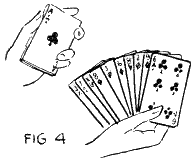
Remove seven or eight cards from the deck and fan them, faces toward spectators who selected cards, Figure 4.
"And as I show the cards, look at them and see whether your cards are among them. When each of you gentlemen sees his card, make a strong mental impression of it by saying the name of it to yourself. Don't say anything aloud, only think it."
As you fan the cards, a few at a time, look for your Key cards — the Eight of Spades and the Ten of Clubs, in this case. If the first card on the "Bottom" of the deck happens to be a Key card, then the "Top" card at the other end of the deck is a selected card. The other selected card will be IN FRONT of the second Key card. If the first card is not a Key card, then look through the rest of the deck as you fan the group of cards, watching for the Key cards. The card in front of each Key card is a selected card.
NOTE:
This is the reason why the selected cards appear in front of the Key cards: A Key card is at the bottom and a selected card is at the top of each pile of cards. When the two piles are put together, the Key card on the bottom of one pile comes on top of the selected card at the top of the other pile. Then when the deck is cut, the Key card on the bottom of the second pile comes on top of the selected card at the top of the whole deck.
After you have made a mental note of what the selected cards are and have fanned the whole deck through and placed each group on the table, pick up the Joker.
"Each of you gentlemen made a mental impression of your respective cards, did you not? I gaze at the Joker, and he! says that he gets an impression that your card, sir, is a red one — hearts — the Nine of Hearts. And you, sir, thought of a spade — the Ace of Spades. Those were the two selected cards. Is that right? Correct! The Joker seldom fails."
5 – CARD APPEARANCE AT SELECTED NUMBER
EFFECT:
Spectator selects a card and remembers it. Card is replaced in deck and thoroughly shuffled into it. Deck is then placed on the floor or on a table. Another spectator is asked to name any number between five and ten. Assume that seven is chosen. Spectator counts the cards from the top of the deck, and when the seventh card is turned over, it is found to be the selected card.
SECRET AND PATTER:
Force a card on a spectator, say the Nine of Hearts. You learned how to FORCE a card in an earlier lesson.
"Remember the card please, and if you care to, show it to a few of your neighbors. Take the pack in your own hands, place your card in it, and shuffle the cards well."
Give deck to spectator, and when he has replaced selected card and shuffled deck, take it from him again.
"To convince you further that your card is well shuffled and lost in the deck, let me run the cards through hurriedly before you."
Fan the cards and run over them quickly. As you do so, notice the Nine of Hearts. Starting with the card behind it, count SIX cards and place second and third fingers of right hand behind the SIXTH card to keep track of it. Do not hesitate while doing this, so that audience will not suspect anything. Continue running through the whole deck.
Now separate deck at a point where you have SIXTH card and place the packet in right hand behind packet in left. This brings the SIXTH card on "Top" of the deck.
You may now riffle shuffle the deck, being careful not to disturb the top seven cards of the deck.
Place deck on table or floor.
"Will you, sir, please select the first number that comes into your mind BETWEEN five and ten."
Accent the word – between – and in most cases, the spectator will say – seven.
"What is your number, please? SEVEN? I shall then cause the selected card to appear at Number Seven in the deck. Count the cards off one at a time from the top of the deck."
Let spectator count off six cards, and then stop him.
"Just a minute, before you count farther."
Turn to spectator who selected card and ask him again what his selected card was. Repeat it with emphasis – THE NINE OF HEARTS.
Then have second spectator turn over the seventh card and show it to audience.
"The seventh card is the NINE OF HEARTS. Correct, sir!"
NOTE:
If spectator chooses some number other than seven, you must not be disconcerted. Be prepared for such an emergency.
If he says five or ten, tell him you want a number BETWEEN five and ten. If he chooses number six, have second spectator count down six cards and then tell audience that you will cause the selected card to appear next to the sixth card. If number eight is called, slip one card from the bottom to the top of the pack or use this ruse: Show the bottom card and say, "That isn't your card, is it? All right, then I shall cause your card to appear the eighth card from the top of the deck." Place this card on the deck and have spectator count down eight cards. If spectator chooses number nine, work it this way: Fan the deck slightly, faces of cards up, and get left little finger under the "bottom" two cards. Square up the deck. Grasp the two cards in your right hand and show as ONE. Then proceed as you would if number eight were called. If you desire, you may permit spectator to choose number ten and work it by showing THREE cards from "bottom" of deck as ONE, then placing them on top of deck and having spectator count down ten cards.
SUGGESTION:
The above effect may be performed without Forcing a card Cut the pack in readiness for the Pass. Have selected card placed on lower packet. Spread bottom of upper packet a little so that you can count off six cards from the bottom quickly. Let these six cards fall on selected card and insert left little finger over them as you square up the deck. Now perform the SIMPLIFIED PASS by shuffling the top packet in front of the bottom one. This leaves the selected card SEVENTH from the top of the deck.
6 – THE CHANGE-ABOUT CARD
EFFECT:
Spectator selects a card and returns it to the deck, which is then thoroughly shuffled. Performer says that he will cause the selected card to jump to the top of the deck. He then shows the top card of the deck and it is NOT the selected one, so he places it on the table. Twice again he fails to make the selected card come to the top, and each time he places the card on the table. A spectator is then asked to choose one of the three cards and the chosen card mysteriously changes into the selected one.
SECRET AND PATTER:
Have spectator draw a card from the deck, remember it, and then return it to the deck where you cut it. Place your left little finger over the selected card and do the SIMPLIFIED PASS, bringing the card to the top.
Hold deck in left hand, backs of cards up. Fan deck a little to the right so that you can insert left little finger under the top three cards. Square deck. Say to spectator who selected card:
"Before going any farther, let me ask you — is the top card your card?"
Pick up the three top cards as one with your right hand and show the third card as the top one.
"It is not."
Replace the three cards on the deck and square up. Fan cards again and get little finger of left hand under top two cards. Square deck.
"In that case, it might prove an interesting experiment to cause the card you selected to appear instantaneously on top of the deck."
Lift the two cards as one and show second card.
"This, then, is your card, is it not?"
Spectator denies it, of course. Release cards on deck and square up, immediately slipping top card halfway off the deck into right hand.
"That is peculiar. I seldom make a mistake like that. I will just lay this card down on the table and try again."
Cut deck and riffle the cards once.
Place top card on table.
"We should be successful this time."
Lift up top card again and show.
"Is this it? No? That is, indeed, strange!"
Place card on table a few inches to left of first card placed on table.
"The third time should surely be successful."
Riffle cards once again and lift off top card.
"No? This isn't your card either? We'll toss that one here."
Place third card at right side of first card a few inches away.
Figure 5 shows arrangement of cards with selected card in the middle.
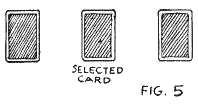
"Three times I have failed to discover your card. Please touch one of the three cards on the table now."
If you lay the cards so that the middle one is nearest the spectator, he will usually touch that one. If he does, then say:
"Just keep your hand firmly upon it."
Turn the other two cards face up.
"I have given you free choice of any of the three cards which you say are not yours. Therefore, your card is some place in the deck. By the way, what was your card? The Queen of Diamonds?"
Riffle deck with left thumb.
"Did you hear that noise? When I ran my thumb over the cards, I caused the card under your hand to jump suddenly up into the deck and change places with the selected card. which is now under your hand. Lift up that card. Is it your selected card, sir? It is!"
Have spectator show card.
NOTE:
In case spectator selects one of the two end cards instead of the middle one, then push that card aside, turn it over, and say that you will eliminate that one. Ask spectator to choose one of the two remaining cards. If he takes the selected card, finish the experiment as before. If not, merely discard the other card also and proceed with experiment.
7 – FIND THE BURGLAR
This experiment is adapted from Jack Merlin's popular effect.
EFFECT:
Two kings are moved from the deck. A card is chosen and returned to the deck, and then the deck is shuffled. First one king is placed in the deck and next to it the other one is placed, both extending about half way. Performer states that the kings are very clever detectives and a burglar could not escape them. Supposing that the selected card is a burglar, it will not take long far the kings to find him. Magician moves kings up and down. Suddenly he pulls them out of the deck and shows the selected card to be between them.
SECRET AND PATTER:
Remove two kings from the deck and place them on the table. Fan rest of cards and have one selected.
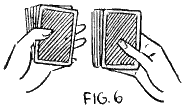
Square up deck and fan it again, separating deck about in half. Hold one portion in each hand, Figure 6.
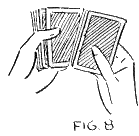
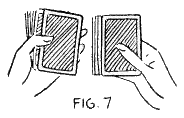
Have selected card placed on top of left-hand portion. With left thumb push it over to right about half an inch, Figure 7.
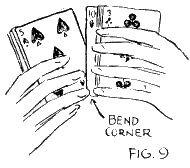
Place packet from right hand on left-hand portion, and as you do so, bend the lower right-hand corner of selected card with third finger of right hand, Figure 8.
Figure 9 shows view underneath the cards. Selected card should project enough so that you can bend the corner easily.
Square up the cards and pass to a spectator to shuffle overhand.
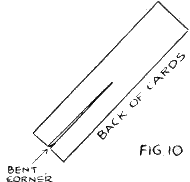
Turn cards up now so that one can see bent corner at top edge. Audience, of course, must not see it, see Figure 10.
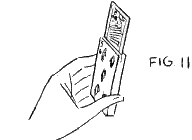
Pick up one of the kings from the table and insert it into the deck in front of the selected card. You give the impression that you are inserting it at random anywhere in the deck. Insert king about half way, Figure 11.
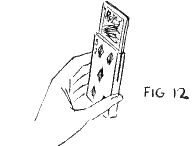
Pick up the other king and insert it in similar manner BEHIND the selected card. The result is the selected card is between the two kings, Figure 12.
"Few people realize that the kings in a deck are really wonderful detectives. Very few things escape them. Should a burglar get into the kingdom, he would have little chance against the wit of these two kings. For instance, let us say that the card the gentlemen selected here is a burglar and that he has been shuffled somewhere among the many other inhabitants of the deck. Though you or I might have difficulty in finding him, it is but a moment's work for the kings to locate him."
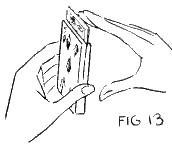
Hold the deck at the sides in your left hand. Tap the kings a little, pushing them downward about an inch. Pull them up again and repeat until the selected card has come up even with the kings. Each time you raise and lower the kings, the middle card automatically comes upward, Figure 13.
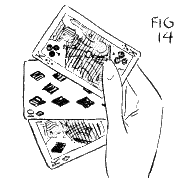
Pull kings from deck and fan them, showing the selected card to be between them, Figure 14.
"Was this your card, sir? The Ten of Diamonds? There it is right between the kings."
8 – THOUGHT LOCATION
EFFECT:
Spectator is asked to shuffle deck of cards, then to count down any number he desires and remember the card at that number. Performer's back is turned while spectator does this. Magician then takes pack and says he will locate the card and place it in his pocket. He removes a card from deck and places it in his right trousers pocket. Cards are then counted down to spectator's number in the deck and selected card is found to have vanished. Performer then removes selected card from his pocket.
SECRET AND PATTER:
Give deck to spectator to shuffle. Have him hold deck with back of cards up.
"Now, sir, count down any number of cards you like and remember the card at that number. For instance, if you counted down eight cards, look at the eighth card. If it should happen to be the Nine of Spades, say to yourself, 'The eighth card is the Nine of Spades.' Do not disturb the order of the cards as you have already shuffled the deck. Remember your card and number so that we can locate the card readily later on."
Turn your back toward spectator while he counts cards and remembers one at selected number.
"After you have noted card at selected number, square up the cards evenly."
When he has done this, turn and face spectator and take deck in your own hands.
"Because of the fact that you have chosen your own number, looked at the card at that number, and squared up the deck, it would seem almost impossible for me to locate your card instantly. Yet that is just what I am going to do. I am going to remove your card from the deck."
Reach into deck and quickly remove a card about from the middle of it. Do it in a hurry so that spectator cannot see just where the card came from in the deck.
"I shall place the card in my pocket."
Keep back of card to audience and place it in your right trousers pocket. Audience believes this to be selected card.
When hand is in pocket, PALM the card and remove right hand with card in it. Place right hand on top of deck in a casual manner, leaving the card there. Whatever number selected card happens to be, this card adds one more number to it.
"Naturally, you are a bit suspicious as to whether the card I placed in my pocket is really your card. First of all, let me ask you what the number of your card is."
Assume that spectator says his card is twelfth from the top.
"The twelfth card from the top. Let us count down twelve cards."
Count off twelve cards, one at a time, into spectator's hand.
"Please look to see whether the twelfth card is yours."
The moment his attention is MISDIRECTED to see what the twelfth card is, PALM off the thirteenth card in your right hand and place it in your right trousers pocket. This is the selected card.
"The twelfth is NOT your card. you say. Well, perhaps, the one I placed in my pocket is your card."
Remove card from pocket with back of it to audience.
"What was your card, may I ask?"
Spectator names card.
"The Nine of Spades. I thought so."
Turn card over and show to audience.
9 – ANOTHER METHOD FOR CARD IN THE POCKET
EFFECT:
Performer asks spectator to think of any number between one and ten, then to count down from the top of the deck and note the card at that number. Performer then takes deck and places it behind his back for a moment. He removes a card from the deck and places it in his pocket. Spectator then counts down to his number again and finds his card gone. Magician then removes it from his pocket.
SECRET AND PATTER:
Have spectator shuffle cards well.
"You have thoroughly shuffled the cards, making it impossible for either of us to know the location of the cards. Hold the deck with backs of cards up. I am going to try to perform an experiment in thought reading with cards. First, think of any number between one! and ten. Have you done that? Now, while my back is turned toward you, count down that number of cards from the top of the deck and note the card at your number. Do not disturb the order of the cards after that as we must keep in mind the location of your card from the top of the deck. After you have done this, square up the deck and give it to me."
Have your back turned while he does this, then turn and face spectator and take the deck.
"As you perhaps know, the fingers and brain are very close-ly connected in impressions — so much so, that by placing the cards behind my back, I can sense the location of your card."
Place cards behind your back and quickly count off ten cards into your right hand. Square these ten cards up and hold them as ONE card. Show them for a moment, backs of cards to the audience. Then place them in right trousers pocket.
"That, I believe, is your card. But, let us check up first. Take the pack in your own hands. What was the number of your card? SEVEN (or whatever it happens to be). Count down seven cards and see whether the seventh card is your card."
As spectator counts the cards and audience watches him, place your right hand in your right trousers pocket and locate the SEVENTH card. You have ten cards in your pocket so regardless of what number the spectator chose, you can readily locate his card.
Remove the selected card from your pocket with back to audience.
"You say the seventh card is NOT your card. What was the card?"
Assume that the spectator names the Jack of Hearts.
"What a strange coincidence."
Turn card to audience and show it to be the selected one.
10 – THE MYSTIC CARD CLOCK DIAL
This is similar in principle to the effect just described, but has a slightly different effect.
EFFECT:
Twelve cards are placed on the table, backs up, to represent the numbers on a clock dial. A spectator is asked to think of any hour on the dial, and while performer turns away, to look at the card at that hour. Magician then gathers up the twelve cards and places them on the deck. He holds deck behind his back, removes a card, and places it in his pocket. He asks spectator to name the hour selected. He then places eleven cards in dial form on table again, leaving a space at the chosen hour. He removes the card he just placed in his pocket and shows it to be the selected card.
SECRET AND PATTER:
Have deck well shuffled by spectator. Place cards on table in a circle to form the numbers of a clock dial. Count them as you place them down, starting with One o'clock, Figure 15.
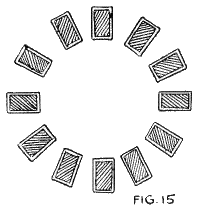
"This is what is known as the magic clock dial and was a popular means for communicating time from one magician to another in centuries gone by. For instance, if a magician wanted to make a date with another magician who lived at a distance, he would merely select the hour, turn over the card at that hour for a moment, and then replace it again. Suppose he wanted to meet his friend at four o'clock. He would turn over the card at number four."
Turn over fourth card and show it. Then turn back of card up again.
"Then he would turn the card over again. Instantly, on a similarly arranged clock dial in his friend's home, a duplicate card would turn over. Rather peculiar, I assure you. However, seeing is believing. While my back is turned, please choose any hour, turn over the card at that hour. remember the name of the card, and turn it back to its original position with its back up."
Turn your back to spectators. After your instructions have been followed, face audience again.
"You have thought of an hour and noted the card at that hour."
Pick up the cards, starting with ONE. Place ONE on TWO, TWO on THREE, etc. until all have been picked up. Square up the twelve cards and place them on the deck, keeping them separated by left little finger. Place deck behind your back.
"With the cards behind my back, I shall locate the card you selected. Quite easy as the selected card automatically turns over. Here it is now."
Hold the twelve cards as ONE, show quickly, and place them in your right trousers pocket.
"I shall place it temporarily in my pocket."
Bring pack up in front again.
"In order to check up, let us arrange the other cards in form of a clock dial again. What was the hour you selected, sir? Six o'clock, the gentleman says."
Lay the cards down, starting with ONE o'clock and count the hours aloud, leaving a space for Six o'clock. Place rest of deck aside, Figure 16.
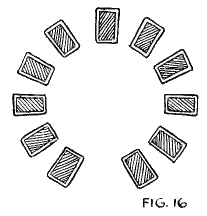
Lay cards down with left hand. At the same time, place right hand in your trousers' pocket and locate the SIXTH card. Place it in front of the others so that you can reach it quickly when you need it.
"The Sixth card is missing from the clock."
Remove the selected card from your pocket and place it, face up, at six o'clock on the dial.
"Does this happen to be the card you selected? It is. Then all is well."
NOTE:
You may repeat the experiment in this manner. Have a card selected again. Then gather up the twelve cards and place them in your pocket BEHIND the eleven cards you already have there. Remove the eleven cards and place them on table, saying that the selected card still remains in your pocket. When you learn the number of the card, locate it quickly, and bring it out.
11 – LOCATION OF CARDS IN A HAT SHUFFLE
EFFECT:
Several cards are selected, marked if desired, and returned to deck. Deck is shuffled and dropped into a hat. Inside of the hat, cards are thoroughly shuffled around. Spectator is then asked to hold hat. Performer reaches into hat with his right hand and brings out, one at a time, the selected cards.
SECRET AND PATTER:
Deck is shuffled. Have several cards selected and removed from deck. Each spectator may mark his card for identification.
Divide deck into two equal portions and have first spectator place his card on lower half. Place upper portion on this, keeping little finger of left hand over selected card. Riffle front edge of cards to give impression that deck is all together.
Go to second spectator. Divide deck again at point held by little finger and have second selected placed on top of first one. Spectators believe that you merely cut the deck at random each time to receive spectator's card. Close pack again with little finger in position.
Continue this until all selected cards have been gathered up. They are all together on top of the lower half of deck, over which you are holding your little finger.
Do the SIMPLIFIED PASS, bringing all the selected cards to the top of the deck. Also riffle shuffle the deck without disturbing position of selected cards.
"Several cards have been selected and returned to the deck and then shuffled well into the deck. To mix the cards even more, I shall drop them into this hat."
Drop cards into a derby or soft hat with a flat bottom. Place the cards with backs up. Shake the hat vigorously from side to side as though mixing the cards up. In reality, you can shake the hat from side to side without disturbing the order of the cards. Try it. They slide back and forth a little but do not mix. A little practice will give you the knack, Figure 17.
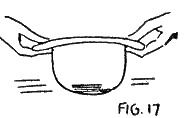
You may even give the hat an occasional shake up and down without disturbing the cards if you do it carefully.
"Now, I shall ask you, sir, to hold the hat up high for a few moments. You can first see that the cards are well mixed."
Let spectator look into hat and have him square up the deck. Then have him hold the hat up high enough so that no one can see into it.
Show both your hands, fingers wide apart.
"Ordinarily, it would be impossible to locate cards in such a mixed condition, yet, I find with sensitive fingers and an impressionistic mind that strange things happen."
Turn to spectator who placed his card in the deck last. His card is the top one on the deck.
"What was your card, sir? The Five of Hearts?"
Show right hand empty and reach into hat. Pull out top card and show it.
"There you are, sir. The Five of Hearts. Next!"
Continue this production of selected cards, taking the spectators in the reverse order in which they place their cards back into the deck.
12 – SELECTED CARDS FROM SPECTATOR'S POCKET
EFFECT:
Three cards are chosen, returned to deck, and shuffled in. Deck is placed in the empty inside coat pocket of a spectator. When Magician counts Three, spectator reaches into his pocket and produces one selected card. This is repeated until all three selected cards have been produced.
SECRET AND PATTER:
After deck has been shuffled, have three cards selected by three spectators. Have the three cards returned to the deck as you did in the preceding experiment. They come on top of lower part of deck with little finger over them in preparation for the SIMPLIFIED PASS. Make the Pass and get cards to top of deck.
Riffle shuffle the deck, keeping the three selected cards at top of deck. Have a spectator come forward to assist you.
"Have you ever given a magical performance, sir? No! Good! Then, I shall let you give one this afternoon. I noted. as you were sitting there, that you possessed unusual magic powers. May I have the loan of your inside coat pocket?"
Sometimes a comedy touch is added here as spectator removes various papers and articles from his pocket.
"By using your own pocket, your magical powers will be strengthened."
Place the deck of cards in his pocket with backs of cards outward when coat is closed.
"As you know, three cards have been selected by various spectators, senators, office holders, and others in the audience. These were returned to the deck and lost somewhere in the shuffle. I really shouldn't say lost, even though to the rest of us they are lost, for I believe that at this very moment you, sir, know the exact position of each selected card."
Turn to spectator who last placed his card on the deck.
"May I ask the name of your card, sir? The Seven of Clubs?"
Now say to spectator assisting you:
"Hold your coat open with your right hand, and when I count THREE, reach into your pocket and with lightning-like rapidity, draw out a card with your left hand. Do not hesitate a moment, reach in, grab a card, and bring it out right away. Are you ready? One – two – three!"
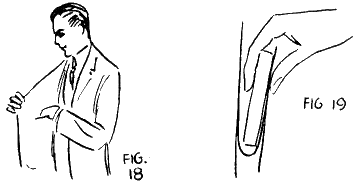
Spectator reaches in quickly with left hand and grasps the card easiest to get at for you rush him. The card he invariably takes is the top card of the deck. When coat is held open, faces of cards are outward. When spectator reaches in, the farthest card away is the easiest for him to grasp, Figures 18 and 19.
"There you are, sir, the Seven of Clubs. Like lightning. he finds them."
Continue this with the second spectator who selected a card, and finally with the first. When the three cards have been produced, take the deck from spectator's pocket.
"Tell your friends anything about your magic power, and if they didn't believe you before, they will now."

TARBELL SYSTEM, INCORPORATED, Chicago.
LESSON 35
Your next lesson gives you some master moves and manipulations in the field of Sleight of Hand with Cards. Some very interesting effects that will prove a welcome addition to your repertoire are also given you. This lesson is extremely valuable to you in developing your skill with cards.
Book contents
Introduction
Core card lessons
- Lesson 9 — The Principles of Card Effects
- Lesson 12 — Cards That Pass in the Night and Cards Up the Sleeve
- Lesson 13 — Review, the Regular Pass and Card Stabs
- Lesson 14 — The Force, Card and Orange, and Banana Effects
- Lesson 15 — Card Positions, Palms, Shifts and Discoveries
- Lesson 16 — Card Penetrations Through Boards and Handkerchiefs
- Lesson 17 — Snap It, Flash Production and the Glass House
- Lesson 18 — Rising Cards
- Lesson 19 — More Rising Card Effects
- Lesson 34 — Twelve Impromptu Effects with Cards
- Lesson 35 — Sleight of Hand with Cards
- Lesson 36 — More Card Magic
Additional card effects
- Lesson 26 — A Card and Ribbon Mystery
- Lesson 29 — The X-Ray Cards
- Lesson 31 — Blindfold Card Reading and A Mystic Discovery
- Lesson 45 — Spirit Photography
- Lesson 54 — The Card Slot