Lesson 31 — Blindfold Card Reading and A Mystic Discovery
BLINDFOLD CARD READING
This bit of mental work is particularly mystifying because of the use of a blindfold.
EFFECT:
Performer divides a deck of cards into two parts. He gives these halves to two spectators and has them shuffle the cards. One of the spectators is asked to pass through the audience and have about ten cards selected, one at a time. The other spectator is then asked to collect the cards, having each member of audience put his own selection into his half of deck. A third spectator is then asked to shuffle cards again. Magician then passes a blindfold out for examination. He goes back to stage and blindfolds himself. He states that he will pass the cards off one at a time with faces to audience and will pick cards selected. In rapid succession, Magician tells cards selected and names them.
PARAPHERNALIA:
1 — A deck of cards. 2 — A blindfold. This should be made of black velvet or velveteen, doubled and about two inches wide. Sew black braid or tape at each end to make tying on easy. SECRET AND PATTER: To Prepare:
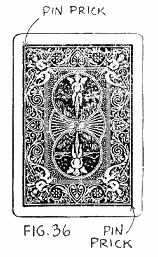
Thoroughly shuffle deck of cards and divide it into halves. Take one of the cards and at two opposite corners on the back prick a hole with a pin. Make these holes just within the printed part of card so that they will not be noticeable, see Figure 36.
Now force the pin through from the face of the card also, so that pin prick can be felt on back of card.
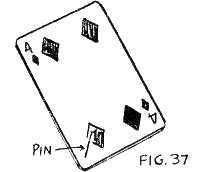
Use this card as a guide. Place it on another card of this packet, faces of both up, and using holes for guide, push pin through bottom card at opposite corners, Figure 37.
Do this with the guide card for rest of this half deck. The pricks are made in opposite corners so that regardless of position of card, pin prick can be felt at lower right corner on back of card.
The other half of deck is left unprepared. Place prepared half, faces of cards up, in left palm. Notice first card of prepared half. Then place unprepared half on top. By remembering first card, you can easily find place to divide the two halves of deck when time comes.
Have blindfold in coat pocket.
To Perform:
Come forward with cards in left hand.
"I have an interesting experiment here in which I use a deck of cards as a fairly rapid method of gaining control of thought waves. I am going to divide the deck into two halves and give one-half to one gentleman here and the other half to another gentleman over here."
Fan cards a little, separate them at key card, and hold half of deck in each hand.
"Will each of you please thoroughly shuffle the cards?"
Give each of two spectators half of deck. Then say to one holding unprepared half:
"That done, I am going to ask you, sir, to go to about ten or so members of the audience and have each select any card he chooses from your half of the deck and hold that card."
Now, to gentleman with prepared half:
"And you, sir, will you please follow the gentleman and have each spectator who selects a card place his card anywhere in your half of the deck?"
After cards have been selected and returned to prepared half of deck, take remainder of unprepared cards and casually drop them in your right coat pocket.
Take prepared half with selected cards in it.
"I believe that you have collected all the selected cards, have you not? Is there any card which has been missed? I believe not. Now, sir, will you please shuffle the cards thoroughly to mix them up well?"
Give cards to spectator to shuffle, then take them again.
Take blindfold from coat pocket and give to spectator to examine.
"In work of this kind, I find that darkness helps me to gain rapid mental impressions, and for that reason, I have my eyes blindfolded. Will you, sir, please examine this black velvet bandage? You will notice that the bandage is very heavy so as to exclude all light."
Take blindfold again. Go up to stage, place cards on table, and blindfold your eyes. You will find that because of the heaviness of the velvet, the blindfold does not fall in to your cheeks at the bottom and you can easily see under it. Audience believes that you are unable to see, but in reality you can see objects close to you. If you bring a card close to you suddenly, you can get a glimpse of it. Experiment with the blindfold to test its possibilities for yourself.
Pick up cards again and hold in left hand, faces of cards toward audience.
"You notice that I have had a number of cards freely selected and returned to the deck and then thoroughly shuffled in. It is impossible for me or anyone else to tell the location of such cards at the present moment. However, I shall pass the cards one at a time from my left hand to my right, and when you who have chosen cards see your card, concentrate on it and think of it to yourself. I shall endeavor to catch your thoughts and stop at your cards."
Begin passing the cards by reaching over with right hand and taking rear card. Hold it up for a moment.
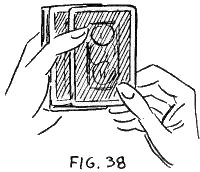
As you take the card, run your right thumb over lower right corner of card to determine whether it has a pin prick in it or not, Figure 38.
The SMOOTH cards are the selected ones. Pass the cards along, feeling for the pin prick on each one, until you come to a smooth card. Hold it up.
"I get the impression that this is a selected card. Who selected this card? Speak out, please, and say, 'here'."
As you say this, make a gesture with the card to bring it close to your body and thus get a glimpse of the card by looking down under your blindfold. The movement is in toward your body and out again at once so that audience sees it just as a gesture and does not suspect anything.
"The Ten of Diamonds — is that correct? Thank you."
Drop card to floor or table.
Continue this until you have run through all the cards. Hold each card up for an instant, then drop to floor or table. When you come to a selected card, ask who selected it, and name the card.
"I have discovered each and every card."
Remove blindfold with a quick flourish and make a slight bow.
A MYSTIC DISCOVERY
Another ingenious mental effect with cards.
EFFECT:
Performer has a deck of cards thoroughly shuffled by a spectator and has him select a card and place it in his pocket. Another spectator takes the deck and also selects a card and keeps it. Magician now takes from his pocket a watch chain. The first spectator is asked to hold the free end of it, and the Magician then tells him the name of his card. The second spectator then holds the watch chain and is also told the name of the card he selected.
PARAPHERNALIA:
1 — Deck of cards. 2 — A watch chain. SECRET AND PATTER: To Prepare:
A set of marked cards are used in this experiment. Even though they are shuffled, performer can tell at a glance which cards have been selected by looking at the edge of deck.
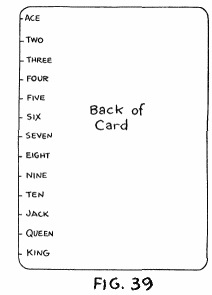
First make a KEY CARD. Take one of the extra cards with advertising on, which usually come with a deck — or use the joker. Mark this card on the back as shown in Figure 39.
Now continue these marks over the left edge of the card so that they can be seen when card is held with only this edge toward you. Use a pencil in marking. You are now ready to mark the deck.
Pick up a card and place it on the Key Card — backs of both cards up. Say the card is an Ace. Make a little dot on the EDGE only of the Ace just at the point where the marking for Ace is on the Key Card.
To differentiate between suits, use this code:
For a Club – one dot.
For a Heart – two dots, close together.
For a Spade – three dots, close together.
For a Diamond – a short line along the edge of the card.
Thus, if this Ace which you just marked is a Club, the mark is one dot at the point where Aces are marked, according to the Key Card. If it is an Ace of another suit, follow the code and place the mark indicated at the Ace point.
Sometimes the edges of the cards may be marked with black and red ink, but care must be taken that the ink does not spread. If you mark this way, use this code:
For a Club – one black dot.
For a Spade – two black dots.
For a Heart – one red dot.
For a Diamond – two red dots.
Here, I am using the first code in pencil. After you have marked the first card, place it aside and take another. Remember, ONLY ONE EDGE OF CARDS IS MARKED.
Assume that the second card is the Seven of Hearts. Place it on the key card and mark the edge at the Seven point with two dots. Continue in the same manner to mark all the cards.
Now place the cards together and square up. Hold left edge of deck toward you and this is what you see:
Thirteen rows of markings — because there are thirteen cards in each suit.
Four kinds of markings in a line in each row because there are four suits of each card.
The rows indicate Ace, Two, Three, Four, Five, Six, Seven, Eight, Nine, Ten, Jack, Queen, King.
The markings indicate Club, Heart, Spade, Diamond.
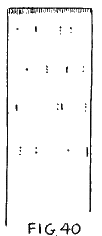
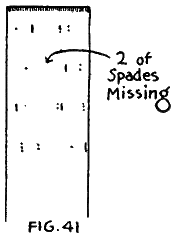
Figure 40 shows part of the edge of the deck with markings on it.
Remove any card from the deck. Then hold the marked edges toward you again. You can see immediately that one of the thirteen rows has only three markings instead of four. The row in which the marking is missing will tell you what number the card is, and the code tells you which suit it is.
Assume that you removed the 2 of Spades. The second row has only three markings left — this tells you a 2 has been removed. The missing mark is Three Dots — this tells you that it is a Spade, Figure 41.
To Perform:
Come forward with deck of cards. Be sure that all marked edges are together. Give cards an overhand shuffle. Hand them to spectator and ask him to give them an overhand shuffle also. The danger of a riffle shuffle is that some of the cards may be turned so that the markings are not all together.
"While the cards are still in your hands, will you please remove one card, remember it, and place it in your coat pocket so that there is no way of my seeing it."
When he has done this, take the cards from him, square them up, glance at the marked edge to see which card has been removed. The three marks in one of the rows instead of four will tell you.
Give cards to another spectator.
"And will you, sir, also remove a card from the deck, remember it, do not let me see it, and place it in your coat pocket?"
This done, take the deck again, square it up, quickly look at edge and determine which card he removed. Place deck aside.
Take watch chain from your pocket.
"As you perhaps know, metal is a good conductor, and I find that a watch chain is an excellent means for carrying vibrations. (To first spectator) Will you please just take one end of this chain in your hand, and I shall hold the other end. Now, concentrate on the card you selected."
Suppose the first selected card is the Seven of Diamonds.
"First the color. I get it — RED. Now the number — SEVEN. And the suit — DIAMONDS. The Seven of Diamonds."
Ask first spectator to take his card from pocket and show to audience, then return it to you.
Now go to second spectator who selected card.
"Will you also please hold one end of this watch chain while I hold the other end. Think of your card."
Suppose his card is the King of Clubs.
"First the color — I see many colors — must be a court card. Think of it — concentrate, please. It is a King – – the King of Clubs. Is that right? Thank you."
Take card and hold up to audience.
SUGGESTION:
A marked deck like this may be used in many ways in conjuring. I call it the Devil's Deck.
In Lesson 29, I taught you an experiment with "X-Ray Cards," in which you prepared the cards with holes through the index corners to determine selected cards which are placed between them.
Somewhat similar to this is an effect which you may work with a marked deck instead. Mark the edges of about twenty cards, leaving rest of deck unprepared. Give marked cards to someone in audience and you retain unprepared ones. Have spectator select a card from his packet and place it anywhere among your cards, which you hold behind your back. Offer your packet for shuffling. Take the cards back, quickly note marked card by looking at edge of packet, then hold packet to side of your head and name card. Remove this card from your packet and repeat experiment.

Book contents
Introduction
Core card lessons
- Lesson 9 — The Principles of Card Effects
- Lesson 12 — Cards That Pass in the Night and Cards Up the Sleeve
- Lesson 13 — Review, the Regular Pass and Card Stabs
- Lesson 14 — The Force, Card and Orange, and Banana Effects
- Lesson 15 — Card Positions, Palms, Shifts and Discoveries
- Lesson 16 — Card Penetrations Through Boards and Handkerchiefs
- Lesson 17 — Snap It, Flash Production and the Glass House
- Lesson 18 — Rising Cards
- Lesson 19 — More Rising Card Effects
- Lesson 34 — Twelve Impromptu Effects with Cards
- Lesson 35 — Sleight of Hand with Cards
- Lesson 36 — More Card Magic
Additional card effects
- Lesson 26 — A Card and Ribbon Mystery
- Lesson 29 — The X-Ray Cards
- Lesson 31 — Blindfold Card Reading and A Mystic Discovery
- Lesson 45 — Spirit Photography
- Lesson 54 — The Card Slot