Bottom Dealing
THE art of dealing from the bottom, although not the most difficult to attain, is perhaps the most highly prized accomplishment in the repertory of the professional. The bottom is the most convenient place for retaining desirable cards during the shuffle or riffle, and perfection in dealing from that position obviates to a great extent the necessity of stocking, as the cards can be dealt at will, and consequently need not be run up in a certain order. Like acquiring many other feats, a perfect understanding of the exact manner in which it is performed will avoid the principal difficulties. Practice will soon do the rest.
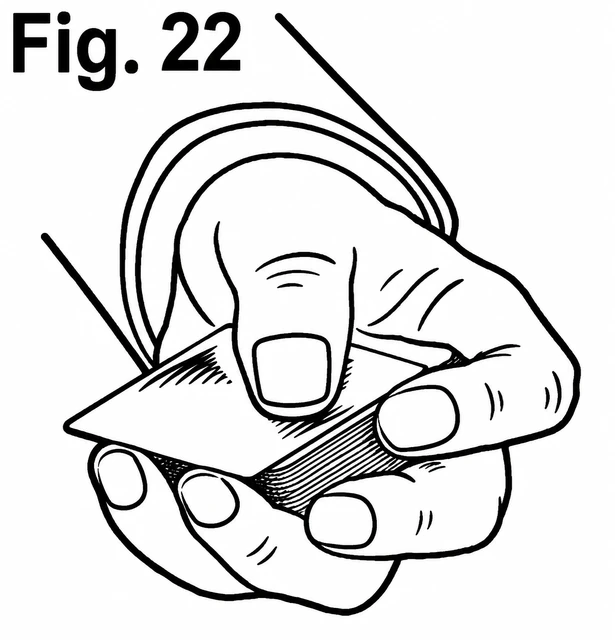
Compare Figure 22 with the original
Hold the deck in the left hand, resting one corner against the middle of the first joint of the second finger, the other corner of the same end in the second joint of the first finger, the first two joints of which rest idly along end of deck. Press the deck outward as much as possible and rest the opposite inner end corner against the palm below the base of thumb. Rest the thumb on the top of deck, pointing towards the second finger tip, which just shows at top of corner. Bring up little finger against the side, and the third finger midway between the second and little fingers. The deck is held in position principally by the corners, between the second finger and the palm below base of thumb. The little finger may aid in holding the deck, but it must be released when the bottom card is pushed out. (See Fig. 22.)
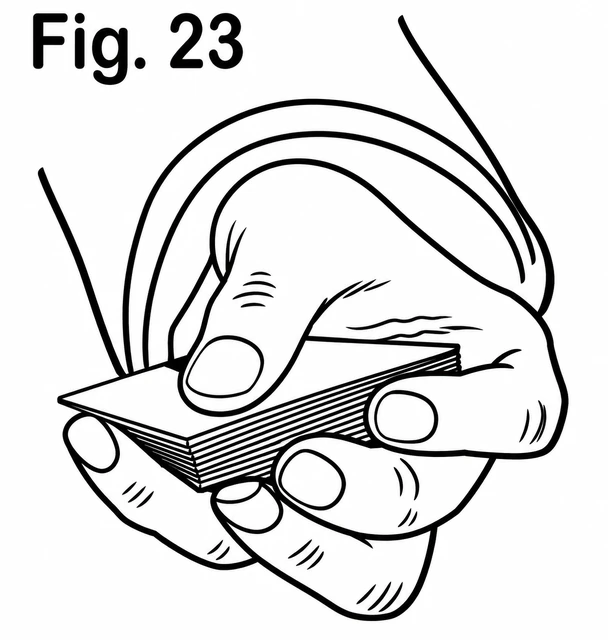
Compare Figure 23 with the original
The second finger and thumb do the work. Draw back the thumb a little and push the top card over in the usual position to seize with the right hand for dealing Then draw back the third finger, which action is concealed by the overhanging card, until the tip rests against the edge of the bottom card. (See Fig. 23.) Press up and slightly inwards against that card and push it out, at same time releasing the little finger and holding the deck firmly between second finger and palm. If this is done properly it leaves the top and bottom cards in the same relative position, the top card effectively concealing the under one Now advance the right hand apparently to take off the top card. (See Fig. 24.)
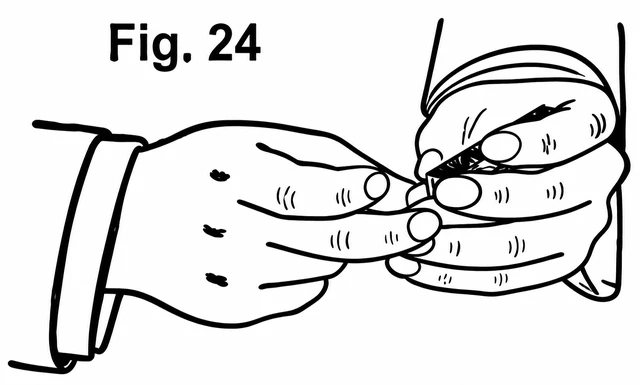
Compare Figure 24 with the original
Draw back the top card with the left thumb, and at the same instant seize the bottom card instead with the right thumb and second finger and deal it in the usual manner. (See Fig. 25.) This can be done so perfectly that the quickest eye cannot detect the ruse. It requires some practice. The main thing is to understand the action thoroughly and hold the deck correctly.
The position is an excellent one for ordinary dealing, and should never be changed. The corner pressed against the palm should be as far from the wrist as possible. Each time a card is pressed out from the bottom, the deck will have a tendency to slip towards the wrist, and must be held, or worked back into position again.
The left hand does nine-tenths of the work. After the hold is established, the main task is in acquiring facility to push out the bottom card with the second finger tip. The cards may come out in numbers, or appear to stick fast; but the process is very easy when the knack is once obtained. The second finger tip comes around the corner to the side, just barely sufficiently to hold the deck in place, and when the third finger tip releases the bottom card from the hold of the second finger, it slips out quite freely. The thumb of the left hand plays a very important part in the blind, by drawing back the top card at the proper instant; and it is this action that makes the deal appear perfectly regular. The thumb movement is identically the same as in the true deal, and the drawing back of the top card is undetectable when properly and rapidly executed. A very slight up and down movement of the left hand as the cards are taken, aids in concealing the action. Hoyle makes a point of instructing that a dealer should always keep the outer end of the deck, and the cards, as dealt, inclined towards the table. Following this rule tends to hide the work of the third finger in bottom dealing.
Bottom dealing is little used with a full deck. It becomes much easier as the pack grows less, consequently the dealer waits until the last several rounds before resorting to it. It is also easier to deal the cards alternately from the top and bottom than to take them from the bottom one after the other. The movement of the third finger need not be so rapid and is less noticeable and should the deck slip out of position, it can be worked back as the top card is being taken. When the bottom cards must be taken consecutively, it is an aid to crimp them very slightly, or to jog them a little, i.e., to allow them to protrude about an eighth of an inch at the side. But neither of the manoeuvres is desirable, or necessary to a good performer.
Book contents
Front matter
Card-table artifice
- Professional Secrets
- Technical Terms
- Position For Shuffle
- Blind Shuffles
- Blind Riffles
- Blind Cuts
- Fancy Blind Cuts
- One-Handed Fancy True Cut
- To Indicate the Location for the Cut
- Bottom Dealing
- Top And Bottom Dealing With One Hand
- Second Dealing
- Ordinary Methods Of Stocking, Locating And Securing
- Stock Shuffle
- Erdnase System of Stock Shuffling
- The Erdnase System of Cull Shuffling
- The Erdnase System of Palming
- To Maintain the Bottom Palm While Dealing
- To Hold the Location of Cut While Dealing
- Shifts — Card-Table Artifice
- To Ascertain the Top Cards While Riffling and Reserve Them at Bottom
- Mode of Holding the Hand
- Skinning the Hand
- The Player Without an Ally
- Three Card Monte
- Mexican Three Card Monte
Legerdemain
- Legerdemain
- Shifts — Legerdemain
- The Blind Shuffle for Securing Selected Card
- Forcing
- Palming
- The Back Palm
- Changes
- Transformations-Two Hands
- Transformations-One Hand
- Blind Shuffles, Retaining Entire Order
- Methods for Determining a Card Thought of
- To Get Sight of Selected Card
- The Slide
- Favorite Sleights for Terminating Tricks
Card tricks
- Card Tricks
- The Exclusive Coterie
- The Divining Rod
- The Invisible Flight
- Tricks With the Prearranged Deck
- The Traveling Cards
- The Row of Ten Cards
- The Acrobatic Jacks
- A Mind-Reading Trick
- Power of Concentrated Thought
- The Acme of Control
- The Card and Handkerchief
- The Top and Bottom Production
- The Three Aces
- The Card and Hat