One-Handed Fancy True Cut
A VERY pretty true cut is made in the following manner. Seize the deck at sides, close to end, so as to expose the whole deck, between the thumb and second and third finger tips of right hand, the fingers close together, but the second finger tip coming only half way down the side. Hook up the top portion with the second finger tip so that the corner will come out free of the third finger thus dividing the deck in two. (See Fig. 16.) Then give the hand a slight swing or jerk downwards and inwards, releasing the upper portion with the second finger, allowing it to fall on the table. Then drop under portion on top. In seizing the deck, if it is slid to the table edge and tilted over slightly, the thumb and fingers take hold much easier, and are certain of raising all the cards.
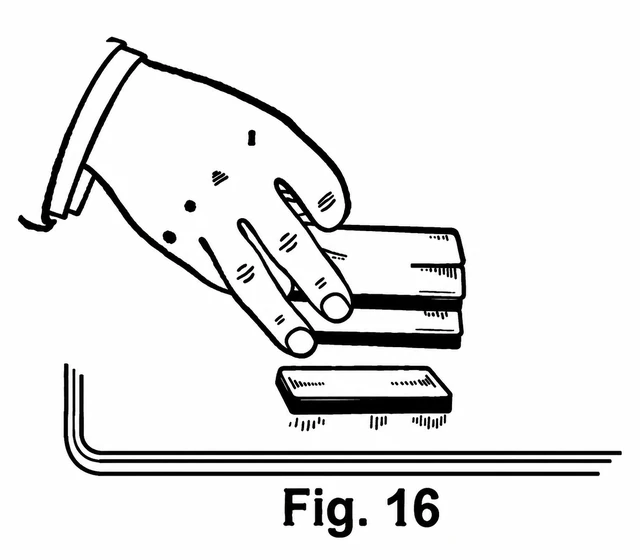
Compare Figure 16 with the original
In making this cut the deck is held but a few inches from the table, and the action must be nicely made to have the cards fall flatly. The run cut can be made in the same way, dropping the packets one on the other. The action is the same when the cut is made by seizing the ends, but it is a little more difficult. No haste should be taken. The movements should be deliberate, so that the truth of the cut is apparent. The only advantage the cut possesses is its beauty, and a possible aid at times, by giving an excuse to square up with both hands. The run cut is liable to leave the cards uneven, and a left palm holdout can be replaced in this way. The only drawback is the danger in making a display of even such simple ability.
Book contents
Front matter
Card-table artifice
- Professional Secrets
- Technical Terms
- Position For Shuffle
- Blind Shuffles
- Blind Riffles
- Blind Cuts
- Fancy Blind Cuts
- One-Handed Fancy True Cut
- To Indicate the Location for the Cut
- Bottom Dealing
- Top And Bottom Dealing With One Hand
- Second Dealing
- Ordinary Methods Of Stocking, Locating And Securing
- Stock Shuffle
- Erdnase System of Stock Shuffling
- The Erdnase System of Cull Shuffling
- The Erdnase System of Palming
- To Maintain the Bottom Palm While Dealing
- To Hold the Location of Cut While Dealing
- Shifts — Card-Table Artifice
- To Ascertain the Top Cards While Riffling and Reserve Them at Bottom
- Mode of Holding the Hand
- Skinning the Hand
- The Player Without an Ally
- Three Card Monte
- Mexican Three Card Monte
Legerdemain
- Legerdemain
- Shifts — Legerdemain
- The Blind Shuffle for Securing Selected Card
- Forcing
- Palming
- The Back Palm
- Changes
- Transformations-Two Hands
- Transformations-One Hand
- Blind Shuffles, Retaining Entire Order
- Methods for Determining a Card Thought of
- To Get Sight of Selected Card
- The Slide
- Favorite Sleights for Terminating Tricks
Card tricks
- Card Tricks
- The Exclusive Coterie
- The Divining Rod
- The Invisible Flight
- Tricks With the Prearranged Deck
- The Traveling Cards
- The Row of Ten Cards
- The Acrobatic Jacks
- A Mind-Reading Trick
- Power of Concentrated Thought
- The Acme of Control
- The Card and Handkerchief
- The Top and Bottom Production
- The Three Aces
- The Card and Hat