Second Dealing
AS THE term indicates, second dealing is the process of dealing the second card from the top, and it is employed almost exclusively in connection with marked cards. It is obvious that the dealer will possess a very great advantage by being enabled to reserve for himself, or an ally, any desirable cards as they appear at the top. He need not bother about acquiring skill at blind shuffling, cutting stocking, or any of the other hundred and one ruses known to the profession.
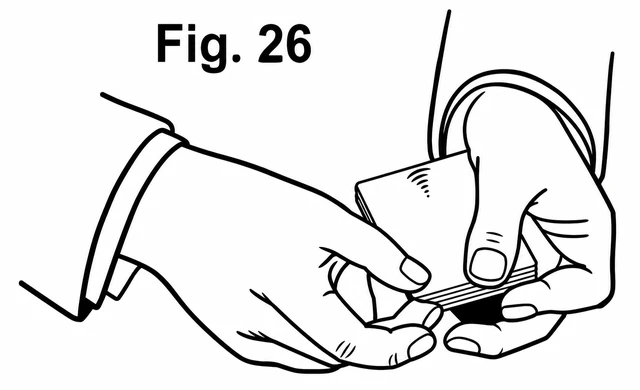
Compare Figure 26 with the original
The deck is held by the left hand much the same as described for bottom dealing, the tip of the thumb being a little over the end of the top card. This position enables the thumb to come in contact with the second card by pushing the top card a trifle downwards. To deal, the left thumb pushes the two cards over the side nearly together, the top card perhaps a little in advance and the second card showing a little above it at the end. The right hand seizes the second card by the exposed corner, the right thumb barely touching the edge, but the right second finger is well under the second card and helps to get it out by an upward pressure as the left thumb draws back the top card. (See Fig. 26.) Then the left thumb again comes in contact with the second card at the upper edge. The third finger tip prevents more than two cards from being pushed over the side. The top card continues to move forward and back as the seconds are dealt, but the rapidity of the backward movement prevents the detection of the action. Properly executed, the appearance of the deal is perfectly regular. An expert can run the whole deck with the utmost rapidity, and still retain the top card.
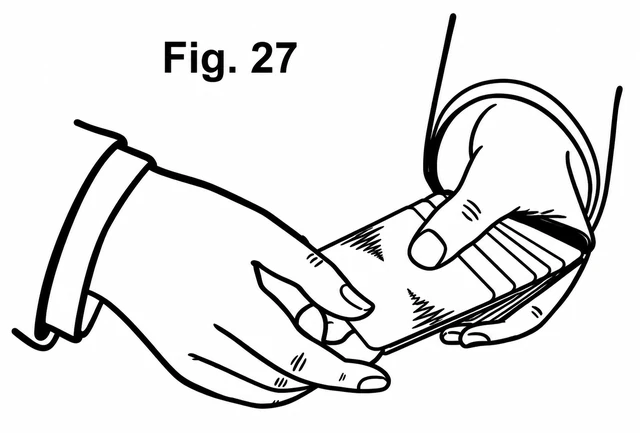
Compare Figure 27 with the original
Another method of second dealing is to hold the cards loosely in the left hand, the left thumb pushing forward several at a time, each a little in advance of the other. As the right hand comes forward, the top card is drawn back and the second dealt. The left thumb uses some pressure in pushing the cards forward, but draws back the top card very lightly so as to have the second card protruding. (See Fig. 27.) The first method is decidedly the better, as it gives greater control of the cards, and there is less liability of the right hand seizing more than one. There is a knack in seizing the second card. The second finger of the right hand comes in contact with it before the top card is drawn back, and gives it a slight pressure upwards, thus helping to prevent it going back with the top card. The right thumb may actually touch the top card as it is drawn back and the second dealt. The whole action of drawing back the top and dealing the second card takes place at the same instant.
To become an adept at second dealing is as difficult a task as can be given in card handling, but once acquired, like many other arts, it is as easy as habit. To the player who uses marked cards this accomplishment is the whole thing, but without readers the time spent in acquiring the skill is wasted as far as advantage playing is concerned. Opportunities for introducing prepared cards are rare, and the process of marking during a game, by crease, crimp, or inking, is slow and detectable. However, with “readers,” “strippers,” or any kind of prepared cards the clever professional who values his reputation will have nothing to do.
Book contents
Front matter
Card-table artifice
- Professional Secrets
- Technical Terms
- Position For Shuffle
- Blind Shuffles
- Blind Riffles
- Blind Cuts
- Fancy Blind Cuts
- One-Handed Fancy True Cut
- To Indicate the Location for the Cut
- Bottom Dealing
- Top And Bottom Dealing With One Hand
- Second Dealing
- Ordinary Methods Of Stocking, Locating And Securing
- Stock Shuffle
- Erdnase System of Stock Shuffling
- The Erdnase System of Cull Shuffling
- The Erdnase System of Palming
- To Maintain the Bottom Palm While Dealing
- To Hold the Location of Cut While Dealing
- Shifts — Card-Table Artifice
- To Ascertain the Top Cards While Riffling and Reserve Them at Bottom
- Mode of Holding the Hand
- Skinning the Hand
- The Player Without an Ally
- Three Card Monte
- Mexican Three Card Monte
Legerdemain
- Legerdemain
- Shifts — Legerdemain
- The Blind Shuffle for Securing Selected Card
- Forcing
- Palming
- The Back Palm
- Changes
- Transformations-Two Hands
- Transformations-One Hand
- Blind Shuffles, Retaining Entire Order
- Methods for Determining a Card Thought of
- To Get Sight of Selected Card
- The Slide
- Favorite Sleights for Terminating Tricks
Card tricks
- Card Tricks
- The Exclusive Coterie
- The Divining Rod
- The Invisible Flight
- Tricks With the Prearranged Deck
- The Traveling Cards
- The Row of Ten Cards
- The Acrobatic Jacks
- A Mind-Reading Trick
- Power of Concentrated Thought
- The Acme of Control
- The Card and Handkerchief
- The Top and Bottom Production
- The Three Aces
- The Card and Hat