Stock Shuffle
RUNNING up the desired cards in a certain order for dealing, while the deck is being shuffled, can be accomplished to any considerable extent only by the hand shuffle. The method in common use by expert players is to draw the particular cards from the bottom. This method is first explained.
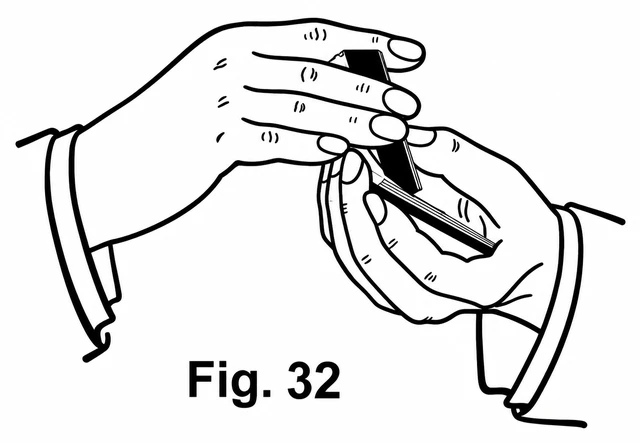
Compare Figure 32 with the original
Seize the deck at ends between the second finger and thumb of the right hand in the usual manner for shuffling, the first finger resting on the side. Run several cards into the left hand, but well down into the palm, so that the second and third fingers protrude to the first joints from underneath. Then when the right hand has made the next downward motion, instead of drawing off the top card with the left thumb press the left second and third fingertips against the bottom card and let it slide into the left hand, drawing it into position on the other cards with the left thumb as the right hand is raised. (See Fig. 32.)
The right hand aids the left fingers by pressing the deck against them and drawing up more horizontally. Then run one card less than the number of players and again draw one from the bottom, and so on until the stock is complete. The left thumb goes through the same motion when the under card is drawn but merely slides across the top card without disturbing it. When the last card has been drawn from the bottom run as many cards as there are players between the dealer and the player for whom the bottom cards are intended, out-jog the next card and shuffle off balance. Then under-cut to out-jog and throw on top.
This example, of course, is for a game in which the cards are dealt one at a time to each player. If the game requires two or more cards at a time the action is the same but merely repeated. The right hand makes the movement of shuffling, on the same plane, or about parallel with the packet held in the left, and this aids in drawing the bottom cards, as well as disguising that action. There is a little difference in the sound as the cards fall from the top and bottom, but it is hardly noticeable. This method requires considerable practice, as the knack of drawing the bottom cards, and but one at a time, does not come easily. But when acquired it can be executed with wonderful facility and speed, and the ruse is practically undetectable. The shuffle may be continued to any length by under-cutting below the stock, jogging the first card, shuffling off and then again undercutting to jog and throwing on top; or the blind top stock, apparent shuffle of the whole deck, may be made as described in this work.
Two or more hands may be run up by this method, if one set is placed at the top and the other at the bottom. The process is to first draw from the top, then from the bottom, in succession, until all the selected cards have been arranged alternately at the bottom of the left-hand packet, then shuffle off balance. Then run several cards from the top for a start, and then draw the first card from the bottom. Then run from the top the number that there are players between where the first bottom card is to fall, and where the second one is intended. Then draw again from the bottom, and so on until the two sets have been run up. The calculation is very simple and of course should be made beforehand. For instance, in a five-handed game of Poker assume that three Queens and three Nines are to be stocked. The Queens are to go to the man who cuts, and the Nines to the second player from the dealer. Place the Queens on top, the Nines under. Run Queen, then draw a Nine, and so on until all are under the deck. Then the calculation would be, on every five cards that are shuffled, to draw the second and fourth from the bottom. The cards must be run up in the reverse order, so the count is made to the right, the dealer being first. His card comes from the top. Then the second card from the bottom, which is the Queen, then the third from the top, then the fourth from the bottom, which is the Nine, then the fifth and first again from the top, then the second from the bottom, and so on until fifteen cards have been run. Then out-jog and shuffle off. Then under-cut to jog and throw on top.
The ability of drawing the bottom cards smoothly and rapidly must be perfectly acquired before this method of stocking can be successfully used. The most that can be said for it is that it is short. A single hand can be run up with one shuffle and a throw. By executing the blind top stock shuffle, after the stock is run up, any awkwardness in the first process may be covered. Success in all card achievements depends on avoiding or allaying suspicion, and the blind shuffles described, if properly performed, will satisfy the most exacting.
Book contents
Front matter
Card-table artifice
- Professional Secrets
- Technical Terms
- Position For Shuffle
- Blind Shuffles
- Blind Riffles
- Blind Cuts
- Fancy Blind Cuts
- One-Handed Fancy True Cut
- To Indicate the Location for the Cut
- Bottom Dealing
- Top And Bottom Dealing With One Hand
- Second Dealing
- Ordinary Methods Of Stocking, Locating And Securing
- Stock Shuffle
- Erdnase System of Stock Shuffling
- The Erdnase System of Cull Shuffling
- The Erdnase System of Palming
- To Maintain the Bottom Palm While Dealing
- To Hold the Location of Cut While Dealing
- Shifts — Card-Table Artifice
- To Ascertain the Top Cards While Riffling and Reserve Them at Bottom
- Mode of Holding the Hand
- Skinning the Hand
- The Player Without an Ally
- Three Card Monte
- Mexican Three Card Monte
Legerdemain
- Legerdemain
- Shifts — Legerdemain
- The Blind Shuffle for Securing Selected Card
- Forcing
- Palming
- The Back Palm
- Changes
- Transformations-Two Hands
- Transformations-One Hand
- Blind Shuffles, Retaining Entire Order
- Methods for Determining a Card Thought of
- To Get Sight of Selected Card
- The Slide
- Favorite Sleights for Terminating Tricks
Card tricks
- Card Tricks
- The Exclusive Coterie
- The Divining Rod
- The Invisible Flight
- Tricks With the Prearranged Deck
- The Traveling Cards
- The Row of Ten Cards
- The Acrobatic Jacks
- A Mind-Reading Trick
- Power of Concentrated Thought
- The Acme of Control
- The Card and Handkerchief
- The Top and Bottom Production
- The Three Aces
- The Card and Hat