Mode of Holding the Hand
THE professional player, ever conscious of the necessity of uniformity, will always hold his hand in the same manner; and as he often finds it convenient to have more than his share of the cards, the position must be one which will always disguise that possibility. The best for all purposes is as follows:
Hold the cards in the left hand, the end fitting into the third joints of the first, second and third fingers, the lower corner resting on the little finger close to the third joint, and the little finger curled in so that the cards rest on the first joint also. The left thumb rests on the upper side, and the first, second and third fingers are curled in so that their tips rest against the back.
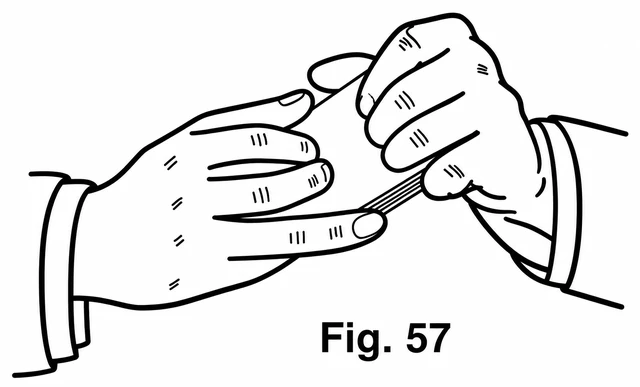
Compare Figure 57 with the original
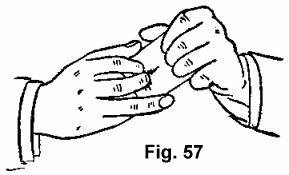
To read the cards, bring the right hand up, the third finger against the under side, the little finger against the end, the first and second fingers curled up on back, and the thumb on top. (See Fig. 57.) Then, with a sliding downward movement of the left thumb crimp or convex the cards sufficiently to read the index on each; or, open the edges slightly with the right thumb by springing the cards one at a time against the left thumb, which is pressed on top to keep them open. This exact position is very important for several reasons, principally because it effectually conceals the number held, and it enables the player to “skin” his hand and palm off the extra cards without fuss or unusual movements. In general appearance the hold is the same as adopted by very many players for the excellent purpose of preventing bystanders from getting a glimpse.
Book contents
Front matter
Card-table artifice
- Professional Secrets
- Technical Terms
- Position For Shuffle
- Blind Shuffles
- Blind Riffles
- Blind Cuts
- Fancy Blind Cuts
- One-Handed Fancy True Cut
- To Indicate the Location for the Cut
- Bottom Dealing
- Top And Bottom Dealing With One Hand
- Second Dealing
- Ordinary Methods Of Stocking, Locating And Securing
- Stock Shuffle
- Erdnase System of Stock Shuffling
- The Erdnase System of Cull Shuffling
- The Erdnase System of Palming
- To Maintain the Bottom Palm While Dealing
- To Hold the Location of Cut While Dealing
- Shifts — Card-Table Artifice
- To Ascertain the Top Cards While Riffling and Reserve Them at Bottom
- Mode of Holding the Hand
- Skinning the Hand
- The Player Without an Ally
- Three Card Monte
- Mexican Three Card Monte
Legerdemain
- Legerdemain
- Shifts — Legerdemain
- The Blind Shuffle for Securing Selected Card
- Forcing
- Palming
- The Back Palm
- Changes
- Transformations-Two Hands
- Transformations-One Hand
- Blind Shuffles, Retaining Entire Order
- Methods for Determining a Card Thought of
- To Get Sight of Selected Card
- The Slide
- Favorite Sleights for Terminating Tricks
Card tricks
- Card Tricks
- The Exclusive Coterie
- The Divining Rod
- The Invisible Flight
- Tricks With the Prearranged Deck
- The Traveling Cards
- The Row of Ten Cards
- The Acrobatic Jacks
- A Mind-Reading Trick
- Power of Concentrated Thought
- The Acme of Control
- The Card and Handkerchief
- The Top and Bottom Production
- The Three Aces
- The Card and Hat