To Indicate the Location for the Cut
- This is Located by the Crimp
- This is Located by the Jog
- This is Located by the Crimp
- This is Located by the Jog
WHILE on the subject of cuts, we shall consider the various methods by which a true cut can be made by an ally, and still leave the complete stock intact. The dealer prepares for this by making an extra cut when his shuffle is completed, and indicates by one of the following methods the point at which he wishes his ally to reverse his last action, by making a true cut.
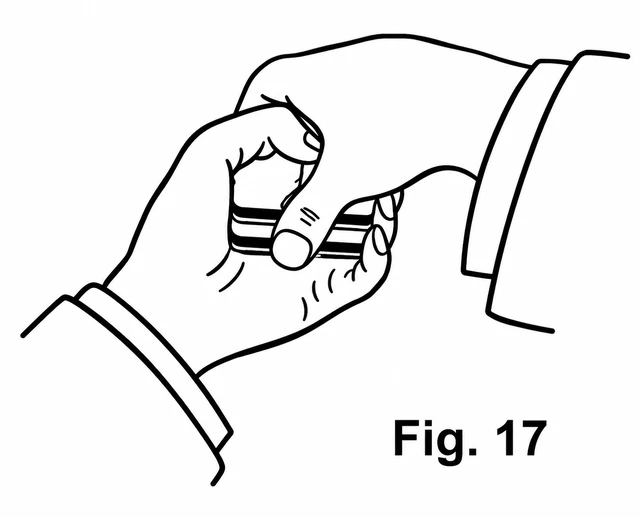
Compare Figure 17 with the original
WHEN using the hand shuffle make an extra under cut of about half the deck, and when throwing the under packet on top shift the right hand slightly inwards and form an in-jog, the left little finger helping to hold the location between the two packets. Then turn the left hand slightly downwards, bringing the right hand over on top of the deck, and seize the ends between thumb and second and third fingers, apparently to square up.
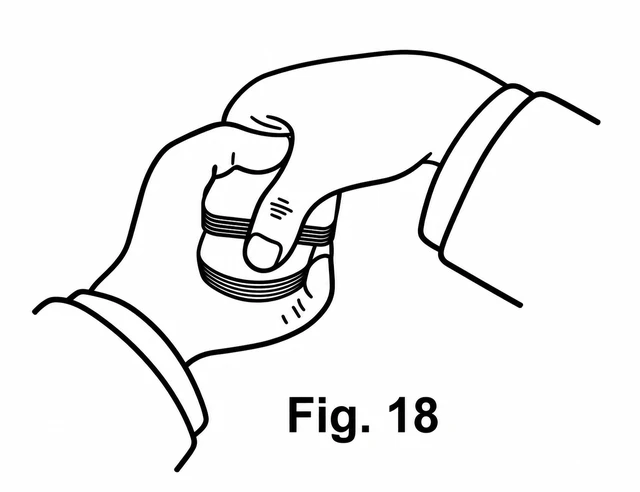
Compare Figure 18 with the original
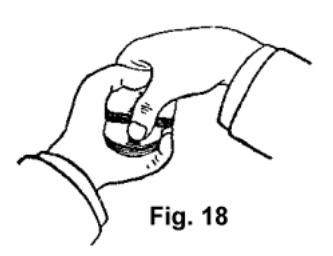
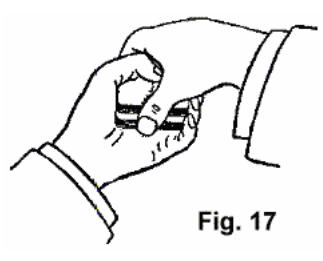
As the right thumb comes against the inner end it pulls up the in-jog slightly, forming a break. (See Fig. 17.) Then with the fingers of left hand crimp, or squeeze the under packet against palm of hand so as to leave the under packet slightly concave. (See Fig. 18) The right hand effectively conceals this action of the left. Lay the deck down perfectly square to be cut. The ally makes the cut at the ends with one hand, and locates the crimp by touch.
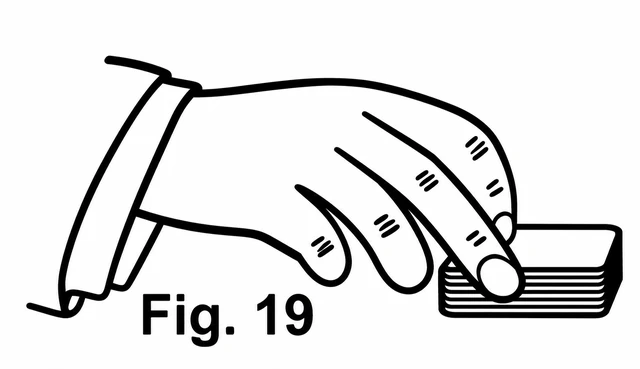
Compare Figure 19 with the original
There is little or no difficulty in finding the crimp. It is the most probable place the cut would be made, even if left to chance and many an unsophisticated player has unconsciously cut into a crimp and aided in his own undoing. If the deck is placed before an innocent player so that his hand naturally seizes the ends, the chances are in favor of his cutting to the opening. (See Fig. 19.) A professional will calculate on this probability when his right-hand neighbor is not an ally. The main objection to the crimp is that the bent cards may be noticed. The dealer immediately crimps in the opposite direction when squaring up after the cut.
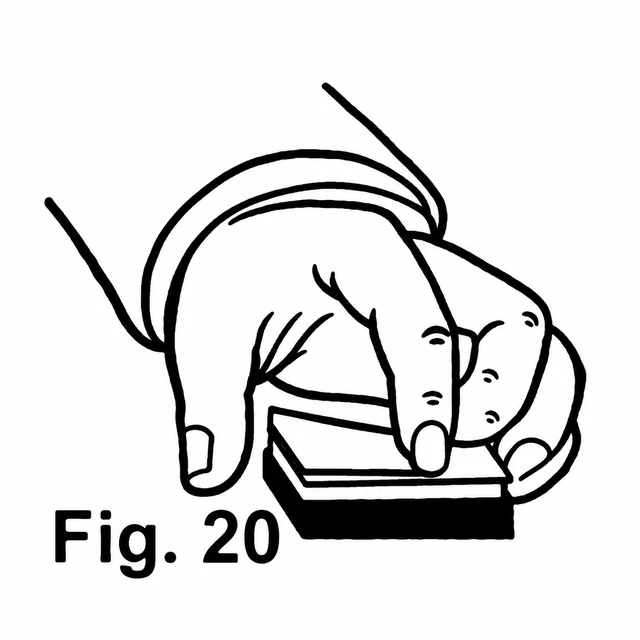
Compare Figure 20 with the original
The same result can be achieved by putting in a convex crimp in the under portion. It is led up to in the same manner, and the first finger of the left hand aids in forming the crimp by being curled up and pressed against the under packet to bend it upwards. In this case the ally cuts at the sides, and locates the crimp accurately by pressing the second or third finger tip on the top near the outside edge. This tilts the upper packet a little, and enables the thumb to find the crimp without an instant’s hesitation. (See Fig. 20.)
This is located by the jog
Compare Figure 20 with the original
WHEN using the hand-shuffle change the position slightly so that the four fingers will lie flatly against the bottom of the deck. Make the extra under cut and bring tips of the second and third left fingers in against and slightly above packet remaining in left hand. In throwing the right-hand packet on top. Let it slide a little across the left finger tips, so that a jog is made by the bottom card or cards. which are prevented from going completely over. (See Fig. 21.) This is perfectly hidden by the right hand. Square up the deck by the ends only and lay down to be cut, thereby not disturbing the jog. The ally cuts with the left hand, seizing the upper packet by the sides, the left thumb easily and instantaneously locating the jog by touch.
The action of both players must be rapid and careless in appearance, but not hurried. The irregularity of the side edges made necessary by the jog does not attract attention or expose the ruse, as in ordinary play the deck is rarely perfectly square when given to cut.
This is located by the crimp
WHEN the riffle is used, the crimp is put in by first concaving the whole deck. This is a natural procedure, as the cards have a tendency to get convex, and it is quite customary for the players to straighten them up. By drawing the deck to the edge of the table the concave tendency can be put in the whole deck first, then as the extra cut is made a convex crimp can be put in the under part by pressing it quickly downwards with right thumb against the table edge as it is drawn out. The ally cuts by the ends.
PERHAPS the best manner of locating the cut when the riffle is used, is to jog the top card by pushing it slightly over the right-hand end, with the left first finger. Then make the extra cut with the right hand, throwing the under portion on top, and squaring up at sides and left-hand end only. The deck is passed to the ally by the sides with the right hand, which conceals the jogged card. The ally cuts by the ends, his thumb easily locating the jog, and seizing the packet above it.
The particular manner in which the dealer forms the crimp, or jog, to locate the cut, matters little if it is done in a natural manner and without attracting attention. But a single irregular movement, or a moment’s hesitation, may ruin the play. Hence, however simple and easy the particular action may be, the execution should be carefully planned and practiced beforehand, and when put into effect should be performed almost mechanically. For these reasons we have devoted much space to many details that may at first appear of little moment.
Book contents
Front matter
Card-table artifice
- Professional Secrets
- Technical Terms
- Position For Shuffle
- Blind Shuffles
- Blind Riffles
- Blind Cuts
- Fancy Blind Cuts
- One-Handed Fancy True Cut
- To Indicate the Location for the Cut
- Bottom Dealing
- Top And Bottom Dealing With One Hand
- Second Dealing
- Ordinary Methods Of Stocking, Locating And Securing
- Stock Shuffle
- Erdnase System of Stock Shuffling
- The Erdnase System of Cull Shuffling
- The Erdnase System of Palming
- To Maintain the Bottom Palm While Dealing
- To Hold the Location of Cut While Dealing
- Shifts — Card-Table Artifice
- To Ascertain the Top Cards While Riffling and Reserve Them at Bottom
- Mode of Holding the Hand
- Skinning the Hand
- The Player Without an Ally
- Three Card Monte
- Mexican Three Card Monte
Legerdemain
- Legerdemain
- Shifts — Legerdemain
- The Blind Shuffle for Securing Selected Card
- Forcing
- Palming
- The Back Palm
- Changes
- Transformations-Two Hands
- Transformations-One Hand
- Blind Shuffles, Retaining Entire Order
- Methods for Determining a Card Thought of
- To Get Sight of Selected Card
- The Slide
- Favorite Sleights for Terminating Tricks
Card tricks
- Card Tricks
- The Exclusive Coterie
- The Divining Rod
- The Invisible Flight
- Tricks With the Prearranged Deck
- The Traveling Cards
- The Row of Ten Cards
- The Acrobatic Jacks
- A Mind-Reading Trick
- Power of Concentrated Thought
- The Acme of Control
- The Card and Handkerchief
- The Top and Bottom Production
- The Three Aces
- The Card and Hat