Favorite Sleights for Terminating Tricks
Catching Two Cards at Fingertips
A favorite manner of terminating a trick that requires the production of two selected cards is to bring one to top and one to bottom, then toss the deck in the air a yard or so straight upwards, retaining the top and bottom cards by pressure and friction of thumb and fingers, then thrusting the hand among the cards as they descend, apparently finding the selected cards in the act.
Leaving Selected Card in Hand of Spectator
A plan for the production of a single card, as the last of a series, is to bring it to the bottom face up and request a spectator to hold the deck firmly by the corner, thumb on top. By striking the deck forcibly from above all the cards will fall from his hand save the selected card, which is retained by the friction of the fingers and left face up in his hand.
The Revolution
This is a great favorite for terminating certain tricks, and has a very showy appearance. If the top card is pushed over the side about half an inch, and the deck dropped flatly on the table from a point of perhaps twelve or fifteen inches above it, the top card will turn over in the descent and lie fairly on top of the deck, face exposed. The turn is caused by the resistance of the air against the protruding side. The facts that the card to be produced is on top, and that a card is pushed over, are concealed.
Cards Rising from the Hand
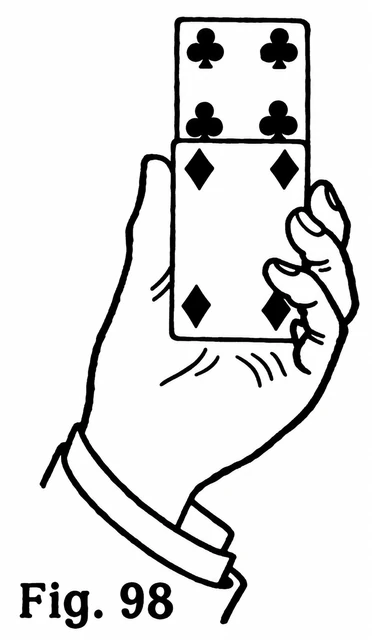
Compare Figure 98 with the original
The selected cards are brought to top of deck and the pack is held in the left hand, thumb at one side and Lying straight along with tip near end, second third and little fingers at opposite side, and first finger at back. The cards are pushed up by first finger, the thumb and other fingers being released sufficiently to allow their rising, but retaining their position. (See Fig. 98.) When the cards are raised to nearly the full length the right hand takes them off. Some address is necessary to push up a card with one finger, but a little practice, and especially at the manner of holding the deck, so as to keep the card in position and yet not retard its upward course, will soon acquire the ability. If the first and second fingers are placed at the back the feat becomes much easier, but of course the effect is proportionately lessened.
Book contents
Front matter
Card-table artifice
- Professional Secrets
- Technical Terms
- Position For Shuffle
- Blind Shuffles
- Blind Riffles
- Blind Cuts
- Fancy Blind Cuts
- One-Handed Fancy True Cut
- To Indicate the Location for the Cut
- Bottom Dealing
- Top And Bottom Dealing With One Hand
- Second Dealing
- Ordinary Methods Of Stocking, Locating And Securing
- Stock Shuffle
- Erdnase System of Stock Shuffling
- The Erdnase System of Cull Shuffling
- The Erdnase System of Palming
- To Maintain the Bottom Palm While Dealing
- To Hold the Location of Cut While Dealing
- Shifts — Card-Table Artifice
- To Ascertain the Top Cards While Riffling and Reserve Them at Bottom
- Mode of Holding the Hand
- Skinning the Hand
- The Player Without an Ally
- Three Card Monte
- Mexican Three Card Monte
Legerdemain
- Legerdemain
- Shifts — Legerdemain
- The Blind Shuffle for Securing Selected Card
- Forcing
- Palming
- The Back Palm
- Changes
- Transformations-Two Hands
- Transformations-One Hand
- Blind Shuffles, Retaining Entire Order
- Methods for Determining a Card Thought of
- To Get Sight of Selected Card
- The Slide
- Favorite Sleights for Terminating Tricks
Card tricks
- Card Tricks
- The Exclusive Coterie
- The Divining Rod
- The Invisible Flight
- Tricks With the Prearranged Deck
- The Traveling Cards
- The Row of Ten Cards
- The Acrobatic Jacks
- A Mind-Reading Trick
- Power of Concentrated Thought
- The Acme of Control
- The Card and Handkerchief
- The Top and Bottom Production
- The Three Aces
- The Card and Hat