Methods for Determining a Card Thought of
IN THREE of the following instances the spectator has no choice, as he is supposed to think of a card he sees, and the performer shows him but one, though apparently without design. In the fourth instance a most ingenious ruse is employed, the spectator being given perfect freedom, yet the card is determined almost as surely.
A.
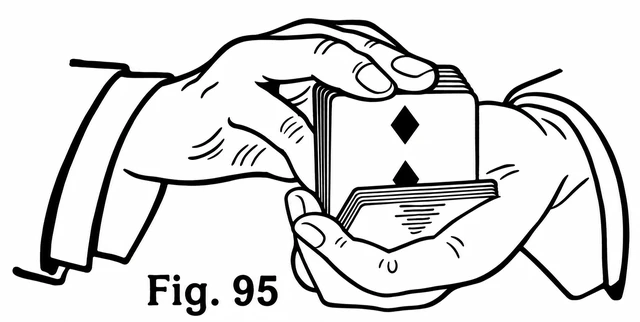
Compare Figure 95 with the original
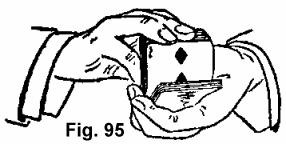
Hold the deck in the left hand, thumb across top near inner end, and first and second fingers at side. Bring over the right hand and seize deck with fingers at outer ends, thumb at inner end, and hold so that the outer ends of the cards may be sprung or “ruffled,” with the faces towards the spectator. Requesting him to think of a card, spring the ends rapidly, stopping for an instant at any one place (see Fig. 95), then completing the ruffle. The springing is performed at such a pace that the spectator can recognize but one card, which is more fully exposed by the momentary lull in the springing, and at this point the performer forms and holds a break with end of left second finger. At the end of the first ruffle ask if card has been noted, and if not repeat the action, but of course hesitating at some other point.
B.
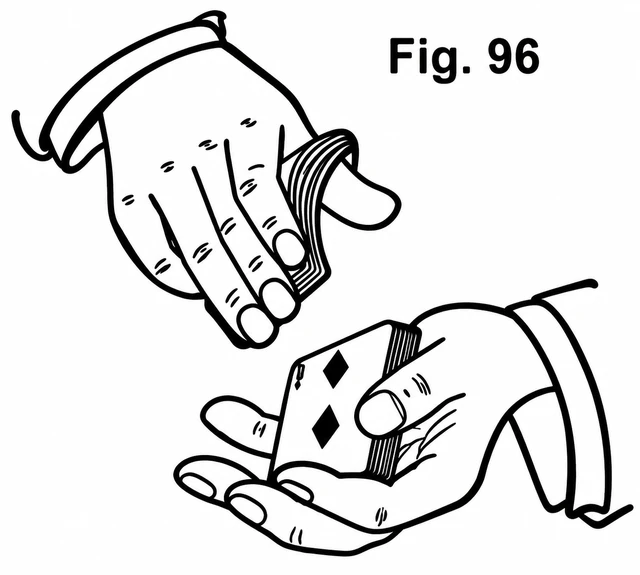
Compare Figure 96 with the original
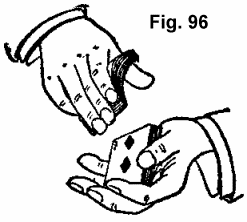
Hold the deck lengthwise in the right hand, face to palm, between second joint of thumb and ends of fingers. Bend finger end downwards and allow ends to escape rapidly, springing them into the left hand in the usual manner of the flourish. Hesitate or stop the springing for an instant, at any stage of the operation (see Fig. 96), and the only card that the performer can notice or fairly distinguish will be the probable selection of the spectator. Of course the performer conceals his notice of the cards as far as possible.
C.
Hold the deck across the left palm face down, extend it towards a spectator, requesting him to think of one of them. As he cannot see any he will naturally attempt to take the deck in his hands, or cut off a portion. In either case let him cut only, and the moment he sees the bottom card of his packet thank him and take back the cut, holding abreak at the location.
D.
This cunning and absolutely unfathomable stratagem must have been devised by an individual of truly Machiavelian subtlety. The deck is held in the left hand face down and the cards are taken off in the right hand and held face to the spectator. Each card is counted as it is taken off the deck, and the right hand packet is kept well squared up, so that but one card remains exposed to view. As the cards are exposed the hands are parted some little distance, and the action of drawing off the cards is made uniform, neither rapidly nor slowly. Now the operator looks covertly into the eyes of the spectator and he sees with surprising distinctness that they follow the movements of his right hand in taking off and exposing the cards. The moment the eyes rest, or lose their intensity, the performer notes the number of the card, but continues the drawing off process. Shortly, asking if a card has been thought of, he closes up deck, secretively counts off to the number, and produces at will. Of course a break may be held at the card noted, but the counting avoids the least change in the right hand action.
Book contents
Front matter
Card-table artifice
- Professional Secrets
- Technical Terms
- Position For Shuffle
- Blind Shuffles
- Blind Riffles
- Blind Cuts
- Fancy Blind Cuts
- One-Handed Fancy True Cut
- To Indicate the Location for the Cut
- Bottom Dealing
- Top And Bottom Dealing With One Hand
- Second Dealing
- Ordinary Methods Of Stocking, Locating And Securing
- Stock Shuffle
- Erdnase System of Stock Shuffling
- The Erdnase System of Cull Shuffling
- The Erdnase System of Palming
- To Maintain the Bottom Palm While Dealing
- To Hold the Location of Cut While Dealing
- Shifts — Card-Table Artifice
- To Ascertain the Top Cards While Riffling and Reserve Them at Bottom
- Mode of Holding the Hand
- Skinning the Hand
- The Player Without an Ally
- Three Card Monte
- Mexican Three Card Monte
Legerdemain
- Legerdemain
- Shifts — Legerdemain
- The Blind Shuffle for Securing Selected Card
- Forcing
- Palming
- The Back Palm
- Changes
- Transformations-Two Hands
- Transformations-One Hand
- Blind Shuffles, Retaining Entire Order
- Methods for Determining a Card Thought of
- To Get Sight of Selected Card
- The Slide
- Favorite Sleights for Terminating Tricks
Card tricks
- Card Tricks
- The Exclusive Coterie
- The Divining Rod
- The Invisible Flight
- Tricks With the Prearranged Deck
- The Traveling Cards
- The Row of Ten Cards
- The Acrobatic Jacks
- A Mind-Reading Trick
- Power of Concentrated Thought
- The Acme of Control
- The Card and Handkerchief
- The Top and Bottom Production
- The Three Aces
- The Card and Hat