The Back Palm
WE ARE afraid the above title is a misnomer. The cards to be concealed are transferred to the back of the hand. Hold the card in the right hand face up between the tip of the thumb at one end and tips of second and third fingers at opposite end, the first joints of the first and little fingers hold the sides. (See Fig. 77.) To make the “palm” slip the tips of the second and third fingers under the end of the card and curl them down until they come under the thumb, at the same time pushing the card outward with the thumb until the inner corners reach the first and little fingers, which hold it in position. (See Fig. 78.) Now, straighten out the four fingers, clipping the corners of the card between the little and third fingertips and the first and second fingertips, and the card lies along the back of the hand. (See Fig. 79.)
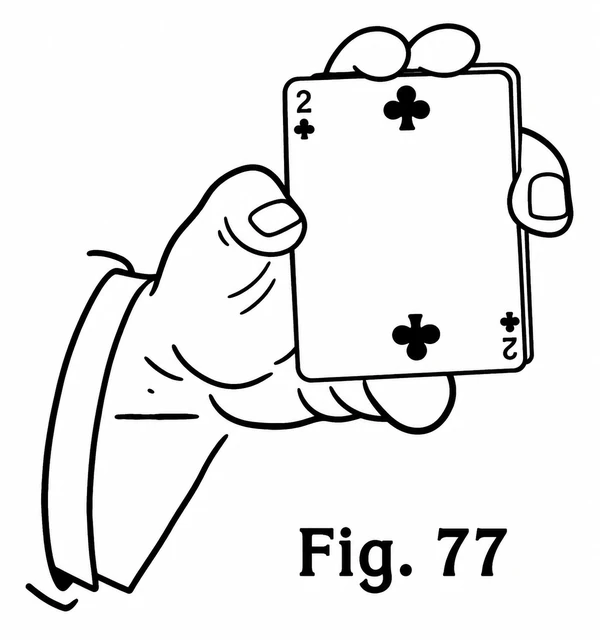
Compare Figure 77 with the original
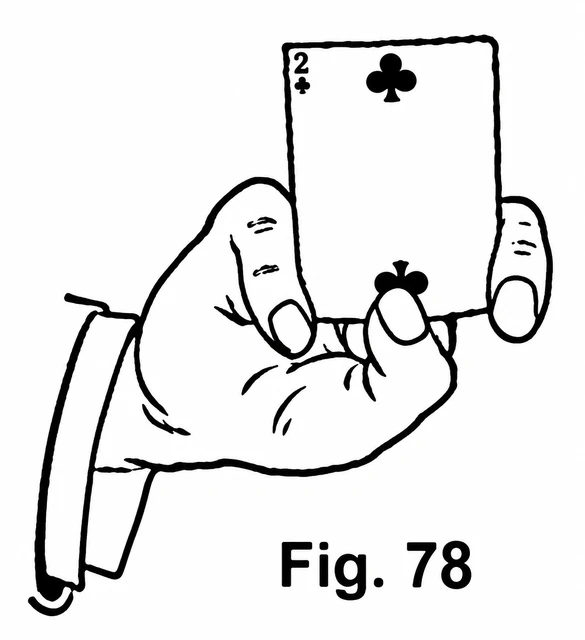
Compare Figure 78 with the original
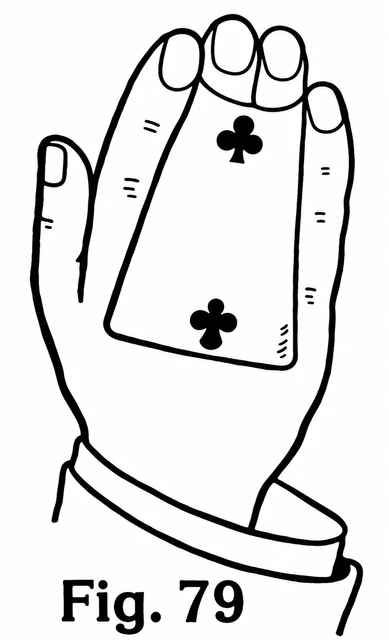
Compare Figure 79 with the original
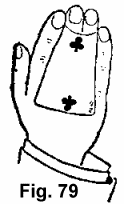
To bring it to the front again curl the four fingers again into the palm, straighten the first fingertip a little so that the thumb may take its place holding the card, then draw the card as far as possible toward the wrist with the thumb and little finger, straightening out the other fingers, then clip the corner between the first and second fingertips, and slide the little finger along the side of the card until it is straight out, this time clipping the outer corners between the same fingers instead of palming in the usual way.
Several cards may be transferred back and forth in this manner, and one at a time may be produced from the back without showing the rest. Perfection in the feat enables a performer to show both sides of the hand, transferring the cards as it is turned over. A slight up-and-down motion and-a backward turn of the wrist is used.
As an exhibition of dexterity this is probably unsurpassed in card manipulation, but it is of little aid in the performance of tricks. However, everything may be put to some use, and the back palm once helped us out of a difficult situation–“but that is another story.”
Book contents
Front matter
Card-table artifice
- Professional Secrets
- Technical Terms
- Position For Shuffle
- Blind Shuffles
- Blind Riffles
- Blind Cuts
- Fancy Blind Cuts
- One-Handed Fancy True Cut
- To Indicate the Location for the Cut
- Bottom Dealing
- Top And Bottom Dealing With One Hand
- Second Dealing
- Ordinary Methods Of Stocking, Locating And Securing
- Stock Shuffle
- Erdnase System of Stock Shuffling
- The Erdnase System of Cull Shuffling
- The Erdnase System of Palming
- To Maintain the Bottom Palm While Dealing
- To Hold the Location of Cut While Dealing
- Shifts — Card-Table Artifice
- To Ascertain the Top Cards While Riffling and Reserve Them at Bottom
- Mode of Holding the Hand
- Skinning the Hand
- The Player Without an Ally
- Three Card Monte
- Mexican Three Card Monte
Legerdemain
- Legerdemain
- Shifts — Legerdemain
- The Blind Shuffle for Securing Selected Card
- Forcing
- Palming
- The Back Palm
- Changes
- Transformations-Two Hands
- Transformations-One Hand
- Blind Shuffles, Retaining Entire Order
- Methods for Determining a Card Thought of
- To Get Sight of Selected Card
- The Slide
- Favorite Sleights for Terminating Tricks
Card tricks
- Card Tricks
- The Exclusive Coterie
- The Divining Rod
- The Invisible Flight
- Tricks With the Prearranged Deck
- The Traveling Cards
- The Row of Ten Cards
- The Acrobatic Jacks
- A Mind-Reading Trick
- Power of Concentrated Thought
- The Acme of Control
- The Card and Handkerchief
- The Top and Bottom Production
- The Three Aces
- The Card and Hat