To Ascertain the Top Cards While Riffling and Reserve Them at Bottom
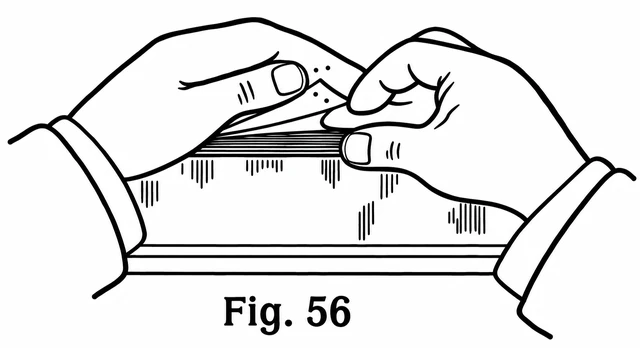
Compare Figure 56 with the original
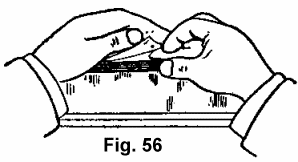
DURING the process of a riffle an expert performer can obtain a glimpse of the top cards and bring them to the bottom in reserve for the deal. It requires a suspicious and very knowing player to detect the ruse. The glimpse is obtained by slightly in-jogging the top card of the left-hand packet, as explained in treatment of “Blind Riffles,” under caption, “No. 1 to Retain Top Stock.” As the thumbs raise the corners of the two packets to riffle, the top card is slightly jogged over and raised by the left thumb, just barely enough to obtain a glance at the index, and when the cards are riffled the card seen is left on top, as it naturally should be. (See Fig. 56.)
It is quite possible to get a glimpse without jogging the card if the cards are sprung in the usual manner and the last one retained for an instant in a slightly elevated position by the left thumb. But this operation is more liable of detection. The opportune moment, both to jog and to get the glimpse, is after the corners are raised and as the thumbs are about to release the cards. The top card is brought to the bottom by a ruse worked in connection with the Blind Cut, described under heading of “No. 4 to Retain Bottom Stock.” An under-cut is made with the right hand, and as the packet is placed on top it is done with a sidling movement, the tip of the right thumb lightly slides across the top card of the then under packet, pushing it a little over the inner side. The left thumb is at the side to receive it, and forms a break, so that it becomes the under card of the top packet when squared up. Then the Blind Cut is executed as described, the top packet to the break is drawn off first, and the rest of the deck in several packets, and the particular card is left at the bottom. The riffle is again executed, retaining this card at the bottom, the glimpse obtained of the next top card of the left-hand packet, which is brought down in like manner, and so on.
These cards might be left on top, but they would be of little use there. If at the bottom, the knowledge of two or three cards is of immense advantage to an expert. When playing alone he either deals without replacing on the cut, or palms for the cut, or shifts after the cut. If he has an ally on his right a Blind Cut is made. In any case he deals the cards from the bottom, to himself if they are desirable, and to an opponent if not.
Book contents
Front matter
Card-table artifice
- Professional Secrets
- Technical Terms
- Position For Shuffle
- Blind Shuffles
- Blind Riffles
- Blind Cuts
- Fancy Blind Cuts
- One-Handed Fancy True Cut
- To Indicate the Location for the Cut
- Bottom Dealing
- Top And Bottom Dealing With One Hand
- Second Dealing
- Ordinary Methods Of Stocking, Locating And Securing
- Stock Shuffle
- Erdnase System of Stock Shuffling
- The Erdnase System of Cull Shuffling
- The Erdnase System of Palming
- To Maintain the Bottom Palm While Dealing
- To Hold the Location of Cut While Dealing
- Shifts — Card-Table Artifice
- To Ascertain the Top Cards While Riffling and Reserve Them at Bottom
- Mode of Holding the Hand
- Skinning the Hand
- The Player Without an Ally
- Three Card Monte
- Mexican Three Card Monte
Legerdemain
- Legerdemain
- Shifts — Legerdemain
- The Blind Shuffle for Securing Selected Card
- Forcing
- Palming
- The Back Palm
- Changes
- Transformations-Two Hands
- Transformations-One Hand
- Blind Shuffles, Retaining Entire Order
- Methods for Determining a Card Thought of
- To Get Sight of Selected Card
- The Slide
- Favorite Sleights for Terminating Tricks
Card tricks
- Card Tricks
- The Exclusive Coterie
- The Divining Rod
- The Invisible Flight
- Tricks With the Prearranged Deck
- The Traveling Cards
- The Row of Ten Cards
- The Acrobatic Jacks
- A Mind-Reading Trick
- Power of Concentrated Thought
- The Acme of Control
- The Card and Handkerchief
- The Top and Bottom Production
- The Three Aces
- The Card and Hat