Skinning the Hand
WHEN too many cards are held the hand must be sorted, the extra cards brought to top or bottom, the discard palmed and restored, smoothly, rapidly and with movements that are customary.
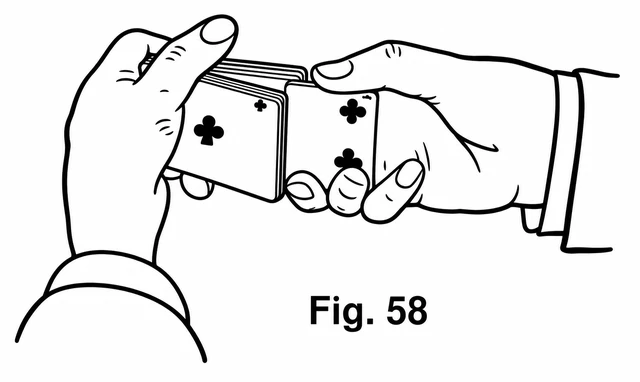
Compare Figure 58 with the original
The cards are held as described for “Mode of Holding Hand.” Separate the upper edges with both thumbs so that the right thumb can press against the card to be brought to the top. Bend this card slightly between right thumb and second and third fingers, so that it can be slipped from beneath the left thumb. Then, holding this card firmly, and keeping the right hand almost stationary, pull out the rest of the cards with the left hand by a backward and inward motion and by pressing the left fingertips against the back. (See Fig. 58.) Then shove the right-hand card on top. The action is not concealed, but made openly. It is a very common procedure for arranging any hand for play or discard. If the discard happen to lie together, bring them to the top with one action.
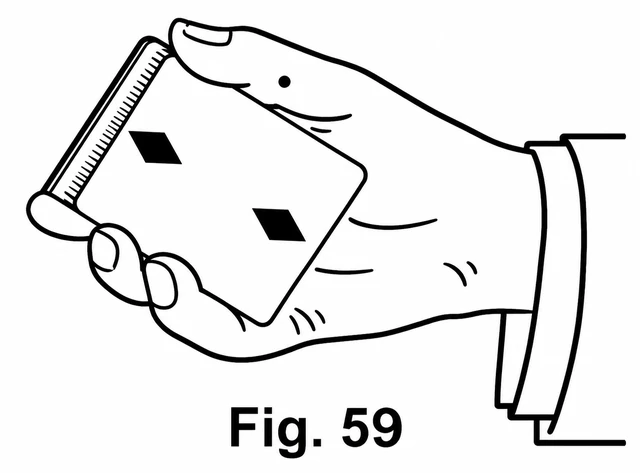
Compare Figure 59 with the original
Now the top cards must be palmed, and one of the methods already described in this work may be employed. But for use in this particular case we would advise another palm, which is most fitting for a discard, and especially the movements leading up to the actual palming. Form a break between the discard and the rest and hold the break with the right thumb. Shift the left thumb to the outer-end corner of the under packet, and slide it down about half an inch into the right palm. Close the break, hold cards with left hand, release the right and push the cards further down into the right palm between base of thumb and third and little fingers, sufficiently to allow tips of right thumb and second finger to reach the outer-end corners over the left thumb and little finger. (See Fig. 59.)
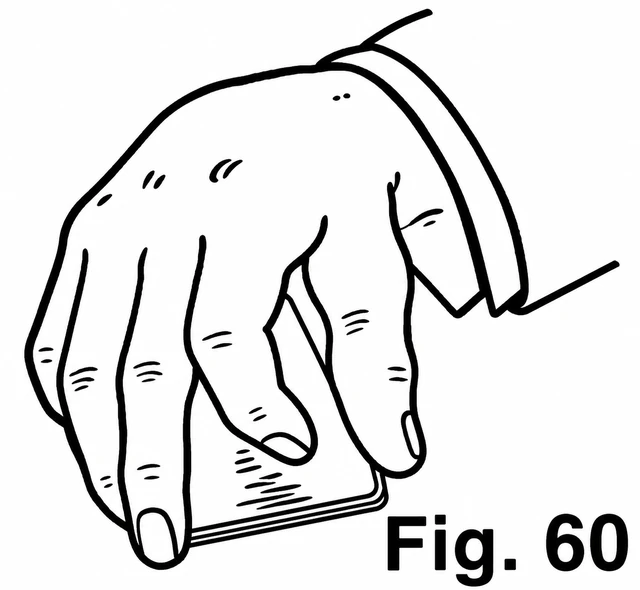
Compare Figure 60 with the original
Now release the left hand entirely and turn the right palm downward. This position covers the sides and the inner end completely, concealing the quantity, and the fact that the packets overlap, and yet has a very easy and natural appearance. ( See Fig. 60.) The right hand can now nonchalantly hold the cards, while the left handles the chips or makes a bet. When ready to deal again, the left hand seizes the cards from below, at the middle of sides, between second and third fingers and thumb, and the little finger on the protruding corner of the under packet, and at the same moment the right four fingers are shifted to the outer end as if to take the fresh hold.
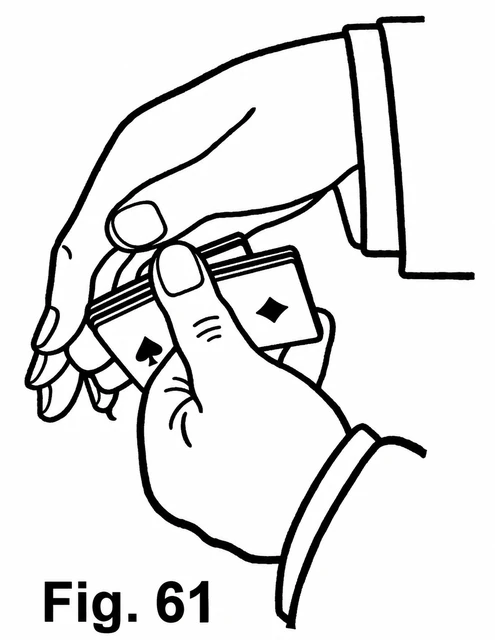
Compare Figure 61 with the original
Press down on the outer end, hold inner protruding end with left little finger, release the upper packet which is held by the left thumb and second and third fingers (see Fig. 61), and it will spring up into the right palm. The left hand instantly draws the under packet out sideways about half way, and the right hand drops it on the table and then places the palmed cards on the deck while picking it up.
This method of palming is excellent after the position is secured, and under the circumstances just described it is better to take this position than to make the palm immediately after the hand is skimmed. If it is desired to palm in the left hand, the discard is retained and the others brought to the top while skinning. Then one of the bottom palms described must be employed.
Book contents
Front matter
Card-table artifice
- Professional Secrets
- Technical Terms
- Position For Shuffle
- Blind Shuffles
- Blind Riffles
- Blind Cuts
- Fancy Blind Cuts
- One-Handed Fancy True Cut
- To Indicate the Location for the Cut
- Bottom Dealing
- Top And Bottom Dealing With One Hand
- Second Dealing
- Ordinary Methods Of Stocking, Locating And Securing
- Stock Shuffle
- Erdnase System of Stock Shuffling
- The Erdnase System of Cull Shuffling
- The Erdnase System of Palming
- To Maintain the Bottom Palm While Dealing
- To Hold the Location of Cut While Dealing
- Shifts — Card-Table Artifice
- To Ascertain the Top Cards While Riffling and Reserve Them at Bottom
- Mode of Holding the Hand
- Skinning the Hand
- The Player Without an Ally
- Three Card Monte
- Mexican Three Card Monte
Legerdemain
- Legerdemain
- Shifts — Legerdemain
- The Blind Shuffle for Securing Selected Card
- Forcing
- Palming
- The Back Palm
- Changes
- Transformations-Two Hands
- Transformations-One Hand
- Blind Shuffles, Retaining Entire Order
- Methods for Determining a Card Thought of
- To Get Sight of Selected Card
- The Slide
- Favorite Sleights for Terminating Tricks
Card tricks
- Card Tricks
- The Exclusive Coterie
- The Divining Rod
- The Invisible Flight
- Tricks With the Prearranged Deck
- The Traveling Cards
- The Row of Ten Cards
- The Acrobatic Jacks
- A Mind-Reading Trick
- Power of Concentrated Thought
- The Acme of Control
- The Card and Handkerchief
- The Top and Bottom Production
- The Three Aces
- The Card and Hat