Mexican Three Card Monte
WHEN the game is played in the following manner the better has no possible chance to win, and yet it appears simpler and easier shall the other. An entirely different subterfuge is employed by the dealer. The three cards are left perfectly flat. Sometimes the four corners are turned the very least upwards, merely enough to allow one card to be slipped under the other when Lying face down on the table, but the bend is not necessary.
The dealer now shows the faces of the three cards, and slowly lays them in a row. Then he makes a pretense of confusing the company by changing their places on the table. Now in explaining the game, he shows the faces of the cards by picking up one, and with it turning over the others, by slipping it under them and tilting them over face up. Then he turns them down again in the same manner and lays down the third card. This procedure is continued until the company understands the game, and the manner of showing the cards has grown customary, as it were.
When the bet is made and the player indicates his choice the dealer at once proclaims that the player has lost, and to prove it he picks one of the other cards and with it rapidly turns over the player’s card, and then the third card, and the third card proves to be the ace.
Of course the better can really select the ace every time, but he is not permitted to turn the cards himself, or touch them at all. The dealer exchanges the card he picks up for the player’s card, and again exchanges that for the third card, when apparently turning them over. The exchange is absolutely impossible to note, and is made as follows:
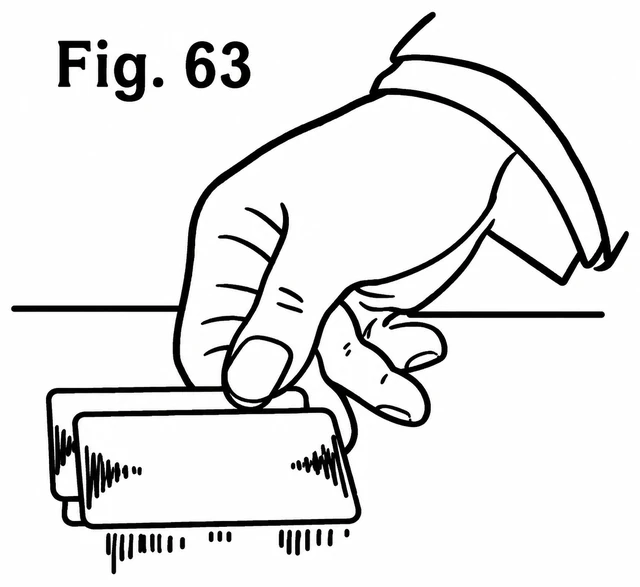
Compare Figure 63 with the original
Hold the card in the right hand between the tips of thumb and first finger close to right inner end corner, thumb on top. Slide the free side of this card under the right side of the card on the table, until it is about two- thirds concealed, but half an inch exposed at the outer end. (See Fig. 63.) This will bring the upper, inner end corner of the table card, against the tip of the second finger. Now shift the thumb to the corner of the table card, holding it against the second finger, carrying it to the left and turning over the lower card with the tip of the first finger. (See Fig. 64.)
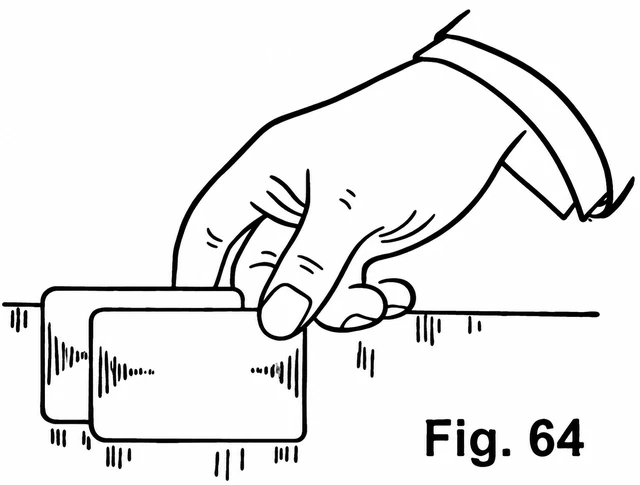
Compare Figure 64 with the original
Of course there is no hesitation in the action. The slipping of the hand card under the table card, and the turning over of the hand card, is done with one movement. The table card is not shown at this stage, but is slipped under the third card and the exchange is again made in like manner. Then the last card is shown.
This method of exchanging can be worked with the first method of dealing or throwing, but in such case the cards are not crimped.
To perform this feat perfectly a cloth covered table must be used. When the table is of polished wood the cards slip about, and it is much more difficult to slip the hand card into position under the other.
Book contents
Front matter
Card-table artifice
- Professional Secrets
- Technical Terms
- Position For Shuffle
- Blind Shuffles
- Blind Riffles
- Blind Cuts
- Fancy Blind Cuts
- One-Handed Fancy True Cut
- To Indicate the Location for the Cut
- Bottom Dealing
- Top And Bottom Dealing With One Hand
- Second Dealing
- Ordinary Methods Of Stocking, Locating And Securing
- Stock Shuffle
- Erdnase System of Stock Shuffling
- The Erdnase System of Cull Shuffling
- The Erdnase System of Palming
- To Maintain the Bottom Palm While Dealing
- To Hold the Location of Cut While Dealing
- Shifts — Card-Table Artifice
- To Ascertain the Top Cards While Riffling and Reserve Them at Bottom
- Mode of Holding the Hand
- Skinning the Hand
- The Player Without an Ally
- Three Card Monte
- Mexican Three Card Monte
Legerdemain
- Legerdemain
- Shifts — Legerdemain
- The Blind Shuffle for Securing Selected Card
- Forcing
- Palming
- The Back Palm
- Changes
- Transformations-Two Hands
- Transformations-One Hand
- Blind Shuffles, Retaining Entire Order
- Methods for Determining a Card Thought of
- To Get Sight of Selected Card
- The Slide
- Favorite Sleights for Terminating Tricks
Card tricks
- Card Tricks
- The Exclusive Coterie
- The Divining Rod
- The Invisible Flight
- Tricks With the Prearranged Deck
- The Traveling Cards
- The Row of Ten Cards
- The Acrobatic Jacks
- A Mind-Reading Trick
- Power of Concentrated Thought
- The Acme of Control
- The Card and Handkerchief
- The Top and Bottom Production
- The Three Aces
- The Card and Hat