Changes
UNDER this general heading we shall describe several of the best methods known for secretly exchanging one or several cards separated from the pack, for others in the pack or held in the other hand.
The Top Change
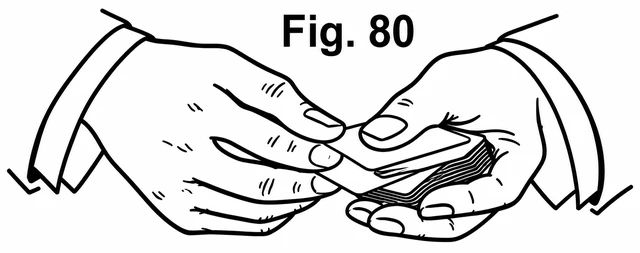
Compare Figure 80 with the original
HOLD the deck in the left hand crosswise, face down, the thumb resting across the top. Hold the card to be exchanged in the right hand between the thumb and first fingertips, thumb on top finger under. Now the hands are brought together for an instant by an easy swing, both hands moving in the same general direction but one hand faster than the other. As they meet the left thumb pushes the top card slightly over the side, the right hand places its card on top and clips the protruding card between the tips of the first and second fingers, carrying it off (see Fig. 80), the left thumb retaining the now top card and sliding it back into position on the deck. In theory it seems that this action will be very easily noticed. In practice, if cleverly performed, it is almost impossible to detect. The general movement or swing of the hands is not stopped when the exchange is made but continued until they are separated again by some little distance, and the swing should be taken naturally, with some ulterior motive, such as playing the card on the table or giving it to some one to hold. A slight turn of the person may bring the hands easily together. The swing may be made in any direction, in or out, up or down, to the right or left, the one hand following or passing the other, but in no case stopping until well separated again.
The Bottom Change
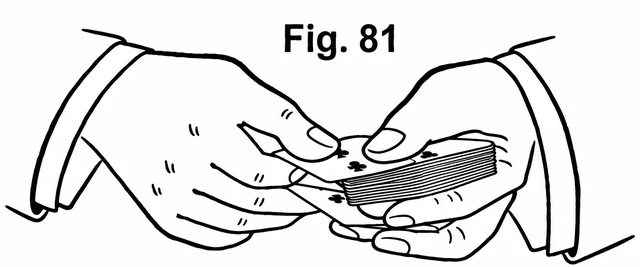
Compare Figure 81 with the original
IN THIS process the action is much the same, the difference being that the card in the right hand is passed to the bottom of the deck, the right hand carrying off the top card as before.
Hold the right hand card between the thumb and first and second fingertips, first finger on top. Hold the deck with the thumb and first finger, dropping the other fingers slightly to receive the right-hand card, drawing it back under the deck as the hands separate. The top card is pushed over as before and carried off by the right thumb and first finger. (See Fig. 81.) The swing of the hands is made in the same manner. The only difficulty in this change is getting the card fairly back under the deck with the left fingers.
The Palm Change
IN THIS process an entirely different subterfuge is employed, and it is probably the most ingenious ever devised for the purpose.
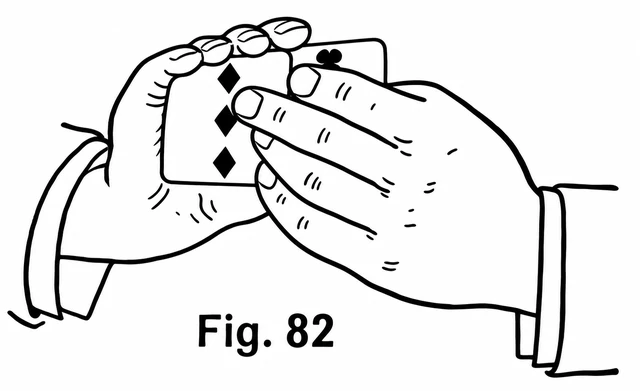
Compare Figure 82 with the original
The two cards to be exchanged are held in the right hand by the ends between the second and third fingertips and the thumb, and close together, so that when shown to the company they appear as one. The right hand is now turned palm down and the left hand apparently takes the card that was exposed, laying it on the table, but in reality takes the second card, leaving the other one palmed in the right hand. This is done by seizing both cards between the left thumb and second and third fingers, and drawing out the upper one with the thumb and pressing the lower one up into the right palm with the left fingers as the top one is drawn off. (See Fig. 82.)
This change is one of the simplest and easiest feats in the whole range of card slights, and yet one of the most useful and undetectable. The action should be performed in about the same time and manner that would ordinarily be taken in transferring a card from one hand to the other.
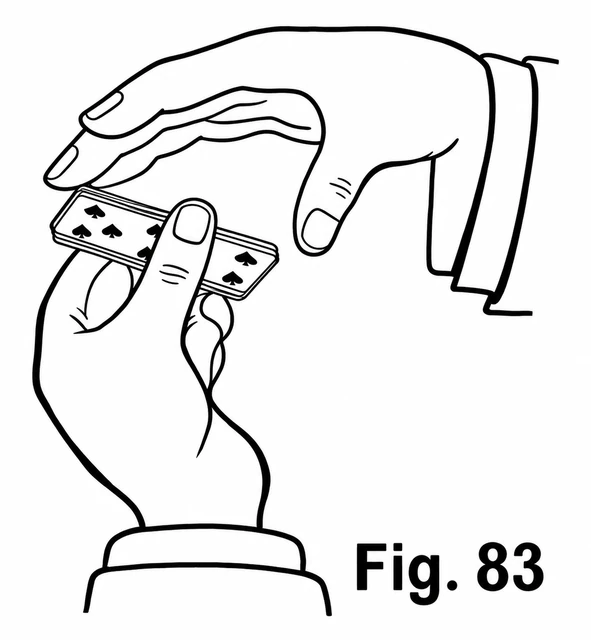
Compare Figure 83 with the original
THIS method may be employed to exchange one or several cards. The cards to be exchanged lie in a packet on the table face up. The other cards are secretly palmed face down in the left hand. The left hand now picks up the packet on the table by the sides, between the thumb and second and third fingertips, and transfers the packet to the right hand. As the left hand turns palm up the right hand palms the packet just picked up and seizes the packet in the left palm by the sides, carrying it slowly and openly away, and the left hand is seen empty. (See Fig. 83.)
As the right hand palms the upper cards the left first finger curls up under the palmed cards, bending them upward, thus enabling the right hand to seize them easier and also effectually taking out the crimp or bend that may have been caused while so closely palmed.
The only objectionable feature of this change is that the right hand carries the packet away by the sides, while it may have been noticed that the packet first in view was seized by the ends. But this is a splendid change for many purposes.
Book contents
Front matter
Card-table artifice
- Professional Secrets
- Technical Terms
- Position For Shuffle
- Blind Shuffles
- Blind Riffles
- Blind Cuts
- Fancy Blind Cuts
- One-Handed Fancy True Cut
- To Indicate the Location for the Cut
- Bottom Dealing
- Top And Bottom Dealing With One Hand
- Second Dealing
- Ordinary Methods Of Stocking, Locating And Securing
- Stock Shuffle
- Erdnase System of Stock Shuffling
- The Erdnase System of Cull Shuffling
- The Erdnase System of Palming
- To Maintain the Bottom Palm While Dealing
- To Hold the Location of Cut While Dealing
- Shifts — Card-Table Artifice
- To Ascertain the Top Cards While Riffling and Reserve Them at Bottom
- Mode of Holding the Hand
- Skinning the Hand
- The Player Without an Ally
- Three Card Monte
- Mexican Three Card Monte
Legerdemain
- Legerdemain
- Shifts — Legerdemain
- The Blind Shuffle for Securing Selected Card
- Forcing
- Palming
- The Back Palm
- Changes
- Transformations-Two Hands
- Transformations-One Hand
- Blind Shuffles, Retaining Entire Order
- Methods for Determining a Card Thought of
- To Get Sight of Selected Card
- The Slide
- Favorite Sleights for Terminating Tricks
Card tricks
- Card Tricks
- The Exclusive Coterie
- The Divining Rod
- The Invisible Flight
- Tricks With the Prearranged Deck
- The Traveling Cards
- The Row of Ten Cards
- The Acrobatic Jacks
- A Mind-Reading Trick
- Power of Concentrated Thought
- The Acme of Control
- The Card and Handkerchief
- The Top and Bottom Production
- The Three Aces
- The Card and Hat