Using the Overhand Shuffle
Controlling the Top Card
Controlling the Bottom Card
Retaining the Top and Bottom Cards in Position
Top Card to Next to Bottom and Back to the Top
The Run
The Injog
The Undercut
Controlling the Top Card
1. Holding the deck as explained, lift it with the right hand, and with the left thumb draw off the top card only in the first movement of the shuffle. Without the slightest pause or hesitation shuffle the other cards on to this one until the shuffle has been completed. The top card is now at the bottom of the pack.
2. Again lift the entire pack and repeat the shuffle you have just made down to the last card, which we know was the card originally at the top. Drop this card on top of all the others in the last movement of the shuffle. After a few trials you will find that this last card will cling to the thumb and fingers without any conscious effort on your part.
In this sleight, as well as in the others to follow, the action must become automatic so that you can look at, talk with, and give your whole attention to your audience. Only in this way can you convince the onlookers that the shuffle is genuine, and you should never forget that it is at this very starting point that illusion begins or is destroyed. If you stare fixedly at your hands while shuffling, Suspicion will inevitably be aroused, and if a spectator suspects that you have "done something" the illusion of your magic is gone.
In practising this shuffle and those that follow, it is a good plan to turn the top card face upwards so that at the finish you can see at a glance if you have made it correctly.
Controlling the Bottom Card
1. Lift the lower half of the pack to begin the shuffle, and in so doing press lightly on the bottom card with the tips of the left middle and ring fingers, holding it back and thus adding it to the bottom of the packet remaining in the left hand.
2. Shuffle off the cards remaining in the right hand, and repeat the action if desired. Nothing could be simpler than this control, and the sleight is valuable because of its ease and naturalness.
Retaining the Top and Bottom Cards in Position
1. Grip the entire pack with the right hand to start the shuffle, at the same time pressing lightly on the top card with the left thumb and on the bottom card (Fig. 2) with the left middle and ring fingers holding them back so that all the cards except these two are lifted clear, the top card falling upon the bottom card. Continue the shuffle, without pause, until completed.
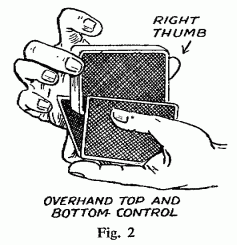
2. Pat the upper side of the deck square and repeat the moves exactly as before by lifting out all but the top and bottom cards, then shuffle off to the last card of those held in the right hand, the card originally at the top, and drop it back again on the top.
Be careful not to pull the cards away sharply in the first movement of the shuffle, making the top and bottom cards come together with a "click." Use a light touch. Note that by placing two known cards at the bottom and a third at the top, all three cards can be controlled by this valuable artifice. Practise the sleight in this way until you can do it with ease and certainty.
Top Card to Next to Bottom and Back to the Top
1. Lift the pack for the shuffle, retaining the top and bottom cards in the left hand as in the preceding sleight. Shuffle the cards in the right hand on to the two cards in the left hand without hesitation. The card originally on the top is now next to the bottom card.
2. Again lift the pack, retaining the top and bottom cards in the left hand. Shuffle off the cards in the fight hand upon the two in the left, allowing the bottom card to fall last, thus returning the top card to its original position.
Later you will find that this sleight is useful for showing that a chosen card which you are controlling is neither at the top nor at the bottom of the pack.
The Run
In magical parlance, this term means the pulling off of cards one by one from the right hand packet with the aid of the left thumb in the course of the shuffle. To make the run, press the left thumb lightly on the back of the top card of the right hand packet while holding this latter packet just tightly enough to allow one card only to escape. It is very important that the single cards be drawn off at the same tempo as the rest of the shuffle, so that there will be no hesitation at the start of the shuffle or its end.
A few minutes' practice with cards that are in good condition will prove how easy the sleight is, yet it is one of the most useful in the card man's arsenal.
The Injog
This term is applied to the subterfuge of causing a card to project about one quarter of an inch from the inner end of the deck. It is one of the oldest stratagems in magic, having been in use for three and a half centuries. It was first mentioned in Scott's Discouverie of Witchcraft , published in 1584.
The action of jogging a card is a simple one. In the course of the shuffle, when a card is to be jogged, move the fight hand slightly towards the body, draw off one card with the left thumb, then move the hand back to its former position and continue the shuffle in the usual way. The card thus jogged should rest on the little finger tip, which enables you to know, by sense of touch alone, that the card is in the proper position (Fig. 3).
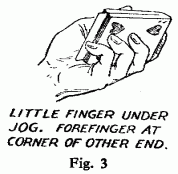
It is advisable at the start to make the card protrude about half an inch and, in shuffling off the remaining cards from the right hand, to make them lie irregularly so that the protruding card is covered and concealed. With practice the jogging of the card can be reduced to approximately a quarter of an inch. Here again it is most important that there shall be no alteration in the tempo. The card must be jogged and the shuffle continued without the least hesitation.
The Undercut
This sleight is used to bring the cards directly under a jogged card to the top of the pack, in the following manner:
A card having been jogged and the shuffle completed, bring the fight hand upwards from a position a little below the left hand so that the point of the thumb will strike against the face of the jogged card, lifting it and the cards above it slightly; then move the right hand outwards with the lower packet, the thumbnail scraping against the face of the jogged card while the middle and ring fingers close on the outer end of the packet. Lift the packet clear and throw it on the top of the deck. This action brings the jogged card to the bottom and the card directly below it to the top of the pack.
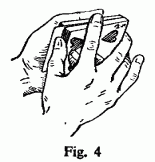
To undercut to a jogged card is a very simple action if the right thumb strikes upward , not inward (Fig. 4).
Book contents
Front matter
The Overhand Shuffle, I
- The Overhand Shuffle, I
- The Overhand Shuffle
- Using the Overhand Shuffle
- Overhand Shuffle Control
- Overhand Shuffle Practice Routine
- Tricks With the Overhand Shuffle
- Introduction
- Topsy-Turvy Cards
- A Poker Player's Picnic
- A Pocket Discovery
- Telepathy Plus
- Thought Stealer
- Pinkie Does It
- A Card and a Number
II. The Riffle Shuffle
- II. The Riffle Shuffle
- The Riffle Shuffle
- Riffle Shuffle Control
- Riffle Shuffle in the Air
- Tricks with the Riffle Shuffle
- An Instinct for Cards
- Mirror of the Mind
- Ultra Card Divination
III. Flourishes
- III. Flourishes
- Introduction
- Displaying the Top Card
- The Ruffle
- The Click
- Spread and turnover
- Springing the Cards
- A Flourish Count
- Throwing a Card
- Waterfall Shuffle
- The Fan
- One-Hand Fan
- Thumb Fan
- Pressure Fan
IV The Glide
V The Glimpse
- V The Glimpse
- Introduction
- Bottom-Card Glimpse
- Top-Card Glimpse
- Fan Peek
- Tricks with the Glimpse
- Gray's Spelling Trick
- Round and Round
VI The Key Card
- VI The Key Card
- Introduction
- The Key Undercut
- Key Undercut Shuffle
- Tricks with the Key Card
- Do as I Do
- The Three Piles
- The Twenty-Sixth Card
- A Meeting of the Minds
- The Non-Poker Voice
- Intuition with Cards
- Sliding Key Card
VII The Palm
- VII The Palm
- Introduction
- Top Palm
- Palm Glimpse
- Replacing Palmed Cards
- Tricks with the Palm
- Card in the Pocket
- Now You See It!
- Grab-Bag Card
- Good-Luck Card
- Do It and Fail
- Gathering of the Clan
- Spring Catch
- A Vested Interest
- Piano Trick
VIII The Backslip
- VIII The Backslip
- The Backslip
- Backslip Force
- Backslip Control
- Tricks with the Backslip
- Lightning Card
- The Tantalizer
- Under Your Hat
IX The Overhand Shuffle, II
- IX The Overhand Shuffle, II
- Injog and Break
- Overhand Break Control
- Overhand Lift Shuffle
- Lift Shuffle Force
- Spread and Break
- Holding a Break
- Spread and Break Control
- Tricks with the Overhand Shuffles
- The Sevens
- Obliging Aces
- Leapfrog
- Spectator's Card Trick
- A Poker Puzzle
X False Shuffles and Cuts
- X False Shuffles and Cuts
- Optical Shuffle
- Charlier Shuffle
- The Cut
- Palm Cut
- Tricks With the Shuffles and Cuts
- An Incomprehensible Divination
- Circus Card Trick
- Black Jack, Detective
XI The Double Lift and turnover
- XI The Double Lift and turnover
- The Double Lift and Turnover
- Double-Lift Glimpse
- Double-Lift Card Reverses
- Tricks with the Double Lift
- Rapid Transit
- The Trey
- Ambitious Card
- Throughth and Consequences
- Insidious Dr. Fu Liu Tu
XII The Pass
- XII The Pass
- Introduction
- The Pass
- Riffle Pass
- Spread Pass
- Spring Pass
- Tricks with the Pass
- Off Agin, On Agin, Finnegin!
- Kangaroo Card
- Righting a Wrong
- Blindfolded Pack
- Double Speller
XIII Miscellaneous Flourishes
- XIII Miscellaneous Flourishes
- Color Change
- Double Color Change
- The Changing Card
- Self-Cutting Deck
- A Pretty Cut
- Pop-Up Card
- A Bit of Byplay
- Charlier Cut
- Acrobatic Aces
XIV The Reverses
- XIV The Reverses
- The Reverses
- Reversed Location
- Tricks with the Reverses
- Spellbound
- A Tipsy Trick
- Double Reverse
- Mentalivity
- Mountebank Miracle
XV The Hindu Shuffle and Other Controls
- XV The Hindu Shuffle and Other Controls
- The Hindu Shuffle
- Hindu Shuffle Control
- Hindu Shuffle Force
- Hindu Shuffle Glimpse
- The Step
- Natural Jog
- Twelve-Down Riffle
- Tricks with the Hindu Shuffle
- All Change Here
- Ewephindit
XVI The Classic Force
- XVI The Classic Force
- The Classic Force
- One-Hand Force
- Bottom Force
- Slide-Out Force
- Two-Card Force
- Riffle-Break Force
- Sliding-Key Force
- Double-Lift Force
- Cut Force
- Tricks with the Force
- Justice Card Trick
- Fours of a Kind
- Pulse Trick
XVII Top and Bottom Changes
- XVII Top and Bottom Changes
- Top Change
- The Changing Card
- Top-Change Byplay
- Bottom Change
- Top and Bottom Changes
XVIII Arrangements
- XVIII Arrangements
- Arrangements
- Tricks with Arrangements
- The Selective Touch
- A Future in Cards
- Jacks Wild
- Think Stop
- Deal Away
- The Educated Cards
- Reds and Blacks
XIX Routines
- XIX Routines
- Routining Card Tricks
- A Table Routine
- A Rollicking Routine
- Card-Discovery Routine
- Razzle-Dazzle Routine