The Classic Force
Forcing a card is the act of making a spectator remove from the pack a card which you wish him to take, although he believes that he has a free choice.
Of all the methods evolved for accomplishing this, the classic force is the oldest and still the best. In this method you spread the deck and invite someone to draw a card. You place the card you want him to take under his fingers at the moment they touch the pack. He removes this card, confident that he has had an uninfluenced choice.
The mechanics of this force are as follows:
1. Let us say that you wish to force the ace of hearts, and this is at the top of the pack. Give the cards an overhand shuffle , taking the card to the bottom and back to the top.
2. Next take the force card to the middle of the pack in the following way: Give the pack another overhand shuffle by undercutting the lower half, injogging the first card, and shuffling off. Turn the left hand so that the pack is horizontal, with the backs of the cards uppermost. Place the right hand over the pack, with fingers at the outer end and the thumb at the inner end. Place the tip of the thumb under the inner edge of the injogged card, pressing it upwards and inwards, so that when it is pushed flush with the pack there will be a small break under it and above the card to be forced. Hold this break with the right thumb, then shift the left hand so that it holds the pack, with the little finger holding the break above the card to be forced.
Unlike the usual method of holding a break, the tip of the left little finger in this case rests against the face of the card above the break.
3. Push cards off the top of the pack with the left thumb, taking them with the right hand, and request someone to take a card. (Robert- Houdin, in Secrets of Conjuring and Magic , has this to say: "It is well to say take, and not choose, though the latter word is frequently used. The word choose implies a liberty of action which it is better not to suggest too strongly.")
Press the left little finger firmly against the side of the lower packet, preventing these cards from spreading to the right.
4. Time the spreading of the cards so that, at the moment the spectator's hand reaches the pack, all the cards above the break have been pushed into the right hand and you are beginning to push the cards under it; the first of these cards, you will remember, is the card to be forced.
At the very moment that you begin to push off this lower portion, the spectator's hand arrives at the deck to make a choice. Advance both hands two or three inches toward his hand and literally place the force card under his fingers. That must be done with finesse, and this is where experience enters into the picture. After you have done a good deal of forcing, you will find that there is a knack in spreading the cards so that the force card is under the spectator's fingers at precisely the right moment.
If, when you first begin to force cards, you find that you have exposed the force card too soon, here is what you do: Spread a few more cards with the left thumb and stop. Hold the pack as in Fig. 105. A little more of the force is exposed than of any other card. Now, as the spectator's hand approaches, turn both hands and the cards a little to the right or left a matter of less than an inch, to make the force card the most convenient to his hand. In ninety-nine cases out of a hundred he will take the card.
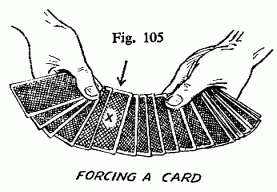
We have mentioned that the tip of the left little finger presses up into the break against the face of the lowermost card of the upper packet. This is a great help in forcing, for when the left thumb pushes this card to the right you can feel it glide over the finger tip and thus you know that the next card is the force card. With experience you can force a card without looking at the pack, relying solely on your left little finger's sense of touch to tell you when you have come to the force card.
The force is certainly simple, but to do it with dead certainty calls for experience and for the timing which comes only with experience. There are also psychological factors which must be kept in mind.
(a) You should shuffle the cards before the force so that you cannot seem to know the position of any card. If the spectator believes this to be the ease, he will remove any card without suspicion, since it does not seem to matter which card he takes.
(b) You must not, by your manner or by anything you say, lead anyone to believe that you have a reason for forcing a card. Your manner must be easy and relaxed. If you are tense, this will be noticed, and although the spectator may not know what you have in mind he will be difficult to control.
You may think: Very well. But, while I am gaining experience, what shall I do if the force fails?
Let us say that the force has failed and that a card has been drawn two or three beyond the force card. Have the card returned at the place from which it was taken and count the number of cards intervening between it and the force card. The force card, the name of which you know, thus becomes a key card, and to locate the chosen card you need only count the number of cards above or below it that you noted previously.
If the card has been removed from a point too far distant from the force card to enable you to count the intervening cards, you do this:
Have the card withdrawn from the pack and, as its name is being noted, remove all the cards to the right of the force card with the right hand. This is easy, because the tip of the left little finger still presses up against the face of the card just above it. Hold these a few inches away from those spread in the left hand and have the selected card replaced on the left-hand portion. Dropping the cards held by the right hand on top of all completes the action. To find the chosen card, look for the card just above your force card, which acts as a key card.
You may still think: But what if the force fails and I cannot use the force card as a key card? In such a predicament, you then do another trick which does not require that a card be forced. You have not stated what you would do with the drawn card, and no one will know that you have changed your plans. This is very important for you, because the knowledge that failure is not going to prove a disaster will prevent tenseness, which spoils more forces than any other single factor.
A final word on the matter of experience. To get experience, make it a practice to attempt to force a card in every trick you perform, whether it calls for a force or not–if, of course, the nature of the trick permits this. In that way you will get invaluable experience and learn the timing of the force, and if you fail in the first few attempts it is a matter of no consequence. You should never, however, force the same card repeatedly simply to show how clever you are, for this is tantamount to revealing a method which you should keep secret.
Book contents
Front matter
The Overhand Shuffle, I
- The Overhand Shuffle, I
- The Overhand Shuffle
- Using the Overhand Shuffle
- Overhand Shuffle Control
- Overhand Shuffle Practice Routine
- Tricks With the Overhand Shuffle
- Introduction
- Topsy-Turvy Cards
- A Poker Player's Picnic
- A Pocket Discovery
- Telepathy Plus
- Thought Stealer
- Pinkie Does It
- A Card and a Number
II. The Riffle Shuffle
- II. The Riffle Shuffle
- The Riffle Shuffle
- Riffle Shuffle Control
- Riffle Shuffle in the Air
- Tricks with the Riffle Shuffle
- An Instinct for Cards
- Mirror of the Mind
- Ultra Card Divination
III. Flourishes
- III. Flourishes
- Introduction
- Displaying the Top Card
- The Ruffle
- The Click
- Spread and turnover
- Springing the Cards
- A Flourish Count
- Throwing a Card
- Waterfall Shuffle
- The Fan
- One-Hand Fan
- Thumb Fan
- Pressure Fan
IV The Glide
V The Glimpse
- V The Glimpse
- Introduction
- Bottom-Card Glimpse
- Top-Card Glimpse
- Fan Peek
- Tricks with the Glimpse
- Gray's Spelling Trick
- Round and Round
VI The Key Card
- VI The Key Card
- Introduction
- The Key Undercut
- Key Undercut Shuffle
- Tricks with the Key Card
- Do as I Do
- The Three Piles
- The Twenty-Sixth Card
- A Meeting of the Minds
- The Non-Poker Voice
- Intuition with Cards
- Sliding Key Card
VII The Palm
- VII The Palm
- Introduction
- Top Palm
- Palm Glimpse
- Replacing Palmed Cards
- Tricks with the Palm
- Card in the Pocket
- Now You See It!
- Grab-Bag Card
- Good-Luck Card
- Do It and Fail
- Gathering of the Clan
- Spring Catch
- A Vested Interest
- Piano Trick
VIII The Backslip
- VIII The Backslip
- The Backslip
- Backslip Force
- Backslip Control
- Tricks with the Backslip
- Lightning Card
- The Tantalizer
- Under Your Hat
IX The Overhand Shuffle, II
- IX The Overhand Shuffle, II
- Injog and Break
- Overhand Break Control
- Overhand Lift Shuffle
- Lift Shuffle Force
- Spread and Break
- Holding a Break
- Spread and Break Control
- Tricks with the Overhand Shuffles
- The Sevens
- Obliging Aces
- Leapfrog
- Spectator's Card Trick
- A Poker Puzzle
X False Shuffles and Cuts
- X False Shuffles and Cuts
- Optical Shuffle
- Charlier Shuffle
- The Cut
- Palm Cut
- Tricks With the Shuffles and Cuts
- An Incomprehensible Divination
- Circus Card Trick
- Black Jack, Detective
XI The Double Lift and turnover
- XI The Double Lift and turnover
- The Double Lift and Turnover
- Double-Lift Glimpse
- Double-Lift Card Reverses
- Tricks with the Double Lift
- Rapid Transit
- The Trey
- Ambitious Card
- Throughth and Consequences
- Insidious Dr. Fu Liu Tu
XII The Pass
- XII The Pass
- Introduction
- The Pass
- Riffle Pass
- Spread Pass
- Spring Pass
- Tricks with the Pass
- Off Agin, On Agin, Finnegin!
- Kangaroo Card
- Righting a Wrong
- Blindfolded Pack
- Double Speller
XIII Miscellaneous Flourishes
- XIII Miscellaneous Flourishes
- Color Change
- Double Color Change
- The Changing Card
- Self-Cutting Deck
- A Pretty Cut
- Pop-Up Card
- A Bit of Byplay
- Charlier Cut
- Acrobatic Aces
XIV The Reverses
- XIV The Reverses
- The Reverses
- Reversed Location
- Tricks with the Reverses
- Spellbound
- A Tipsy Trick
- Double Reverse
- Mentalivity
- Mountebank Miracle
XV The Hindu Shuffle and Other Controls
- XV The Hindu Shuffle and Other Controls
- The Hindu Shuffle
- Hindu Shuffle Control
- Hindu Shuffle Force
- Hindu Shuffle Glimpse
- The Step
- Natural Jog
- Twelve-Down Riffle
- Tricks with the Hindu Shuffle
- All Change Here
- Ewephindit
XVI The Classic Force
- XVI The Classic Force
- The Classic Force
- One-Hand Force
- Bottom Force
- Slide-Out Force
- Two-Card Force
- Riffle-Break Force
- Sliding-Key Force
- Double-Lift Force
- Cut Force
- Tricks with the Force
- Justice Card Trick
- Fours of a Kind
- Pulse Trick
XVII Top and Bottom Changes
- XVII Top and Bottom Changes
- Top Change
- The Changing Card
- Top-Change Byplay
- Bottom Change
- Top and Bottom Changes
XVIII Arrangements
- XVIII Arrangements
- Arrangements
- Tricks with Arrangements
- The Selective Touch
- A Future in Cards
- Jacks Wild
- Think Stop
- Deal Away
- The Educated Cards
- Reds and Blacks
XIX Routines
- XIX Routines
- Routining Card Tricks
- A Table Routine
- A Rollicking Routine
- Card-Discovery Routine
- Razzle-Dazzle Routine