Topsy-Turvy Cards
It is always a good rule to begin a series of card feats with a short, startling effect, one that will arouse the interest of the onlookers immediately and stimulate their interest in the marvels to follow. In this effect one half of the pack is placed face to face with the other half, yet, on the word of command, the cards right themselves so that all of them face the same way.
Whenever possible you should use a borrowed deck, and we shall suppose that one has been handed to you with the request: "Show us some card tricks."
1. Take the pack and place it face down on your left hand. With your left thumb spread the cards by pushing them over to the fight hand under pretence of examining the backs. "These seem to be ordinary cards," you say. "Let's see the faces." Close the deck into the left hand and square the cards, holding them in dealing position.
2. Take hold of the outer end of the deck between the right thumb on top and the fingers on the bottom, lift it and turn it over inwards–that is to say, towards your body–and lay it in your left hand, face upwards. Spread the cards as before, showing the faces and remarking, "Just ordinary cards, aren't they?" Close the pack into the left hand again and square it, but this time, in doing so, let the lowermost card slip off the tip of the fight thumb
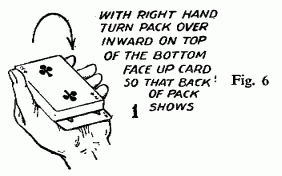
and push the rest of the cards forward about an inch (Fig. 6).
3. Grasp the outer end of the deck as before and turn it over inward on to the left hand and on to the face-up card. Square the pack and hold it in your left hand so that it slopes downward a little; thus no one can see the reversed card now on the bottom.
4. Cut off about half the cards by grasping them at the ends between the fight thumb and middle finger. Turn the right hand over with a little flourish to show the face card of this packet and look at that card yourself, saying, "I turn one half of the cards face upward, so." As you say this, quietly turn your left hand over bringing it back upwards, thus bringing the reversed card uppermost (Fig. 7).
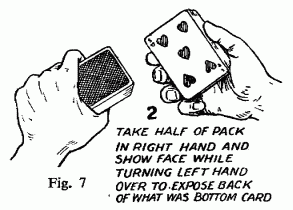
5. Still keeping your eyes fixed on the face card of the packet in your right hand, continue: "I'll put this packet face upwards on the back of my left hand." Do so (Fig. 8). The packet in the left hand, which the spectators think is face downwards, is really face upward with a single reversed card on top.
6. Draw out the packet from your left hand, grasping it at the sides near the ends, as you say, "These face- down cards I'll place on the face- up packet," and you do so, being careful to slope the packet so that no glimpse can be had of its
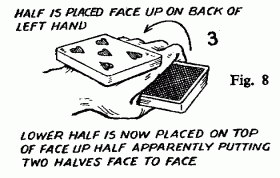
bottom card. Take the pack off the back of your left hand and replace it in that hand, which you turn palm upwards, between the tips of the thumb on one side and the fingers on the other. With the right hand turn the pack over sideways three times, each time taking it between the left thumb and fingers as you say, "You see half the pack faces one way, the other half the reverse way." The third turn will bring the single reversed card to the bottom.
7. "I want to test these cards to see if I shall be able to do anything with them. I shall therefore order all the face-up cards to turn face downwards. Let me show you what I mean. I take one of the face-up cards, so." Draw out the bottom card by the end toward your body, deliberately turn it face downwards on the top of the pack. " Allez oop! " you exclaim, and, with a flourish, you spread the whole pack on the table. All the cards are face downwards. "Excellent! You have trained your cards well. I am sure we shall have a great success with them."
The most important thing for the beginner at card magic to bear in mind is this: A conjuring trick is just what the performer makes of it. It may be composed of the simplest elements, yet, given a plausible plot and dressed with appropriate patter, it can be transformed into an imposing illusion. In other words, it is not so much what you do as what you make the onlookers think you do.
The preceding trick affords an example of this fact. Merely to take the cards and go through the motions of apparently reversing them would be a tame affair, a mere curiosity. Asserting that the cards are intelligent, that they can be trained to act by themselves, puts a different complexion on the matter. The onlookers are amused by your fairy tale; they take a greater interest in the performance and sometimes actually persuade themselves that there might be something in it after all.
It has been said that "the proper way to do tricks is to do tricks." That is true, provided it is borne in mind that the tricks must not only be done but must also be presented or acted properly. Good presentation can only be acquired by actual performance before an audience, even if it is composed only of your home circle. Confidence in yourself is the main thing. If you know that you can do the trick without any possible hitch, then you can devote your whole attention to "putting across" the fairy tales which you are telling. To help you in gaining this confidence, we shall from time to
time explain tricks which practically work themselves–self-workers, as they are called.
The art of interspersing these self-workers with tricks that call for skill is an important principle of card magic. The most eminent magicians use self-workers; but they use only the good ones, never those which call for endless dealing of cards or obvious mathematical principles. Some of the good self-workers are gems of subtlety and misdirection. Some of them depend on faults of observation on the part of the spectators; many depend on the inability of most people to understand properly what is being done.
The trick that follows is one of the latter kind and, when you have performed it, you will be astonished at the effect it causes. It is called A Poker Player's Picnic .
Book contents
Front matter
The Overhand Shuffle, I
- The Overhand Shuffle, I
- The Overhand Shuffle
- Using the Overhand Shuffle
- Overhand Shuffle Control
- Overhand Shuffle Practice Routine
- Tricks With the Overhand Shuffle
- Introduction
- Topsy-Turvy Cards
- A Poker Player's Picnic
- A Pocket Discovery
- Telepathy Plus
- Thought Stealer
- Pinkie Does It
- A Card and a Number
II. The Riffle Shuffle
- II. The Riffle Shuffle
- The Riffle Shuffle
- Riffle Shuffle Control
- Riffle Shuffle in the Air
- Tricks with the Riffle Shuffle
- An Instinct for Cards
- Mirror of the Mind
- Ultra Card Divination
III. Flourishes
- III. Flourishes
- Introduction
- Displaying the Top Card
- The Ruffle
- The Click
- Spread and turnover
- Springing the Cards
- A Flourish Count
- Throwing a Card
- Waterfall Shuffle
- The Fan
- One-Hand Fan
- Thumb Fan
- Pressure Fan
IV The Glide
V The Glimpse
- V The Glimpse
- Introduction
- Bottom-Card Glimpse
- Top-Card Glimpse
- Fan Peek
- Tricks with the Glimpse
- Gray's Spelling Trick
- Round and Round
VI The Key Card
- VI The Key Card
- Introduction
- The Key Undercut
- Key Undercut Shuffle
- Tricks with the Key Card
- Do as I Do
- The Three Piles
- The Twenty-Sixth Card
- A Meeting of the Minds
- The Non-Poker Voice
- Intuition with Cards
- Sliding Key Card
VII The Palm
- VII The Palm
- Introduction
- Top Palm
- Palm Glimpse
- Replacing Palmed Cards
- Tricks with the Palm
- Card in the Pocket
- Now You See It!
- Grab-Bag Card
- Good-Luck Card
- Do It and Fail
- Gathering of the Clan
- Spring Catch
- A Vested Interest
- Piano Trick
VIII The Backslip
- VIII The Backslip
- The Backslip
- Backslip Force
- Backslip Control
- Tricks with the Backslip
- Lightning Card
- The Tantalizer
- Under Your Hat
IX The Overhand Shuffle, II
- IX The Overhand Shuffle, II
- Injog and Break
- Overhand Break Control
- Overhand Lift Shuffle
- Lift Shuffle Force
- Spread and Break
- Holding a Break
- Spread and Break Control
- Tricks with the Overhand Shuffles
- The Sevens
- Obliging Aces
- Leapfrog
- Spectator's Card Trick
- A Poker Puzzle
X False Shuffles and Cuts
- X False Shuffles and Cuts
- Optical Shuffle
- Charlier Shuffle
- The Cut
- Palm Cut
- Tricks With the Shuffles and Cuts
- An Incomprehensible Divination
- Circus Card Trick
- Black Jack, Detective
XI The Double Lift and turnover
- XI The Double Lift and turnover
- The Double Lift and Turnover
- Double-Lift Glimpse
- Double-Lift Card Reverses
- Tricks with the Double Lift
- Rapid Transit
- The Trey
- Ambitious Card
- Throughth and Consequences
- Insidious Dr. Fu Liu Tu
XII The Pass
- XII The Pass
- Introduction
- The Pass
- Riffle Pass
- Spread Pass
- Spring Pass
- Tricks with the Pass
- Off Agin, On Agin, Finnegin!
- Kangaroo Card
- Righting a Wrong
- Blindfolded Pack
- Double Speller
XIII Miscellaneous Flourishes
- XIII Miscellaneous Flourishes
- Color Change
- Double Color Change
- The Changing Card
- Self-Cutting Deck
- A Pretty Cut
- Pop-Up Card
- A Bit of Byplay
- Charlier Cut
- Acrobatic Aces
XIV The Reverses
- XIV The Reverses
- The Reverses
- Reversed Location
- Tricks with the Reverses
- Spellbound
- A Tipsy Trick
- Double Reverse
- Mentalivity
- Mountebank Miracle
XV The Hindu Shuffle and Other Controls
- XV The Hindu Shuffle and Other Controls
- The Hindu Shuffle
- Hindu Shuffle Control
- Hindu Shuffle Force
- Hindu Shuffle Glimpse
- The Step
- Natural Jog
- Twelve-Down Riffle
- Tricks with the Hindu Shuffle
- All Change Here
- Ewephindit
XVI The Classic Force
- XVI The Classic Force
- The Classic Force
- One-Hand Force
- Bottom Force
- Slide-Out Force
- Two-Card Force
- Riffle-Break Force
- Sliding-Key Force
- Double-Lift Force
- Cut Force
- Tricks with the Force
- Justice Card Trick
- Fours of a Kind
- Pulse Trick
XVII Top and Bottom Changes
- XVII Top and Bottom Changes
- Top Change
- The Changing Card
- Top-Change Byplay
- Bottom Change
- Top and Bottom Changes
XVIII Arrangements
- XVIII Arrangements
- Arrangements
- Tricks with Arrangements
- The Selective Touch
- A Future in Cards
- Jacks Wild
- Think Stop
- Deal Away
- The Educated Cards
- Reds and Blacks
XIX Routines
- XIX Routines
- Routining Card Tricks
- A Table Routine
- A Rollicking Routine
- Card-Discovery Routine
- Razzle-Dazzle Routine