Now You See It!
Have a spectator select a card, note it, return it to the pack, and himself shuffle the pack. Announce that you will find the card if you are allowed four attempts. Accordingly you remove four cards from the deck without showing their faces. When, however, you do show the cards, not one of them is the chosen card. You replace them on the table, request the spectator to point to one of them, and–lo and behold– it is his card!
1. First of all, before you offer to show the trick, secretly note and remember the bottom card of the deck. Bring this card to the top with an overhand shuffle . Let us assume that this card is the four of spades.
2. Holding the deck in your left hand, place both hands behind your back, saying, "I propose to attempt a surprising little feat under these conditions, with the cards held behind my back to prove that the result is inherent in the cards. I have nothing to do with it, it just happens as you will see." While saying this and still facing the audience, with your left thumb push the top card (the four of spades) into your right hand, its back against the palm and the slightly bent fingers. Turn this hand palm upwards and with it clasp the back of the left hand. In this position the card held in the right hand is concealed in a natural manner.
3. Turn your back to the audience and ask a spectator to take the pack and shuffle it. When he has done so, request him to replace it in your hand face downwards . Failure to make this last stipulation would lead to an embarrassing result.
Continue: "You have shuffled the cards, and clearly I cannot know the position of any card. Now will you cut the pack at any point you wish?" When the spectator has removed the upper portion of the pack, turn around facing him and ask him, "Will you assure everyone that you cut the cards at a point of your own choice?" Seize this opportunity to place the card secretly held in your right hand on top of the remainder of the pack in your left hand and again grasp the back of the left hand exactly as before. Be careful not to move your elbows during this action.
4. Once more turn your back to the audience and with your left thumb push forward the top card of your packet. This is, of course, the four of spades which you have just secretly added, but the onlookers will be convinced that it is a card the name of which you cannot possibly know. Continue, "Please take the card at which you cut and show it to everyone."
Pause for a moment or two, then say, "Now replace the card on this packet and then place your packet on top of all. Finally, take the pack and shuffle it thoroughly so that none of us can have the slightest notion where your card may be in the deck."
5. When this has been done, face your audience, take the deck and say, "My feat is this. I shall remove four cards and one of them will be your card–I hope I" Run through the cards, remove three as unlike the spectator's card as possible and put them on the table face downwards. Using our example of the four of spades as the chosen card, you would remove the seven of diamonds, the seven of hearts, and the eight of diamonds. Thus the spectator will know at a single glance at each of them that you have not found his card. Finally, remove the chosen card and place it on the other three.
6. Pick up the four cards and hold the packet face downwards in your left hand in position for the glide . Tip up the packet and show the face card–a red card–and ask, "Is this your card?"
"No."
Turn the packet face downwards, draw out the bottom card which you have just shown and put it on the table face downwards, tipping it up a little so that the spectators can get a glimpse of its face. Do this casually, not ostentatiously.
7. Draw out the card now at the bottom of the packet and put it on the top. Tip the packet upwards and show the card now at its face.
"Is this your card?" you ask. When this is denied, turn the packet face downwards and perform the glide , thus drawing out the chosen card above it–in this case the four of spades. Place it face downwards on the table beside the first card. Be careful not to show its face.
8. Two cards remain in your left hand. Remove the lower one and place it on top of the other card. Tip up the packet and show the face card. "Then is this your card?" you ask. Upon receiving a negative response, drop your hand, remove this card, and place it beside the other two.
9. You now hold one card face downwards in your left hand and this card you have already shown. Turn it face upwards and ask, "Is this your card?" Immediately place it face downwards beside the other three, even before the spectator has a chance to reply. It was for this purpose that you chose three cards altogether unlike the chosen card in both suit and value. Using this precaution you will find that the audience will never notice you have shown the same card twice. In this case we have supposed that the chosen card was a black card, and you have shown three red cards only, so that the merest glance at each card satisfies the onlookers that you have failed. They have no real interest in the cards you show and therefore do not study them closely.
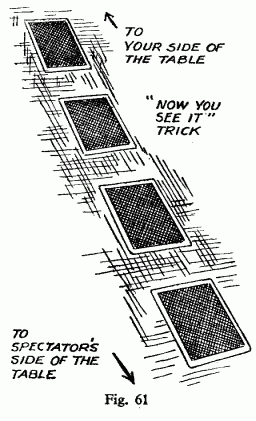
10. You have placed the four cards on the table in a row, which extends away from the spectator, with the selected card second from the end nearest him (Fig. 61). Ask him to touch one of the four cards. He will in nineteen cases out of twenty point to the second card, the chosen card!
Pick up the other three cards, show them casually and drop them on the deck.
"What was the name of your card?" you ask.
"The four of spades!"
Wave your hand over the one card remaining on the table. Then slowly turn it face upwards. It is the chosen card.
You will ask, "But what shall I do if the spectator points to one of the other cards?" In that case you would resort to a stratagem known as the equivoque . If he points to one of the other cards, you continue, "And one of the other cards, too, if you please." If, now, he touches the chosen card, you remove the other two cards and place them on the deck. But if he points to another of the indifferent cards you remove and discard them both . Thus you interpret his choice with your own end in view. The spectator does not know why you have asked him to point to a card and therefore cannot object to your actions. In either case two cards will be left on the table, the chosen card and another.Now say, "Please point to one of the two cards."
Again you interpret his choice as suits you best. If he points to the chosen card, remove the other one and drop it on the pack. But if he points to the indifferent card you discard it. This Hobson's choice must always bend the spectator to your will and bring the trick to a successful conclusion.
All feats in which cards transpose or change are especially effective, for they appear to be the most baffling to laymen. Of these the foregoing is one of the most brilliant.
Book contents
Front matter
The Overhand Shuffle, I
- The Overhand Shuffle, I
- The Overhand Shuffle
- Using the Overhand Shuffle
- Overhand Shuffle Control
- Overhand Shuffle Practice Routine
- Tricks With the Overhand Shuffle
- Introduction
- Topsy-Turvy Cards
- A Poker Player's Picnic
- A Pocket Discovery
- Telepathy Plus
- Thought Stealer
- Pinkie Does It
- A Card and a Number
II. The Riffle Shuffle
- II. The Riffle Shuffle
- The Riffle Shuffle
- Riffle Shuffle Control
- Riffle Shuffle in the Air
- Tricks with the Riffle Shuffle
- An Instinct for Cards
- Mirror of the Mind
- Ultra Card Divination
III. Flourishes
- III. Flourishes
- Introduction
- Displaying the Top Card
- The Ruffle
- The Click
- Spread and turnover
- Springing the Cards
- A Flourish Count
- Throwing a Card
- Waterfall Shuffle
- The Fan
- One-Hand Fan
- Thumb Fan
- Pressure Fan
IV The Glide
V The Glimpse
- V The Glimpse
- Introduction
- Bottom-Card Glimpse
- Top-Card Glimpse
- Fan Peek
- Tricks with the Glimpse
- Gray's Spelling Trick
- Round and Round
VI The Key Card
- VI The Key Card
- Introduction
- The Key Undercut
- Key Undercut Shuffle
- Tricks with the Key Card
- Do as I Do
- The Three Piles
- The Twenty-Sixth Card
- A Meeting of the Minds
- The Non-Poker Voice
- Intuition with Cards
- Sliding Key Card
VII The Palm
- VII The Palm
- Introduction
- Top Palm
- Palm Glimpse
- Replacing Palmed Cards
- Tricks with the Palm
- Card in the Pocket
- Now You See It!
- Grab-Bag Card
- Good-Luck Card
- Do It and Fail
- Gathering of the Clan
- Spring Catch
- A Vested Interest
- Piano Trick
VIII The Backslip
- VIII The Backslip
- The Backslip
- Backslip Force
- Backslip Control
- Tricks with the Backslip
- Lightning Card
- The Tantalizer
- Under Your Hat
IX The Overhand Shuffle, II
- IX The Overhand Shuffle, II
- Injog and Break
- Overhand Break Control
- Overhand Lift Shuffle
- Lift Shuffle Force
- Spread and Break
- Holding a Break
- Spread and Break Control
- Tricks with the Overhand Shuffles
- The Sevens
- Obliging Aces
- Leapfrog
- Spectator's Card Trick
- A Poker Puzzle
X False Shuffles and Cuts
- X False Shuffles and Cuts
- Optical Shuffle
- Charlier Shuffle
- The Cut
- Palm Cut
- Tricks With the Shuffles and Cuts
- An Incomprehensible Divination
- Circus Card Trick
- Black Jack, Detective
XI The Double Lift and turnover
- XI The Double Lift and turnover
- The Double Lift and Turnover
- Double-Lift Glimpse
- Double-Lift Card Reverses
- Tricks with the Double Lift
- Rapid Transit
- The Trey
- Ambitious Card
- Throughth and Consequences
- Insidious Dr. Fu Liu Tu
XII The Pass
- XII The Pass
- Introduction
- The Pass
- Riffle Pass
- Spread Pass
- Spring Pass
- Tricks with the Pass
- Off Agin, On Agin, Finnegin!
- Kangaroo Card
- Righting a Wrong
- Blindfolded Pack
- Double Speller
XIII Miscellaneous Flourishes
- XIII Miscellaneous Flourishes
- Color Change
- Double Color Change
- The Changing Card
- Self-Cutting Deck
- A Pretty Cut
- Pop-Up Card
- A Bit of Byplay
- Charlier Cut
- Acrobatic Aces
XIV The Reverses
- XIV The Reverses
- The Reverses
- Reversed Location
- Tricks with the Reverses
- Spellbound
- A Tipsy Trick
- Double Reverse
- Mentalivity
- Mountebank Miracle
XV The Hindu Shuffle and Other Controls
- XV The Hindu Shuffle and Other Controls
- The Hindu Shuffle
- Hindu Shuffle Control
- Hindu Shuffle Force
- Hindu Shuffle Glimpse
- The Step
- Natural Jog
- Twelve-Down Riffle
- Tricks with the Hindu Shuffle
- All Change Here
- Ewephindit
XVI The Classic Force
- XVI The Classic Force
- The Classic Force
- One-Hand Force
- Bottom Force
- Slide-Out Force
- Two-Card Force
- Riffle-Break Force
- Sliding-Key Force
- Double-Lift Force
- Cut Force
- Tricks with the Force
- Justice Card Trick
- Fours of a Kind
- Pulse Trick
XVII Top and Bottom Changes
- XVII Top and Bottom Changes
- Top Change
- The Changing Card
- Top-Change Byplay
- Bottom Change
- Top and Bottom Changes
XVIII Arrangements
- XVIII Arrangements
- Arrangements
- Tricks with Arrangements
- The Selective Touch
- A Future in Cards
- Jacks Wild
- Think Stop
- Deal Away
- The Educated Cards
- Reds and Blacks
XIX Routines
- XIX Routines
- Routining Card Tricks
- A Table Routine
- A Rollicking Routine
- Card-Discovery Routine
- Razzle-Dazzle Routine