Conus Ace Trick
The number of four-ace tricks is now almost legion, but one of the first and still the best is the one devised by the French conjurer Conus a century ago. With slight modification the trick is as effective today as it ever was. The plot, as in all great tricks, is simple: The four aces are transformed in a spectator's hands into four other cards, and they are finally found in one of his pockets.
Preparation. You will need a deck of cards and four duplicate aces. On the top of the deck place the four duplicate aces, with the ace of clubs uppermost. On top of all place the ace of clubs from the deck, so that at the top you have two aces of clubs followed by the three duplicate aces. The other three aces of the deck are scattered through it. Remove any four in different card from the pack, then put it in its case and put the case on your table.
Procedure. The steps are as follows:
1. Invite a spectator to come forward to assist you. Seat the volunteer at a small table at your left. Pick up the card case and, saying that you will use a deck of cards, remove the cards and lay the case on the table. Spread the cards with their faces outwards, showing them but keeping the aces at the top bunched together. Close the spread and insert your left little finger under the five top cards. Square the deck and hold the break under the five top cards by pressing the little finger firmly against the side of the deck. You can then hold the deck quite openly, yet you are ready to palm the five cards whenever you please.
2. Address the spectator: "You, sir, are to act as a committee of one on behalf of this large and intellectual audience, so I want you to be absolutely satisfied about everything that takes place. You agree to that?"
"Yes."
"First, we haven't made any arrangement about this trick, have we?"
"No."
"As a matter of fact, you have never seen me before in your life, have you?"
"No." (Sometimes when the assistant is an acquaintance and people know it, you get some fun out of his accommodating answer.)
"Fine, you will be satisfied about everything that takes place?" "Yes."
"You won't say yes if you mean no?"
"No."
"You mean no?"
"Yes."
"Good! Now that we thoroughly understand each other, will you take the deck, remove the aces, and see that there are only four all together?" In the meantime you have quietly palmed the five top cards and taken the pack in your right hand.
3. Place the deck on the table before him and, as he begins to run through it, turn to the audience. "You cannot be too careful. Some people, especially when playing poker, use a lot of aces." Turn to your assistant, who has found and removed three aces and is searching for the ace of clubs. "One, two, three aces," you say. "What have you done with the fourth?" Seize his right lapel with your right hand, pulling his coat open. Hold it for a moment as you say to the audience, "Did you see what he did?" Then take the lapel with your left hand and thrust your right hand into his inner breast pocket. Bring out the first ace of clubs and leave the other four aces in the pocket. Show it, and under cover of the laughter this causes whisper to him, "Button up your coat just to make them laugh." He
does this, and the action always causes amusement. It also safeguards you against any premature discovery of the duplicate aces, safely ensconced in the buttoned coat.
4. "You mustn't do that. I'm the one to do the trick, you are the committee." Take the deck; open it bookwise, and have the spectator insert the four aces. Close the pack on them, and in putting it on the table make a pretence of manipulating the cards. "Now, sir, the aces are in the middle of the deck?" Having seen you make a suspicious move, he will express doubt about that. "You are quite right," you say. "I want you to be perfectly satisfied. Watch." Take the deck, turn it face upwards, run through it to the four aces and show them in the middle. "Right?" Close the spread, inserting your left little finger tip above two of the aces. Make the pass in turning the deck face downwards, and lay the cards on the table.
5. "Now, sir, those four aces placed in the middle by yourself will travel to any position you may like to name. For instance, would you like them all at the top or all at the bottom, or one on the top and three on the bottom, or one on the bottom and three on the top, or… say, two at the top and two at the bottom?" Rattle off the first choices very rapidly, the last after a momentary pause, then say, "Wait; for greater safety, place your hand on the deck."
Nearly always the spectator chooses the last suggestion. "Two above and two below," he says. Tap the deck with your right forefinger, say "Pass!" and then have him remove the cards himself. A round of applause is sure to follow.
If another position is chosen, you have at least one ace already there. Take the pack and let the spectator remove that one; then, as he shows it, make the pass to bring the others to the position required.
6. Show the four aces and place them on the top of the deck. "You did that very well. With a few years' practice I'm sure you will make a good magician. Now, suppose I place the aces on the table, so–" (deal them face downwards) "land you place your hand on them." Grasp his hand and place it on the four cards. "Do you think I could take them away from you and send you four other cards? You'd like to see me try? By the way, are you quite sure that you have the four aces?"
The spectator, not having seen the aces since they were placed on the deck, expresses his doubts. "That's right. I'm glad you are a little sceptical, for I want you to be quite certain. See–" (take the four cards and show them) "–they are the four aces." Replace them on the top of the pack.
7. Look at your hands , make a rapid movement as if making the pass , then deal the four top cards on the table, and again place his hand on them. "This time you have them?" The spectator responds that he is not at all sure about that. "There is such a thing as being too sceptical," you say. "Turn the cards over yourself." As he does so slip the tip of your left little finger under the top card. He turns the cards over and shows the aces.
8. Take them again. Casually place them on the deck, then remove them, taking the top card with them. "There has been no change so far," you say, holding the packet of five cards up so that he and the audience can see the face of the indifferent card. Drop the packet on the deck, and then deal off the four aces. Grasp his hand and place it on them. "This time you have the aces." The spectator vigorously protests that he has not. Appeal to the onlookers, "You are all satisfied that the aces are on the table?" There will be cries of "No I No!"
Pretending to be at a loss as to how there can be any doubt about the matter, turn to the spectator, "I can't do the trick until you are perfectly satisfied. Please turn the aces over and show them to everybody." In the meantime you have had ample opportunity to palm five cards from the top of the deck in your right hand. Retain the deck in that hand.
The aces are shown amidst laughter and much to the surprise of all. Maintain your attitude of being a little bewildered by the attitude of the audience. Take the aces one by one in your left hand, and hold them face downwards. Lay the pack down and suggest that the spectator look it over. Take the aces with your right hand, adding the five palmed cards to them. Hold the packet face outwards by the ends between the right thumb and fingers and say, "Now, to make quite sure there can be no mistake, I'll give the aces a good bend, so." Squeeze the ends, making the face of the packet concave. "There can be no doubt about the aces now."
9. Take the deck in your left hand, and drop the packet from your right hand on top. "Can you tell me where the aces are now?" you ask. Seeing the bent cards, the spectator answers confidently, "On the top." "Satisfied at last. Watch very closely." Deal the four top cards very delicately one by one and place them in a pile before him. As you remove the fourth card press the left thumb on the pack, taking the bend out of the other cards. Turn the top indifferent card face upwards, saying, "You see, they're all gone." In replacing it slide it under the top ace, which you push off the pack a little to facilitate this. "Place your hand on the aces and your other hand on top of that. Don't move your hands or the audience will think you are doing the trick and not me.
10. "Here's the impossible thing I shall try to do. I shall change those four aces you are holding so tightly and send you four other cards. Here is one card." Make the double lift and turnover , showing the indifferent card seen just before. Turn them down as one card and thumb off the top card–an ace–face downwards on the table.
Begin an overhand shuffle by pulling out all except the top and bottom cards, thus keeping the changed card out of sight, drop the pack on the two cards, undercut half the deck, injog the first card, and shuffle off. Undercut to the injog , bringing the three aces back to the top. Take off two cards as one and, holding them toward the spectator, ask him to breathe on the card. As he does so, slide the two cards rapidly apart, saying, "I didn't ask you to blow . You've made two!" Drop them on the first ace without showing their faces.
11. Spread the cards and ask the spectator to remove one. "Show it to everyone," and, as he does so, palm the top card in your right hand and take the deck in that hand. "What card did you take? The ten of diamonds," you say, taking it face downwards in your left hand. Lay the pack down and take the card in your right hand, adding the palmed ace to it. Hold the card(s) up by the ends showing it (them), and place it (them) in your left hand, face outwards, the thumb on the face and the fingers on the back (Fig. 115).
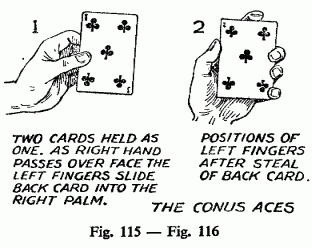
"I shall change this card into one of your aces. Would you like me to do it visibly or invisibly? Visibly? Very well, I pass my hand over the cards, so–" (pass your empty right hand across the card) "–and nothing happens. I pass it over again–" (this time push the rear card with the left fingers into the right hand and palm it) "–and again nothing happens." Change the grip of the card in your left hand so that it is held between the thumb on one side and the middle finger on the other, with the forefinger resting on the middle of the top end (Fig. 116). "This is the critical time.
Watch? Pass the right hand over the card and deposit the palmed card on it without pausing a moment. The tips of the fingers and thumb make a frame into which it fits snugly.
"One ace!" you exclaim. Pick up the other three one by one, placing them in the left hand fanwise and saying, "Two! Three! All four!…. Will you look at your four cards and see what I have sent you? Show them to everybody."
The spectator turns his four cards and shows four indifferent cards. Take this opportunity to slip the indifferent card from the back of the four aces in your right hand on to the deck, which you have picked up with your left hand. Pause while you display the four aces, and acknowledge the applause as if the trick was ended.
12. Casually place the aces on the top of the pack and immediately palm them in your right hand, taking the pack in that hand. Then say to the spectator, "You did that very nicely. I'd like you to try another trick before I put the deck away." Pick up the card ease with your left hand, put the pack down with your right hand, and take the case in that hand. "Place your hand on the deck. Right. Now I shall make the aces pass up your sleeve into one of your pockets. Pass! Did you feel them go? No? Well, run through the deck…. No aces? Then kindly search your pockets." As he does this, take the pack, adding the palmed aces to it, and place it in the case.
The spectator finally unbuttons his coat and much to his surprise finds the four aces in his breast pocket. The duplicate aces were placed in his pocket so long before that no one remembers that you even so much as touched him.
Not only is the trick a most effective one but it affords ample opportunities for inoffensive fun which the assisting spectator will enjoy as much as the audience.
Book contents
Front matter
The Overhand Shuffle, I
- The Overhand Shuffle, I
- The Overhand Shuffle
- Using the Overhand Shuffle
- Overhand Shuffle Control
- Overhand Shuffle Practice Routine
- Tricks With the Overhand Shuffle
- Introduction
- Topsy-Turvy Cards
- A Poker Player's Picnic
- A Pocket Discovery
- Telepathy Plus
- Thought Stealer
- Pinkie Does It
- A Card and a Number
II. The Riffle Shuffle
- II. The Riffle Shuffle
- The Riffle Shuffle
- Riffle Shuffle Control
- Riffle Shuffle in the Air
- Tricks with the Riffle Shuffle
- An Instinct for Cards
- Mirror of the Mind
- Ultra Card Divination
III. Flourishes
- III. Flourishes
- Introduction
- Displaying the Top Card
- The Ruffle
- The Click
- Spread and turnover
- Springing the Cards
- A Flourish Count
- Throwing a Card
- Waterfall Shuffle
- The Fan
- One-Hand Fan
- Thumb Fan
- Pressure Fan
IV The Glide
V The Glimpse
- V The Glimpse
- Introduction
- Bottom-Card Glimpse
- Top-Card Glimpse
- Fan Peek
- Tricks with the Glimpse
- Gray's Spelling Trick
- Round and Round
VI The Key Card
- VI The Key Card
- Introduction
- The Key Undercut
- Key Undercut Shuffle
- Tricks with the Key Card
- Do as I Do
- The Three Piles
- The Twenty-Sixth Card
- A Meeting of the Minds
- The Non-Poker Voice
- Intuition with Cards
- Sliding Key Card
VII The Palm
- VII The Palm
- Introduction
- Top Palm
- Palm Glimpse
- Replacing Palmed Cards
- Tricks with the Palm
- Card in the Pocket
- Now You See It!
- Grab-Bag Card
- Good-Luck Card
- Do It and Fail
- Gathering of the Clan
- Spring Catch
- A Vested Interest
- Piano Trick
VIII The Backslip
- VIII The Backslip
- The Backslip
- Backslip Force
- Backslip Control
- Tricks with the Backslip
- Lightning Card
- The Tantalizer
- Under Your Hat
IX The Overhand Shuffle, II
- IX The Overhand Shuffle, II
- Injog and Break
- Overhand Break Control
- Overhand Lift Shuffle
- Lift Shuffle Force
- Spread and Break
- Holding a Break
- Spread and Break Control
- Tricks with the Overhand Shuffles
- The Sevens
- Obliging Aces
- Leapfrog
- Spectator's Card Trick
- A Poker Puzzle
X False Shuffles and Cuts
- X False Shuffles and Cuts
- Optical Shuffle
- Charlier Shuffle
- The Cut
- Palm Cut
- Tricks With the Shuffles and Cuts
- An Incomprehensible Divination
- Circus Card Trick
- Black Jack, Detective
XI The Double Lift and turnover
- XI The Double Lift and turnover
- The Double Lift and Turnover
- Double-Lift Glimpse
- Double-Lift Card Reverses
- Tricks with the Double Lift
- Rapid Transit
- The Trey
- Ambitious Card
- Throughth and Consequences
- Insidious Dr. Fu Liu Tu
XII The Pass
- XII The Pass
- Introduction
- The Pass
- Riffle Pass
- Spread Pass
- Spring Pass
- Tricks with the Pass
- Off Agin, On Agin, Finnegin!
- Kangaroo Card
- Righting a Wrong
- Blindfolded Pack
- Double Speller
XIII Miscellaneous Flourishes
- XIII Miscellaneous Flourishes
- Color Change
- Double Color Change
- The Changing Card
- Self-Cutting Deck
- A Pretty Cut
- Pop-Up Card
- A Bit of Byplay
- Charlier Cut
- Acrobatic Aces
XIV The Reverses
- XIV The Reverses
- The Reverses
- Reversed Location
- Tricks with the Reverses
- Spellbound
- A Tipsy Trick
- Double Reverse
- Mentalivity
- Mountebank Miracle
XV The Hindu Shuffle and Other Controls
- XV The Hindu Shuffle and Other Controls
- The Hindu Shuffle
- Hindu Shuffle Control
- Hindu Shuffle Force
- Hindu Shuffle Glimpse
- The Step
- Natural Jog
- Twelve-Down Riffle
- Tricks with the Hindu Shuffle
- All Change Here
- Ewephindit
XVI The Classic Force
- XVI The Classic Force
- The Classic Force
- One-Hand Force
- Bottom Force
- Slide-Out Force
- Two-Card Force
- Riffle-Break Force
- Sliding-Key Force
- Double-Lift Force
- Cut Force
- Tricks with the Force
- Justice Card Trick
- Fours of a Kind
- Pulse Trick
XVII Top and Bottom Changes
- XVII Top and Bottom Changes
- Top Change
- The Changing Card
- Top-Change Byplay
- Bottom Change
- Top and Bottom Changes
XVIII Arrangements
- XVIII Arrangements
- Arrangements
- Tricks with Arrangements
- The Selective Touch
- A Future in Cards
- Jacks Wild
- Think Stop
- Deal Away
- The Educated Cards
- Reds and Blacks
XIX Routines
- XIX Routines
- Routining Card Tricks
- A Table Routine
- A Rollicking Routine
- Card-Discovery Routine
- Razzle-Dazzle Routine